PCB Assembly

Stacy Lu

 NextPCB Capabilities
Printed Circuit Boards
 Process Capabilities
 Quality
 Drills & Throughplating
 Factory & Certificate
 PCB Assembly Factory Show
Certificate

Support Team
Feedback:
support@nextpcb.com


Hardware teams are being asked more often whether their circuit boards contain PFAS. This guide explains what PFAS are, how they differ from RoHS and REACH, where they can appear in PCBs and PCB assemblies, where the EU restriction stands, and which documents to request from a supplier. It also describes the PFAS, RoHS and REACH test reports that NextPCB holds, and what those reports cover.
PFAS stands for per- and polyfluoroalkyl substances. There is no single universally accepted definition, but a widely used structural definition covers any chemical that contains at least one fully fluorinated methyl group (–CF3) or methylene group (–CF2–), with a few exceptions. Under this definition the family contains thousands of substances, and the EU restriction proposal covers roughly 10,000 of them.
PFAS include both small molecules, such as PFOS and PFOA, and polymers called fluoropolymers, such as PTFE, PFA, FEP and ETFE. Fluoropolymers are chemically stable and have excellent electrical properties, which is why they appear in electronics, but they fall under the broad PFAS definition used by regulators.
RoHS, REACH and PFAS rules regulate different things, so passing one tells you little about the others.
| Regime | What it covers | Does it cover PFAS? | Typical evidence from a supplier |
|---|---|---|---|
| RoHS (Directive 2011/65/EU, amended by (EU) 2015/863) | Ten restricted substances in electrical and electronic equipment: lead, mercury, cadmium, hexavalent chromium, PBB, PBDE, and four phthalates (DEHP, BBP, DBP, DIBP) | No. None of the ten restricted substances is a PFAS | RoHS test report |
| REACH SVHC (Candidate List) | Substances of very high concern. If an article contains an SVHC above 0.1% by weight, the supplier must inform customers | Only a few individual PFAS are on the Candidate List. It does not cover PFAS as a group | REACH SVHC test report |
| POPs Regulation ((EU) 2019/1021) | Persistent organic pollutants, including PFOA and related compounds | Yes, for specific listed PFAS only | Material declaration, test report |
| EU universal PFAS restriction (proposal under REACH) | All PFAS, with proposed use-specific derogations | Yes, but not yet adopted | Supplier PFAS declaration, material list |
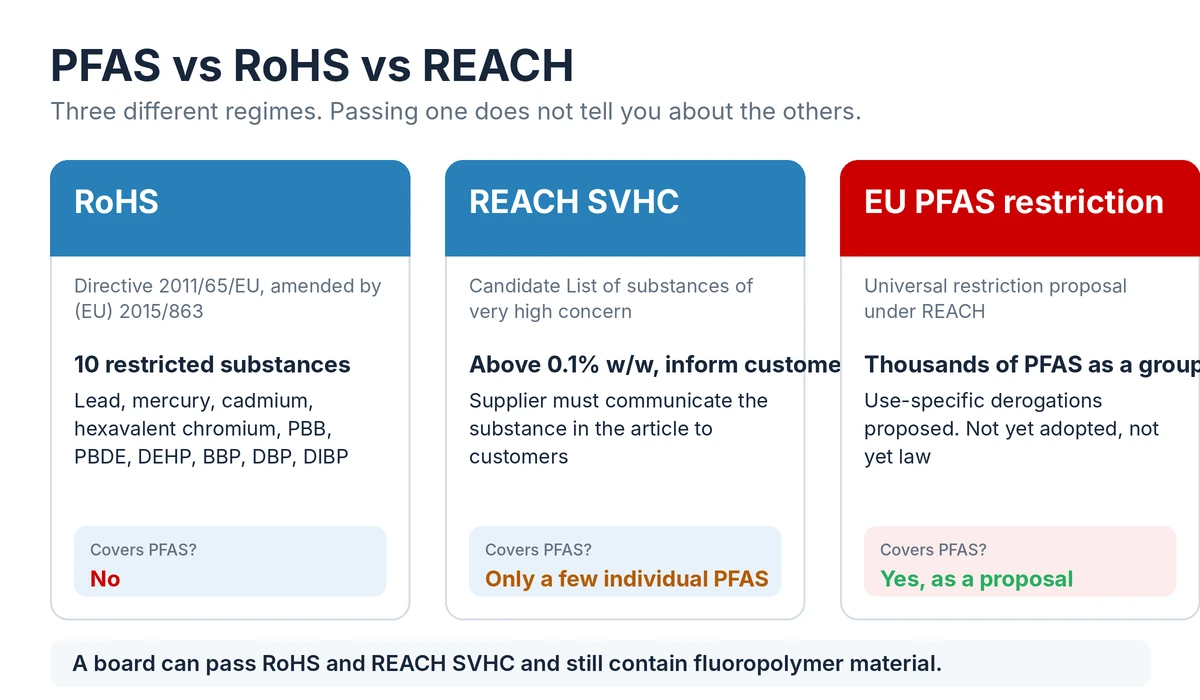
In practice this means a board can be RoHS compliant and REACH SVHC compliant and still contain fluoropolymer material, because neither regime restricts PTFE as a group. For RoHS compliance in PCB manufacturing, see our guide to RoHS compliant PCB manufacturing.
Whether a given board contains PFAS depends on its materials and on the chemistry used to make it. The main places to look are:
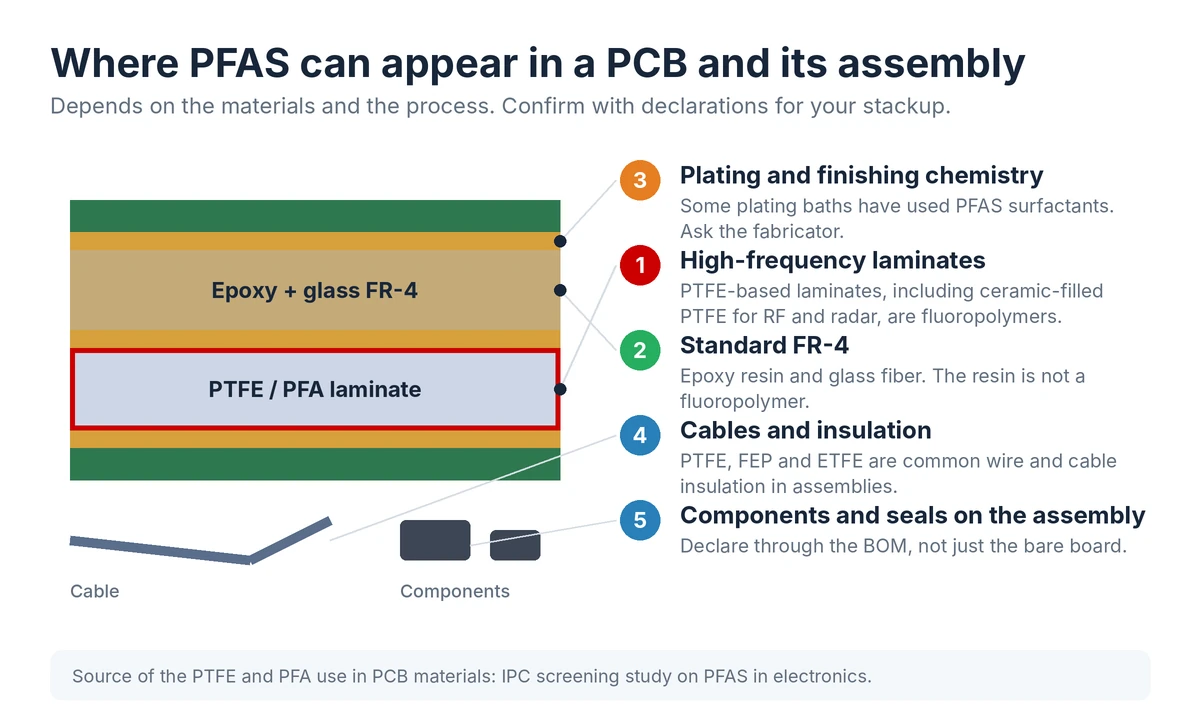
Standard FR-4 is an epoxy resin and glass fiber laminate, and its resin is not a fluoropolymer. A board built only from standard FR-4 with a common surface finish is therefore much less likely to contain fluoropolymer than a PTFE high-frequency board, but only declarations and test reports for your specific materials can confirm it.
The universal PFAS restriction is a proposal under REACH. National authorities of the Netherlands, Germany, Denmark, Norway and Sweden submitted it to ECHA in January 2023, and electronics and semiconductors are one of the 15 sectors it covers. It is not law yet.
| Date | Step |
|---|---|
| January 2023 | Restriction proposal submitted to ECHA |
| March 2026 | ECHA's Risk Assessment Committee (RAC) adopts its opinion; the Socio-Economic Analysis Committee (SEAC) agrees a draft opinion |
| 26 March to 25 May 2026 | Public consultation on the SEAC draft opinion |
| End of 2026 (target) | SEAC adopts its final opinion; both opinions go to the European Commission |
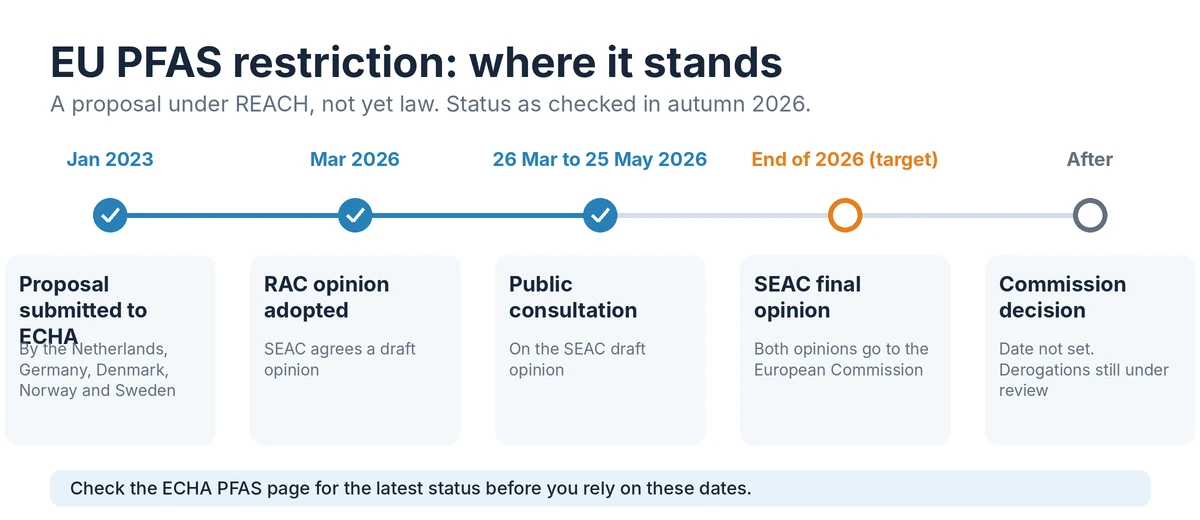
Both committees support an EU-wide restriction with time-limited derogations, and they have signalled that many of the proposed derogations will be removed or reduced. A decision on specific electronics uses has not been made. As of autumn 2026, no EU-wide ban applies to PTFE or other fluoropolymers in electronic components, but you should plan for change. Check the ECHA PFAS page for the latest status, because dates and derogations may change. Some countries and US states have also adopted their own PFAS product rules, so check the markets you sell into.
NextPCB's PCB manufacturing facility (Jiujiang) holds third-party test reports from Centre Testing International (CTI) for PFAS, RoHS and REACH SVHC. They are available on our certificate and test report page.
| Report | Basis | Result | Date |
|---|---|---|---|
| PFAS | 553 PFAS substances, analyzed by LC-MS/MS and GC-MS, referencing EN 17681-1:2022 and EN 17681-2:2022 | All tested PFAS not detected (N.D., below the method detection limit) | 2 July 2025 |
| RoHS | Directive 2011/65/EU with amendment (EU) 2015/863, ten restricted substances | PASS | 2 July 2025 |
| REACH SVHC | 250 substances of very high concern | PASS (SVHC concentration of 0.1% w/w or less) | 23 September 2025 |
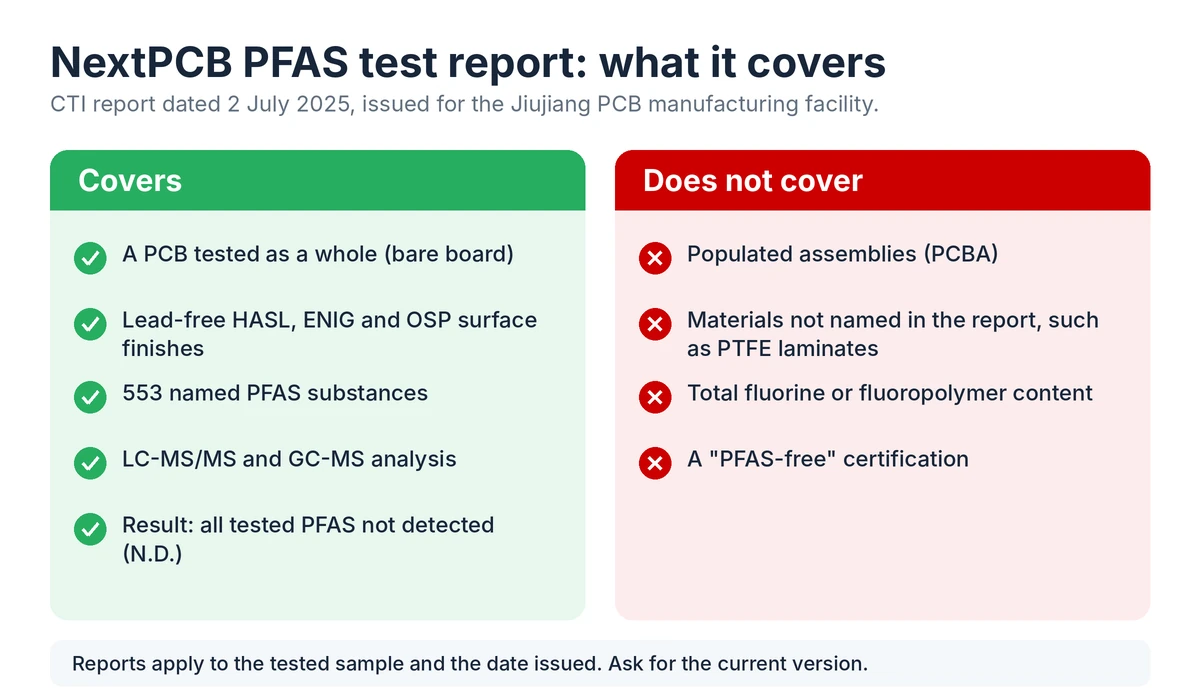
If your project uses PTFE or other fluoropolymer materials, or you need a declaration for a specific stackup or assembly, tell our engineers when you request a quote and ask which documents are available for your materials. Reports reflect the date they were issued, so ask for the current version when your customer requires it.
“PFAS-free” is not a defined term, so ask what the claim is based on. Use this checklist:
For surface finishes covered by the NextPCB PFAS report, see our comparison of HASL and lead-free HASL surface finishes.
No. RoHS restricts ten specific substances, and none of them is a PFAS. A RoHS report therefore says nothing about PFAS.
Yes. PTFE is a fluoropolymer, and fluoropolymers fall under the broad structural definition of PFAS used by regulators. PTFE remains legal in the EU today, but it is within the scope of the EU restriction proposal.
Not currently. The universal PFAS restriction is still a proposal, and derogations for specific uses are still under review. Check the ECHA PFAS page for the latest status.
Standard FR-4 is an epoxy resin and glass fiber laminate, and its resin is not a fluoropolymer. Whether a specific board is free of PFAS in a regulatory sense depends on all of its materials and on the process chemistry, so ask for declarations and test reports for your stackup.
Yes. NextPCB's PCB manufacturing facility holds a CTI PFAS test report dated 2 July 2025, covering 553 PFAS substances on a PCB with lead-free HASL, ENIG and OSP finishes. All tested PFAS were not detected. See the report scope above and our certificate and test report page.
A test report states what was tested and measured on a specific sample, with its method and detection limits. “PFAS-free” is not a defined regulatory term, so it needs a clear basis: the definition of PFAS used, the materials covered and the evidence behind the claim.
Document where and why they are used, ask your suppliers for declarations, and follow the EU timeline. If your RF performance allows, evaluate laminates that do not use fluoropolymer resin. Our engineers can discuss material options when you request a quote.

Still, need help? Contact Us: support@nextpcb.com
Need a PCB or PCBA quote? Quote now