PCB Assembly
Arya Li, Project Manager at NextPCB.com

 NextPCB Capabilities
Printed Circuit Boards
 Process Capabilities
 PCB Design-Aid & Layout
 Quality
 Drills & Throughplating
 Factory & Certificate
 PCB Assembly Factory Show
Certificate

Support Team
Feedback:
support@nextpcb.com


Automotive customers rarely ask only for "a tested board". They ask for specific evidence: a thermal shock result, a microsection report, proof that the laminate resists CAF, a cleanliness figure. This guide explains what each of these tests shows, which of them you can request from NextPCB, and what to write in your order so the right test is run. For the full range of board tests, see our 16 PCB reliability test methods. For board types and capabilities, see our automotive PCB and PCBA solutions.
In This Guide
A quality certificate and a test report are different things. An IATF 16949 certificate covers a site's quality system (see IATF 16949 certified PCB and PCBA). A test report is evidence about a specific board or lot. Which reports you need is set by your customer's specification.
| Test | What it shows | At NextPCB |
|---|---|---|
| Thermal shock | Whether plated holes and interconnects survive extreme temperature swings | Supported in our laboratory. Test method and conditions are agreed per project. |
| Microsection | The internal structure of the board: plating, hole walls, layer connections | Report available on request when you place the order. |
| CAF resistance | Whether a laminate and design resist conductive filament growth between conductors | Handled through material selection and design discussion with our engineers. |
| Ionic contamination | Residual ionic material on the board surface | Our laboratory has an ionic contamination tester and can provide test data. |
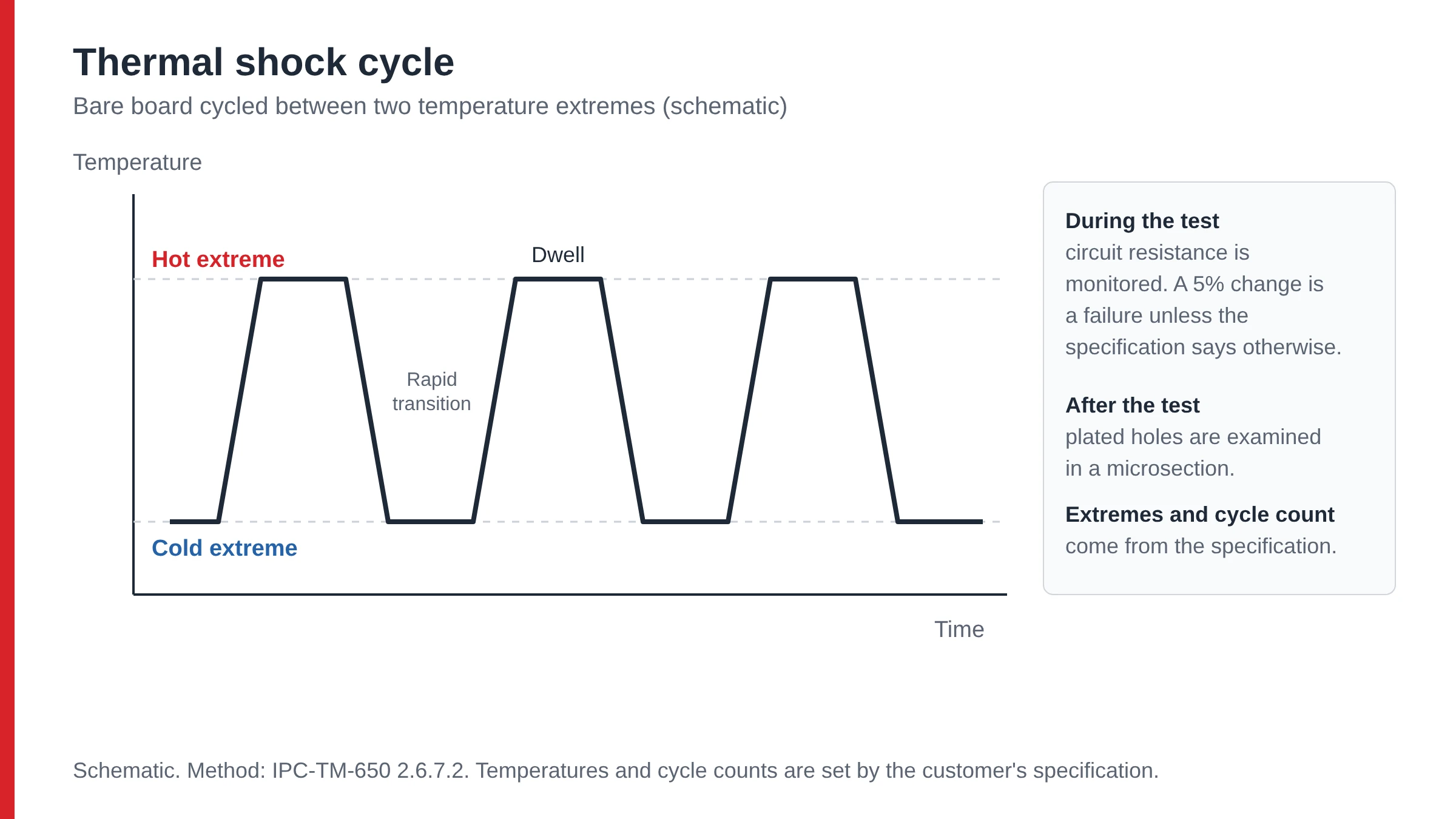
Thermal shock exposes bare boards to sudden, extreme temperature changes to test the quality of their interconnects. IPC-TM-650 method 2.6.7.2 defines it. The method has the board cycled between a cold and a hot extreme while the resistance of a test circuit is monitored, and then checks the plated holes in a microsection. A resistance change of more than 5% from the first cycle counts as a failure unless the specification says otherwise.
The standard leaves the conditions to the user. For quality conformance testing, its defaults include a low extreme of -55 °C and 100 cycles, and it lets the specification choose other extremes and counts. These are the standard's figures, not NextPCB test conditions. Your customer's specification decides which ones apply.
Thermal shock is not the same as thermal stress. The thermal stress (solder float) test in our PCB reliability test methods guide floats a sample on molten solder to check how the board withstands soldering heat. Thermal shock cycles the board between two temperature extremes to find weak plated holes and connections. Automotive specifications often call for both.
Our laboratory supports thermal shock testing. Send the method, the temperature extremes and the cycle count your customer specifies, and our engineers will confirm how the test can be run.
A microsection cuts a sample through the board, mounts and polishes it, and examines it under a microscope. It is the most direct way to see what is inside a plated hole. It is used to check:
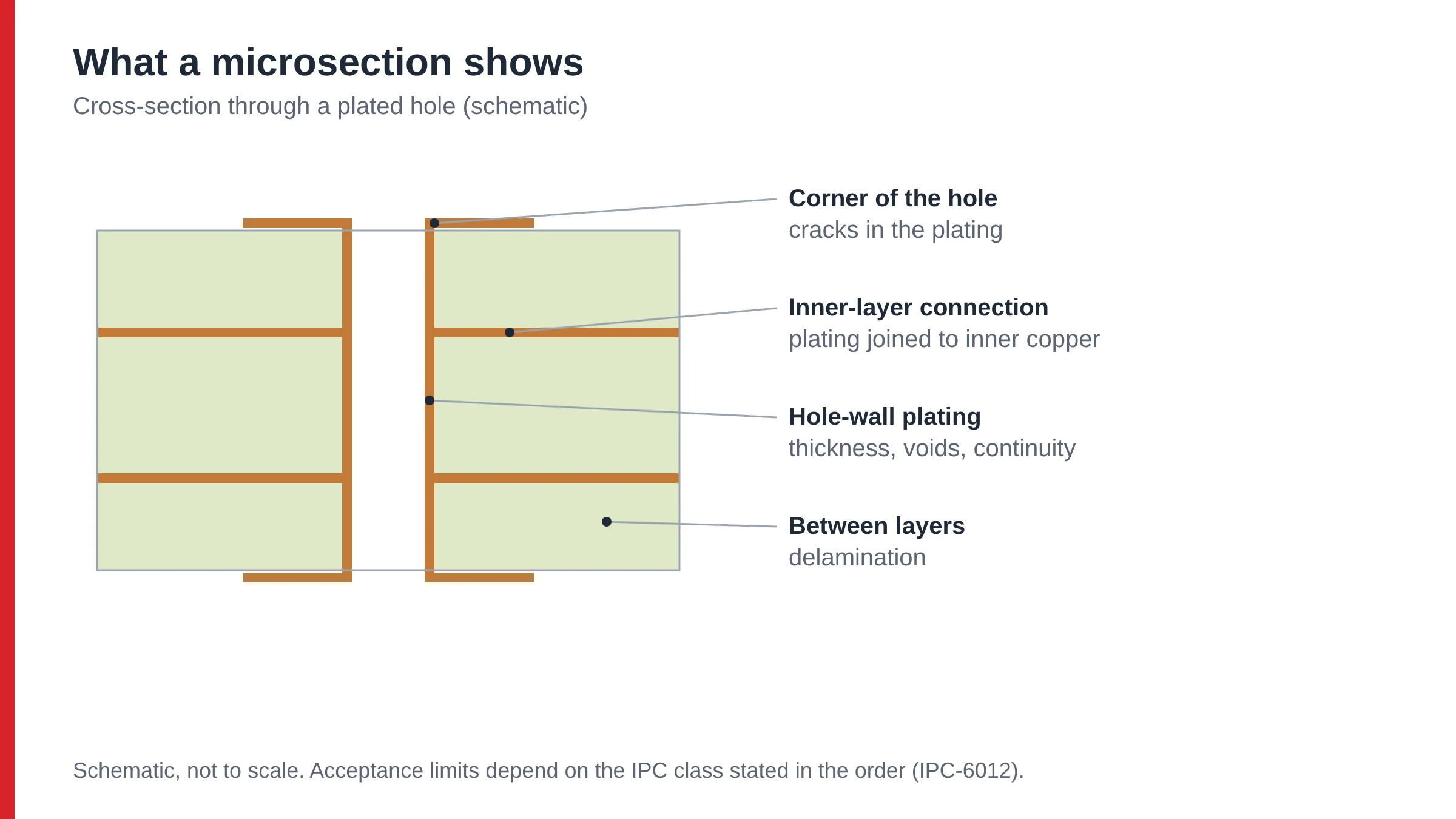
Acceptance limits come from IPC-6012 and depend on the class. See IPC-6012 and IPC Class 2 vs Class 3 for how the classes differ, and automotive PCB design for the automotive addendum. Always state the class in your order, because the same section can pass one class and fail another.
The microsection is done in our own laboratory. You can request a microsection report when you place the order.
Conductive anodic filament (CAF) is a failure mode in which a conductive path grows along the glass fibres inside the laminate between two conductors, under humidity and voltage bias. It can cause leakage or a short circuit long after the board has shipped. IPC-TM-650 method 2.6.25 is a laminate-level test for it. It holds test coupons in a humid chamber (65 °C or 85 °C at about 87% relative humidity) under a bias voltage for 500 hours and counts a net as failed if its insulation resistance drops by more than a factor of ten.
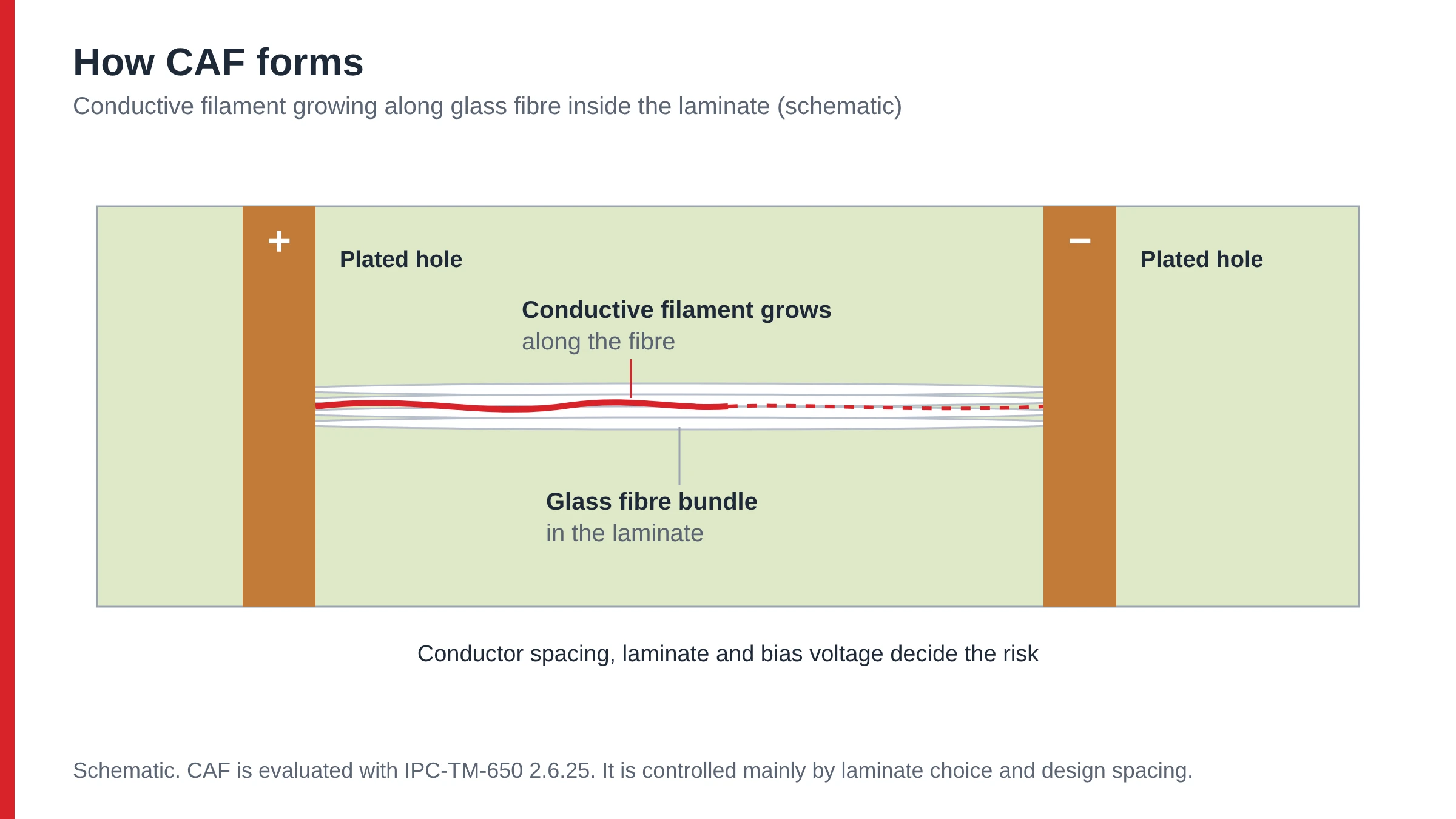
CAF is mainly decided before the board is made, by two choices:
If your customer requires CAF test data for a specific laminate and stack-up, tell us at the quoting stage so we can discuss the material and the options with you.
Under-hood and cabin electronics see humidity, condensation and voltage. Residual ionic material on a board can combine with moisture and bias voltage to cause leakage and electrochemical migration. That is why automotive specifications often set a cleanliness requirement.
The test method, principle and acceptance basis are explained in the ionic contamination section of our PCB reliability test methods guide. Our laboratory has an ionic contamination tester and can provide the test data. State the limit your customer sets, so that the result can be read against it.
| Item | What to state |
|---|---|
| IPC class and standard | Class 2 or Class 3, and any automotive addendum your customer requires |
| Microsection report | Request it at order, and say which features and how many sections your customer needs |
| Thermal shock | The method, temperature extremes, cycle count and pass criterion from your specification |
| CAF | The laminate model and any CAF data you require, stated at the quoting stage |
| Cleanliness | The ionic contamination limit your customer sets |
| Traceability and documents | The level you need and the approval documents your customer requires, agreed per project |
For the full set of checks on an automotive supplier, see how to select an automotive-grade PCB manufacturer.
No. The certificate covers a site's quality management system. Test reports are evidence about a specific board or lot and are agreed with your customer's requirements. See IATF 16949 certified PCB and PCBA.
No. Thermal stress floats a sample on molten solder to check how the board withstands soldering heat. Thermal shock cycles a board between two temperature extremes to test the quality of plated holes and interconnects.
Yes. You can request a microsection report when you place the order. State the IPC class and the features you need examined.
CAF is a conductive filament that grows inside the laminate between conductors under humidity and voltage. It is controlled mainly through the choice of laminate and the spacing in the design, so raise it with our engineers before release.
That is set by your customer's specification, not by the board type. Send us the specification with your files and our engineers will review it with you.
Upload your Gerber files for a quote, or send your customer's test requirements to our engineers first.

Still, need help? Contact Us: support@nextpcb.com
Need a PCB or PCBA quote? Quote now