PCB Assembly

Lolly Zheng- Sales Account Manager at NextPCB.com

 NextPCB Capabilities
Printed Circuit Boards
 Process Capabilities
 Quality
 Drills & Throughplating
 Factory & Certificate
 PCB Assembly Factory Show
Certificate

Support Team
Feedback:
support@nextpcb.com


Shortage conditions change quickly, so figures and forecasts below are dated where possible.
On November 18, the Global Electronics Association (IPC) issued an industry alert saying that shortages across the PCB supply chain are escalating, and that the exposure may rival the 2021 chip shortage. That is a judgement call, not a like-for-like measurement, and the two episodes differ in cause, breadth and likely duration.
This article lines up the 2021 chip shortage and today's PCB and materials shortage side by side. It shows where the comparison holds, where it breaks down, and what buyers can reasonably take from 2021.
The 2021 shortage began with a mismatch between demand and supply. Bain's later review points to Covid-19 lockdowns and extreme weather as short-term disruptions, and to a surge in demand for tech products as the larger factor. Automakers cut orders when the pandemic hit, then found themselves at the back of the line for wafers when demand returned.
Gartner reported in May 2021 that devices such as power management chips, display drivers and microcontrollers, made on legacy-node 8-inch fabs, were hit first. The shortage then spread to substrates, wire bonding, passives, materials and testing. AlixPartners estimated in September 2021 that the shortage would cost the auto industry $210 billion in revenue that year, with about 7.7 million vehicles of lost production, up from its May estimate of $110 billion and 3.9 million vehicles.
Lead times lengthened sharply. Susquehanna's overall average, as reported by The Register, rose from 13.9 weeks in fall 2020 to a record 26.6 weeks in March 2022. For a snapshot of how the situation looked at the time, see our May 2021 article on how long the semiconductor shortage would last.
The current pressure is centered on high-layer PCBs and the materials behind them. According to the IPC alert, AI-server boards are moving to 40 to 60 or more layers, compared with about 12 for a typical PC board. Each added layer consumes more glass fabric, resin, copper foil and laminate. The alert says the largest buyers are securing available supply, which pushes automotive, industrial, medical, defence and telecommunications customers back in the queue.
The alert cites bookings up 56.1% in the year to September against shipments up 13.3%, and lead times of 16 to 20 weeks or more for high-layer boards. Memory is tight as well: TrendForce expects DRAM contract prices to rise about 20% quarter on quarter in the fourth quarter of 2026, a slower pace than earlier in the year. For the materials and AI-demand background, see our guides to the PCB raw material shortage and why AI servers are driving up PCB prices. Current quote and lead-time effects are covered in why PCB lead times and prices are rising, and the part-level picture, including memory, in our overview of the electronic components shortage.
The last column is our own reading of how close each comparison is. It is an editorial assessment, not a finding from any of the sources.
| Dimension | 2021 chip shortage | Current PCB and materials shortage | Our read |
|---|---|---|---|
| Main trigger | Pandemic-era swings in demand, lockdowns and plant shutdowns, order cancellations followed by a rebound. | AI-server demand for high-layer boards and materials, with large buyers securing supply first. | Different cause |
| Where the bottleneck sits | Legacy-node wafers first, then substrates, wire bonding, passives, materials and testing. | Laminate, glass fabric, copper foil and resin, plus memory. | Similar pattern: spreads along the chain |
| Who waits at the back of the queue | Automotive and industrial buyers. | Automotive, industrial, medical, defence and telecommunications buyers. | Similar |
| Breadth | Many chip types and many kinds of electronic equipment. | Concentrated in high-layer boards, specific materials and memory. Standard low-layer boards are less directly exposed. | Different, and still debated |
| Lead-time evidence | Average chip lead time rose from 13.9 weeks (fall 2020) to 26.6 weeks (March 2022). | 16 to 20 weeks or more for high-layer boards. | Not comparable: different products and measures |
| Price vs availability | Both: foundries and chip makers raised prices while supply was short. | IPC calls availability, not price, the main risk. Some prices are rising too, for example laminate and DRAM. | Mixed |
| Capacity response | New fabs take years to build. | New board plants are being built, but they depend on the same constrained materials. | Similar: slow |
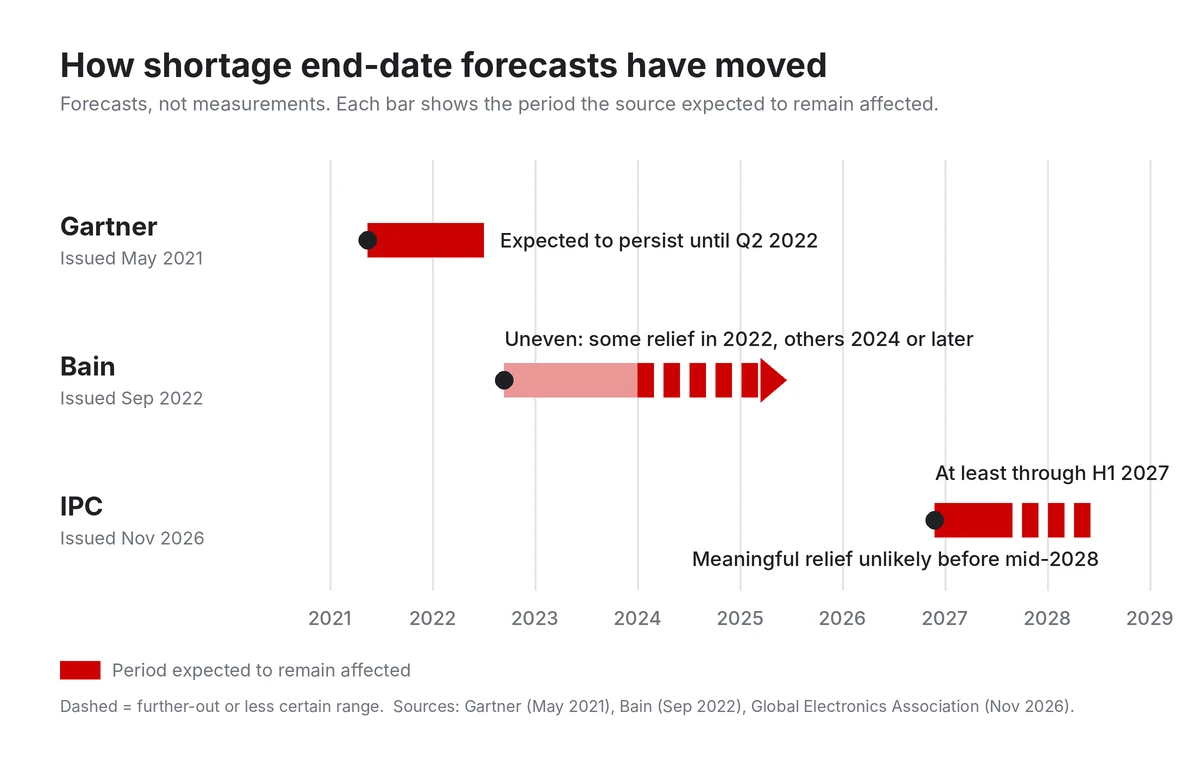
| Outlook | Gartner (May 2021) expected normal by Q2 2022. Bain (September 2022) said some companies saw relief in 2022 while others might wait until 2024 or later. | IPC expects the shortage to last at least through the first half of 2027, with meaningful relief unlikely before mid-2028. | Both uncertain |
A fair reading includes the signals that cut against a straight 2021 comparison.
Bain's review offers three lessons that may carry over, with the caveat that today's cause is different.
This article is about the comparison, so we keep the practical advice to the lessons 2021 actually taught. Step-by-step safeguards for today's market are in how to protect your PCB project from the material shortage.
That is not established. IPC says the exposure may rival 2021, but the two are measured differently and the causes differ. In 2021, the AlixPartners estimate of $210 billion in lost auto revenue gave one measure of damage. There is no equivalent figure yet for the current shortage.
Less directly, in our assessment. The strongest pressure is on high-layer boards and high-end materials, while standard FR-4 boards typically do not use those tiers. Indirect effects, such as price changes or longer queues at suppliers, are still possible.
Nobody knows. IPC expects it to last at least through the first half of 2027, with meaningful relief unlikely before mid-2028, and a Starteam Global and Würth Elektronik analysis cited by Evertiq expects no significant easing before 2028. These are forecasts, and the 2021 experience shows that end dates can move.
Only against demand you can reasonably forecast. For long-lead items such as high-layer boards, ordering earlier is sensible. Buying well beyond your needs can worsen shortages and tie up cash.

Still, need help? Contact Us: support@nextpcb.com
Need a PCB or PCBA quote? Quote now