

 NextPCB Capabilities
 PCB Assembly
 Layer Buildup
 SMD-Stencils
 PCB Design-Aid & Layout
 Mechanics
 Quality
 Drills & Throughplating
 Factory & Certificate



If your latest BOM quote came back with a DRAM line item priced three times higher than it was six months ago, or a Nexperia part number sitting on 20-week allocation, you're not dealing with a normal component cycle. The 2026 electronic component shortage isn't the broad, everything-is-scarce crisis of 2021–2022. It's something more targeted and, in some ways, harder to plan around: a selective supply squeeze where standard logic ICs, sensors, and optoelectronics are reasonably healthy, while memory, MLCC passives, power semiconductors, and a handful of legacy chip families tied to one geopolitical flashpoint are under severe, sustained pressure.
This article pulls together data from TrendForce, IDC, WSTS, Reuters, Bloomberg, Lawfare, and Z2Data to build a complete picture of what's driving the 2026 shortage, which component categories are actually at risk, and what buyers and design teams can do about it while the market stays tight.
This is a companion piece to our article on the PCB Raw Material Shortage in 2026, which covers the board-level side of this story — copper, glass fabric, and resin. This article covers the part-level side: the semiconductors, memory, and passives that get assembled onto that board. Read them together for the full BOM-to-board picture.
We'll keep this page updated as new pricing and lead-time data comes in, so bookmark it if you're tracking this for procurement planning.
On this page:
- Is there really an electronic component shortage in 2026? (Quick answer)
- Timeline: how the 2026 component shortage unfolded
- What's actually driving the shortage
- a. AI and HBM demand is consuming memory and packaging capacity
- b. The Nexperia crisis and legacy chip geopolitics
- c. MLCC and passive component demand from EV and AI hardware
- d. Trade policy and tariff volatility
- Not all component categories are affected equally
- Regional snapshot: China, Europe, Korea/Japan, and the US
- What this means for your BOM and production schedule
- How to protect your project: a buyer's sourcing checklist
- Outlook: when will the component shortage ease?
- Is this connected to the PCB raw material shortage?
- FAQ
1. Is there really an electronic component shortage in 2026? (Quick answer)
Yes, but it isn't uniform. The global semiconductor market is on track to grow more than 25% in 2026, reaching roughly $975 billion according to WSTS, driven almost entirely by AI infrastructure spend. Inside that growth number, though, is a sharply divided market. Conventional DRAM contract prices rose 90–95% quarter-over-quarter in Q1 2026 and a further 58–63% in Q2, according to TrendForce. NAND flash climbed 55–60% QoQ over the same stretch. DRAM spot prices are up nearly 700% year-over-year as of mid-2026, per Bloomberg reporting, and IDC projects 2026 DRAM and NAND supply growth of just 16% and 17% year-on-year, respectively — well below the 20–30% growth the industry has historically needed to keep pace with demand.
At the same time, a separate and unrelated shock — China's export controls on Nexperia, one of the world's largest suppliers of legacy transistors and diodes — forced Volvo, Volkswagen, and Honda to warn of production stoppages in late 2025, and buyers are still working through the qualification fallout months later.
A sourcing team's view: The headline numbers make this look like 2021 all over again, but the shape of the problem is different, and that actually matters for how you respond. In 2021, almost everything was short at once, so the only real lever was to over-order and hope. In 2026, the shortage is concentrated in specific categories: HBM and DRAM, high-capacitance MLCCs, SiC power devices, and a narrow band of legacy parts caught up in the Nexperia dispute. Standard logic, sensors, connectors, and mature analog ICs are, for the most part, sourceable on normal terms. The teams having a rough year are the ones treating this as an undifferentiated crisis and panic-buying across the whole BOM. The teams having a manageable year are the ones who audited their BOM line by line, identified the handful of genuinely exposed parts, and built a plan around those specifically.
2. Timeline: how the 2026 component shortage unfolded
Like the PCB material shortage, this wasn't a single event. It was two mostly independent shocks — a geopolitical one and a structural one — that landed within weeks of each other and have continued compounding through the year.
Figure 1: Timeline of the 2026 electronic component shortage — the Nexperia export-control crisis (Sept–Nov 2025) and the AI-driven memory shortage (Mar–Aug 2026) unfolded as two parallel tracks.
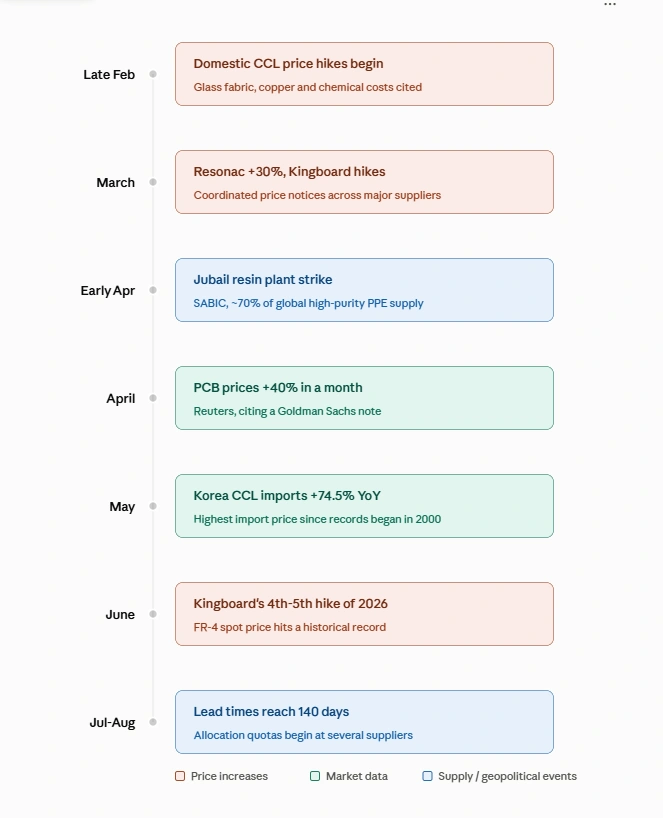
Table 1: Timeline of the 2026 electronic component shortage
| Period | Event |
|---|---|
| Sept 29, 2025 | U.S. Department of Commerce expands the scope of the BIS Entity List, adding Nexperia's Chinese operations. |
| Sept 30, 2025 | The Dutch government takes control of Nexperia under emergency powers, citing national security and technology-transfer concerns related to Chinese parent company Wingtech. |
| Oct 4, 2025 | China's Ministry of Commerce (MOFCOM) issues export controls prohibiting Nexperia's Chinese unit and subcontractors from exporting finished components and sub-assemblies to foreign countries. |
| Mid-Oct 2025 | Nexperia's China-based management instructs staff to disregard directives from the company's Dutch headquarters. Inventory of GP BJTs, MOSFETs, logic gates, and rectifiers begins declining sharply across the channel. |
| Late Oct 2025 | Volvo and Volkswagen warn of imminent factory closures due to chip shortages. ACEA and the American Automotive Innovation trade group both call for urgent resolution. |
| Nov 1, 2025 | Following a Trump-Xi summit, China agrees to resume Nexperia shipments as part of a broader one-year trade truce; the U.S. reduces tariffs and China pauses several retaliatory measures, including on Nexperia and certain critical materials. |
| Dec 2025–Jan 2026 | Honda extends production suspensions at several China facilities as wafer supply remains unstable; European automakers report it takes until January 2026 to find workable supply again despite the truce. |
| Feb 2026 | TrendForce and The Register warn of sharp Q1 DRAM and NAND price increases as AI hyperscalers and cloud providers continue straining memory supply. |
| Mar 2026 | TrendForce confirms Q1 2026 DRAM contract prices rose 90–95% QoQ; NAND rose 55–60% QoQ. SK Hynix confirms its entire 2026 DRAM production is already sold. |
| Mar–Apr 2026 | Manufacturer price-increase notices land across TI, ADI, Infineon, STMicro, and Nexperia-adjacent suppliers, effective April 1. SiC MOSFET allocation tightens sharply at onsemi as EV and onboard-charger demand outpaces capacity. |
| Jun 2026 | TrendForce confirms Q2 2026 DRAM contract prices rose a further 58–63% QoQ; NAND up 70–75% QoQ. Samsung and SK Hynix warn publicly that AI-driven memory shortages could persist until 2027 or later. |
| Jul 2026 | SK Hynix's CEO warns the memory shortage could last past 2030. DRAM spot prices are reported up nearly 700% year-over-year. Data centers are now estimated to consume roughly 70% of global memory output. |
| Jul–Aug 2026 | TrendForce projects Q3 DRAM growth slowing to 13–18% QoQ and NAND to 10–15% — still rising, but decelerating as consumer OEMs reach the limit of what they can pass through in retail pricing. |
The key pattern: the Nexperia dispute and the memory shortage are two separate root causes that happened to collide in the same window, and neither has fully resolved. That's why component buyers are dealing with two distinct risk profiles at once, not one.
3. What's actually driving the shortage
3.1 AI and HBM demand is consuming memory and packaging capacity
High-bandwidth memory (HBM) for AI accelerators converts roughly three DRAM wafers into one HBM stack, and HBM capacity for 2026 was already sold out well before the year began. Samsung, SK Hynix, and Micron together control more than 95% of global DRAM production, and all three have systematically reallocated capacity toward HBM and server-grade DDR5, leaving conventional DDR4/DDR5 modules used in PCs, routers, and mid-range consumer electronics in short supply. IDC frames this as a genuine zero-sum allocation problem: every wafer committed to an HBM stack for a GPU is a wafer denied to a laptop or smartphone module.
The consequence is a market where supply-side investment lagged demand for years. Industry analysts note that memory makers made little new capacity investment through 2024 and early 2025, leaving the industry poorly positioned when AI-driven demand accelerated in mid-2025. New fab capacity from Micron and SK Hynix isn't expected to reach volume production before 2027, which is why even easing quarter-over-quarter growth rates (as seen in Q3 2026) still represent a market that remains structurally undersupplied.
3.2 The Nexperia crisis and legacy chip geopolitics
Nexperia is not a headline-grabbing AI chip supplier — it makes unglamorous but essential legacy parts: transistors, diodes, and MOSFETs used throughout automotive electronics, from anti-lock braking systems to lighting control and infotainment. That's exactly what made the disruption so severe. Nexperia holds an estimated 40% share of the transistor and diode segment it competes in, with roughly 60% of its revenue tied to automotive customers who depend on tightly calibrated just-in-time manufacturing.
When the Dutch government's intervention triggered Chinese export controls on Nexperia's China-based operations, the practical effect was that Nexperia's own Dongguan facility — its largest packaging and testing site — was cut off from its own headquarters' authority, and finished parts stopped moving to customers outside China. Even after the November 2025 truce restored shipments, the damage didn't disappear overnight: automotive-grade components require AEC-Q100/Q101 qualification, a process that can't be compressed into weeks, so buyers who wanted a genuine second source were still working through requalification well into 2026.
3.3 MLCC and passive component demand from EV and AI hardware
Multilayer ceramic capacitors (MLCCs) are one of the least visible but most consequential shortage categories in 2026. Demand has scaled dramatically on the device side: modern smartphones use roughly double the MLCC count of models from a decade ago, and a single EV can require around 10,000 MLCCs versus roughly 2,000 in a comparable combustion vehicle. AI servers add another high-density draw on the same supply. On the manufacturing side, high-capacitance MLCCs require extremely thin, precisely stacked ceramic-and-metal layers, a process that doesn't scale quickly and doesn't respond well to simply adding factory floor space.
Because this is a large enough topic on its own — with its own supplier landscape, lead-time data, and sourcing tactics — we've covered it in a dedicated deep dive: Passive Component Shortage 2026: MLCC Lead Times. If MLCCs or other passives are a meaningful share of your BOM, that article covers the category in more depth than we can here.
3.4 Trade policy and tariff volatility
Layered on top of both the memory shortage and the Nexperia dispute is an ongoing pattern of U.S.–China trade friction that shows no sign of becoming predictable. Tariffs on semiconductors, substrates, and assembly equipment have moved from theoretical to landing directly on purchase orders, forcing buyers to rework supplier mixes and build cost buffers into quarterly forecasts. Compounding the problem, lead times for the chip-making equipment needed to expand capacity still run 18–30 weeks, meaning that even well-funded capacity expansion can't respond quickly enough to relieve near-term pressure. For buyers, the practical takeaway is that policy risk now needs to be tracked with the same discipline as price and lead-time risk — it can move a component from "available" to "restricted" in a matter of weeks.
4. Not all component categories are affected equally
Just as with PCB laminates, the impact of this shortage varies enormously by component category. Treating your entire BOM as equally at-risk leads to wasted effort; treating it as equally safe leads to painful surprises.
Figure 2: Approximate component lead times by category, mid-2026. HBM and SiC/GaN power devices face the longest waits, while standard logic ICs and connectors remain close to normal.
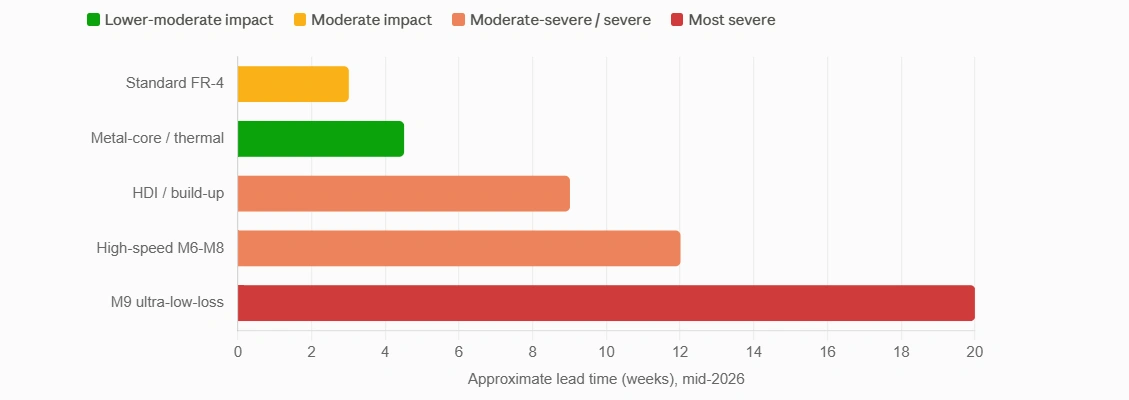
Table 2: Component category impact and typical lead times, mid-2026
| Component category | Typical use case | Impact level | Approximate lead time (mid-2026) |
|---|---|---|---|
| Standard logic ICs, sensors, optoelectronics | General consumer and industrial electronics | Low – supply largely healthy | Normal to slightly extended |
| Legacy discretes (transistors, diodes, MOSFETs — Nexperia-adjacent) | Automotive, consumer electronics | Severe, geopolitically driven | Weeks to months, requalification-dependent |
| Conventional DRAM (DDR4/DDR5) | PCs, servers, consumer electronics | Severe, allocation-based | Supplier quota; 10–20% monthly price increases reported |
| HBM | AI accelerators, data center GPUs | Most severe — sold out for 2026 | Allocation only; effectively no open-market supply |
| NAND / enterprise SSD | Storage, data centers | Moderate-severe | Rising prices, tightening allocation |
| High-capacitance MLCCs (automotive/AI grade) | EVs, AI servers, smartphones | Moderate-severe, structural | Varies significantly by spec — see our MLCC shortage guide |
| SiC / GaN power devices | EV powertrains, onboard chargers, data center power | Severe | 20–30 weeks |
| Connectors, standard passives | General electronics | Low-moderate | Slightly extended |
If your design leans heavily on standard commodity parts, your exposure right now is manageable. If it depends on HBM, high-grade MLCCs, SiC devices, or a Nexperia-sourced legacy part with no qualified second source, that's where planning effort should concentrate.
Not sure which categories your BOM is exposed to? Our BOM service can help identify at-risk line items and flag alternates before you're locked into a spec that's hard to source.
5. Regional snapshot: China, Europe, Korea/Japan, and the US
China
Nexperia's China-based unit has worked to lock in domestically produced silicon wafers to cover its 2026 IGBT production independent of its Dutch headquarters, a process industry sources estimate could take around six months to fully qualify. The broader push toward domestic semiconductor self-sufficiency has accelerated as a direct result of the dispute.
Europe
Volvo, Volkswagen, and Honda's European operations bore the brunt of the Nexperia disruption, with ACEA warning it could take months to qualify alternate suppliers for AEC-Q100/Q101-rated automotive parts. European OEMs are now treating supplier concentration risk as a standing agenda item rather than a one-time event, with several building continuous lifecycle-monitoring programs to catch EOL and allocation risk earlier.
Korea and Japan
SK Hynix and Samsung, controlling the bulk of global HBM and DRAM output, have both publicly acknowledged that AI-driven memory shortages could extend well beyond 2027, with SK Hynix's CEO going as far as warning of pressure lasting past 2030. Both companies have prioritized long-term supply agreements with hyperscale customers over spot-market or consumer-channel availability.
United States
U.S. buyers are navigating the shortage through two parallel tracks: monitoring new domestic capacity from Intel, TSMC Arizona, and Samsung Texas as a medium-term relief signal, while managing near-term tariff and Entity List exposure on any BOM touching Chinese-linked suppliers. Independent distributors have become a more prominent sourcing channel as manufacturer-controlled allocation systems tighten for both memory and legacy discretes.
6. What this means for your BOM and production schedule
Three practical realities are showing up across procurement teams right now:
- Lead times are no longer a fixed planning assumption. A part that shipped in weeks a year ago may now sit on an allocation queue with no committed date. If your production schedule was built on 2025 lead-time data, it's likely already out of date for memory, SiC, and Nexperia-adjacent parts.
- Price is a moving target, not a fixed line item. With DRAM suppliers signaling further monthly increases through the end of 2026, quotes that once held for a full quarter may now only be valid for weeks.
- Allocation, not price, is the real constraint for the most exposed categories. HBM has effectively no open-market supply at any price. For these categories, being on a supplier's forecast and allocation list matters more than what you're willing to pay.
A quick self-check: if your BOM depends on HBM, an unqualified single-source MLCC, or a Nexperia-linked part with a tight production window, you're in the highest-risk tier. If your design leans on standard logic, sensors, and mature passives, your exposure is manageable with normal planning discipline.
7. How to protect your project: a buyer's sourcing checklist
- Audit your BOM by supplier, not just by part number. Flag every line item sourced from Nexperia, Samsung, SK Hynix, Micron, TI, ADI, Infineon, and STMicro so you know your real concentration risk before it becomes a production problem.
- Qualify second sources in advance, not during a shortage. Automotive-grade requalification (AEC-Q100/Q101) alone can take months — starting that process after a disruption hits is the most expensive way to solve it.
- Track lifecycle status continuously, not just at design time. End-of-life parts discovered after the last-time-buy window closes are the hardest and costliest shortage to fix.
- Move to forecast-based ordering wherever volume allows. Suppliers on allocation are prioritizing customers who share a rolling forecast, even an informal one.
- Diversify sourcing channels rather than depending on a single distributor. A mix of authorized and verified independent channels gives you options when a primary source goes on allocation.
- Separate your board-level and part-level risk planning. A PCB material delay and a component allocation delay have different causes and different mitigations — don't manage them as one problem. See our companion article on the PCB raw material shortage for the board-side view.
At NextPCB, component sourcing is handled through HQ Online, our dedicated components platform, which sources across a broad distributor network rather than a single channel and gives you real-time visibility into pricing and availability as you build your BOM. Combined with our BOM service, our team can flag exposed line items and suggest qualified alternates before you commit to production — the same DFM-stage risk-flagging approach we use on the PCB material side.
None of this makes the underlying market easy. Prices are up and lead times are longer than anyone would like across memory, MLCCs, and legacy discretes. But this is a market that rewards early visibility over reactive scrambling. The teams that audit their BOM early, qualify alternates before they need them, and share a real forecast with their suppliers are, in practice, the ones still hitting their production dates through this cycle.
8. Outlook: when will the component shortage ease?
Relief timelines vary sharply by category, and none of them are near-term:
- Conventional DRAM and NAND are expected to stay tight through 2026, with meaningful new fab capacity from Micron and SK Hynix not reaching volume production before 2027. Most analysts don't expect a real supply-demand rebalance before late 2027 or 2028; SK Hynix's own CEO has floated pressure lasting past 2030.
- Legacy discretes tied to the Nexperia dispute depend more on geopolitical resolution than industrial timelines — the November 2025 truce eased the acute crisis, but full requalification of alternate sources for automotive-grade parts is likely to extend well into 2026 and possibly beyond.
- High-capacitance MLCCs face multi-year capacity build-out timelines given the precision manufacturing involved; see our MLCC-specific guide for category detail.
- SiC and GaN power devices should see gradual improvement as EV and data-center-driven capacity investments mature, though 20–30 week lead times are likely to persist through at least 2026.
Signals worth tracking: DRAM contract price growth continuing to decelerate quarter-over-quarter (as it did between Q2 and Q3 2026), confirmed volume production dates from Micron and SK Hynix's new fabs, and stabilization — not just resolution — of the U.S.–China trade relationship underpinning the Nexperia dispute.
9. Is this connected to the PCB raw material shortage?
Yes, but it's a related problem, not the same one. This article covers the part-level shortage — semiconductors, memory, and passives that get assembled onto a bare board. Our companion article, PCB Raw Material Shortage in 2026, covers the board-level shortage: copper, glass fabric, and resin, the physical inputs that become the copper-clad laminate itself.
Both shortages trace back to the same root cause — the scale of AI infrastructure investment in 2026 — but they involve entirely different supply chains, different bottlenecks, and different mitigation strategies. If your project is exposed to both board-level material delays and component-level allocation risk, plan for them separately rather than assuming one solves the other.
10. FAQ
Is there an electronic component shortage in 2026?
Yes, but it's selective rather than broad. Memory (especially HBM and DRAM), high-capacitance MLCCs, SiC power devices, and Nexperia-linked legacy discretes are under severe pressure, while standard logic ICs, sensors, and mature analog parts remain reasonably available.
Why are DRAM and memory prices so high in 2026?
AI data centers and hyperscale cloud providers have driven demand for HBM to the point where it consumed nearly all available capacity for 2026, pulling memory manufacturers' production away from conventional DDR4/DDR5 used in PCs and consumer electronics. TrendForce reported DRAM contract prices up 90–95% QoQ in Q1 2026 and a further 58–63% in Q2.
What is the Nexperia chip crisis, and is it resolved?
In late 2025, the Dutch government took control of Nexperia over technology-transfer concerns, prompting China to restrict exports from Nexperia's Chinese operations. A November 2025 trade truce restored shipments, but automotive-grade requalification for alternate suppliers continues to extend recovery well into 2026.
Which components are hardest to source in 2026?
HBM, conventional DRAM, high-capacitance automotive and AI-grade MLCCs, SiC/GaN power devices, and Nexperia-adjacent legacy discretes are the categories facing the most severe allocation and lead-time pressure.
Is this the same as the PCB material shortage?
No. This shortage affects components assembled onto a board; the PCB material shortage affects the bare board itself — copper, glass fabric, and resin. They share a root cause in AI infrastructure demand but require separate sourcing strategies.
How can I reduce component sourcing risk for my project?
Audit your BOM by supplier concentration, qualify second sources before you need them, track component lifecycle status continuously, and work with a sourcing partner — such as HQ Online or our BOM service — that draws from multiple distribution channels rather than a single source.
Sources: TrendForce, IDC, WSTS, Reuters, Bloomberg, Lawfare Media, Z2Data, and public statements from Samsung, SK Hynix, Nexperia, and ACEA.