

Arya Li, Project Manager at NextPCB.com

 NextPCB Capabilities
Printed Circuit Boards
NextPCB Capabilities
Printed Circuit Boards
 PCB Assembly
 Layer Buildup
 SMD-Stencils
 PCB Design-Aid & Layout
 Mechanics
 Quality
 Drills & Throughplating
 Factory & Certificate
 PCB Assembly Factory Show
Certificate
PCB Assembly Factory Show
Certificate

Support Team
Feedback:
support@nextpcb.com


Passive component shortages are not new—the industry has lived through several boom-bust cycles over the past two decades—but the drivers behind 2026 sourcing pressure look different from previous cycles. Demand from AI server infrastructure, electric vehicles, and renewable energy systems is pulling on the same MLCC, inductor, and resistor capacity that consumer electronics has historically relied on, creating uneven lead times across component categories. This article breaks down what is actually driving 2026 passive component tightness, which categories are most exposed, and the concrete design and sourcing strategies that reduce a board's vulnerability to supply disruption.
Three demand sources are converging on the same capacity base that supplies general electronics. AI server and data center buildout requires extremely high MLCC counts per board—GPU power delivery networks alone can consume hundreds of capacitors per board, and hyperscaler order volumes dwarf typical consumer product runs. Electric vehicle production continues to scale globally, and automotive-grade passives (AEC-Q200 qualified, X8R/X7R dielectrics) draw from a narrower qualified supplier base than commercial-grade parts, so even modest EV volume growth disproportionately tightens that segment. Renewable energy and grid infrastructure projects add a third demand pull, particularly for high-voltage, high-current inductors and power resistors.
On the supply side, passive component fabs run on long capacity-expansion cycles—new MLCC and ferrite production lines take 12 to 24 months to come online from the capital decision—so supply cannot respond to demand spikes as quickly as semiconductor fabs with more flexible allocation. This structural lag is the core reason lead times extend faster than they recover.
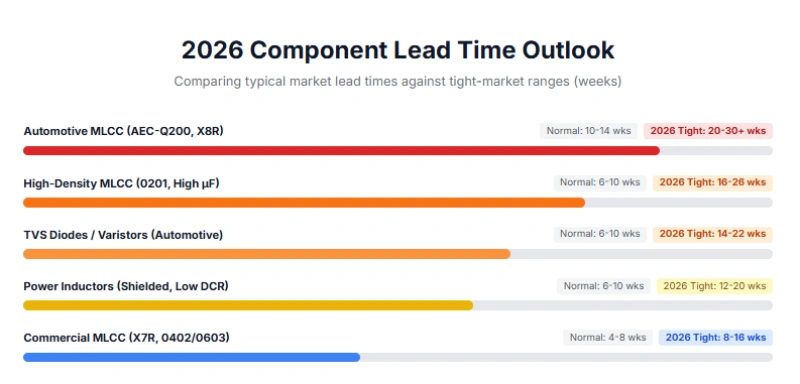
(Estimate Time)
Multilayer ceramic capacitors are the single highest-volume passive component on most boards, and they are also the category most exposed to 2026 tightness for several interlocking reasons. High-capacitance, small-case-size MLCCs (0402 and 0201, mid-to-high microfarad values) compete directly between consumer device miniaturization trends and AI server decoupling networks, which both want the same high-density, low-ESL part. Automotive-grade X7R and X8R MLCCs draw on separate qualified production lines with lower throughput than commercial-grade equivalents, so automotive lead times often run longer even when commercial parts ease.
For background on how dielectric class affects both performance and sourcing flexibility, see our comparison of X7R vs C0G vs X5R MLCC dielectrics—C0G/NP0 parts, used in fewer but more specialized applications, tend to see less demand volatility than general-purpose X7R parts used across the broadest range of designs. Designers evaluating package size trade-offs as part of a sourcing strategy may also find our MLCC package size selection guide useful, since stepping up one case size from 0201 to 0402 often opens a meaningfully larger supplier pool with little PCB area penalty.
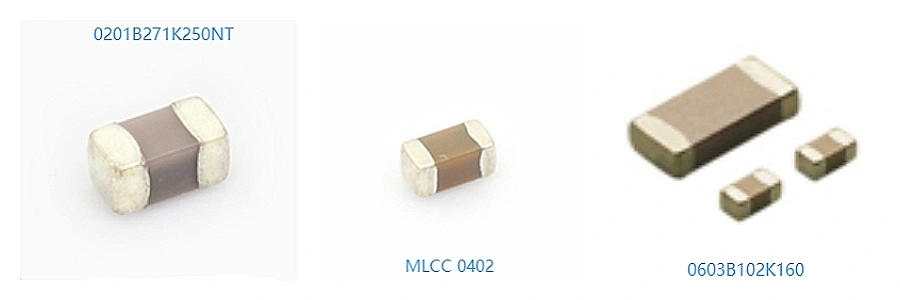
0201 vs 0402 vs 0603
Power inductors used in DC-DC conversion and VRM stages face their own pressure point: AI server power delivery networks use multiphase designs with high per-board inductor counts, and the shielded, low-DCR inductor types favored for high-efficiency conversion come from a smaller supplier base than generic unshielded parts. Our power inductor guide for AI server PDN design covers the specification trade-offs relevant to sourcing flexibility in this category.
Chip resistors have generally remained the most supply-stable passive category, since resistor manufacturing capacity is less concentrated and switching between manufacturers introduces fewer qualification hurdles than capacitor or inductor substitutions. Protection devices—TVS diodes, varistors, and PTC resettable fuses—sit in between: standard parts are broadly available, but automotive- and industrial-qualified variants with specific clamping voltage or hold-current ratings can extend to 20+ week lead times during demand spikes.
| Component Category | Standard Lead Time (Normal Market) | 2026 Tight-Market Range | Exposure Level |
|---|---|---|---|
| Commercial MLCC (X7R, 0402/0603) | 4–8 weeks | 8–16 weeks | Moderate–High |
| High-density MLCC (0201, high µF) | 6–10 weeks | 16–26 weeks | High |
| Automotive MLCC (AEC-Q200, X8R) | 10–14 weeks | 20–30+ weeks | Very High |
| C0G/NP0 MLCC (precision/timing) | 4–8 weeks | 6–12 weeks | Low–Moderate |
| Power inductors (shielded, low DCR) | 6–10 weeks | 12–20 weeks | Moderate–High |
| Chip resistors (standard tolerance) | 2–6 weeks | 4–8 weeks | Low |
| TVS diodes / varistors (automotive-grade) | 6–10 weeks | 14–22 weeks | Moderate–High |
These ranges vary by manufacturer and region and should be treated as directional rather than exact; checking current distributor stock and quoted lead times at the BOM-finalization stage remains essential.
The most effective shortage mitigation happens before the BOM is locked, not after a part goes out of stock.
Beyond the schematic, sourcing-side practices meaningfully reduce shortage exposure. Submitting a complete, accurate BOM early lets a manufacturing partner flag long-lead items before they become a build blocker rather than discovering the gap at kitting. NextPCB's BOM service cross-references submitted part numbers against live component marketplace stock, surfacing lead-time risk and suggesting qualified alternates during the quoting stage rather than after assembly has started.
For prototype and low-volume runs, building in a small inventory buffer for known long-lead passives—rather than ordering exact build quantities—avoids a single shortage from halting an entire production batch over a handful of missing capacitors. For larger volumes, locking in supplier agreements or last-time-buy notifications for components with known allocation risk gives longer visibility into upcoming constraints than reactive distributor checking.
Beyond the design and BOM practices above, NextPCB's own sourcing setup includes a few specific mechanisms aimed at reducing exposure to 2026-era passive component tightness.
√ Partial turnkey, with a preference for local procurement. NextPCB supports partial turnkey builds where the customer supplies select components while NextPCB sources the rest. For overseas clients, however, shipping customer-supplied capacitors and resistors into China adds customs clearance steps and logistics time that can offset any cost savings and introduce schedule risk. For builds where lead time is a concern, NextPCB generally recommends full local procurement through its own supply chain rather than relying on customer-supplied passives.
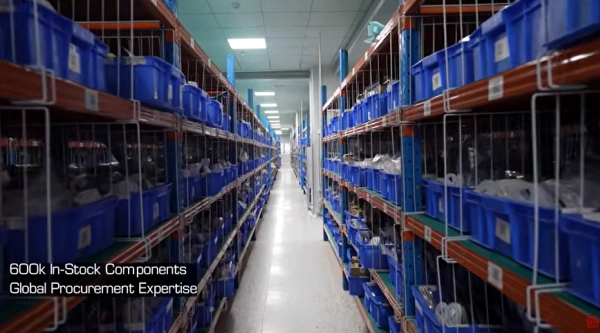
√ Direct access to HQ Online's local inventory. NextPCB is integrated with HQ Online (hqonline.com), the component marketplace operated under the same Electronics group. HQ Online maintains a large local warehouse—reported at over 600,000 component SKUs—covering common passive values independent of overseas distributor stock levels. When a part runs short through typical international distribution channels, NextPCB can draw directly from this warehouse, which in many cases gets components to the SMT line within a couple of days rather than waiting on international distributor lead times.
√ Incoming inspection for parts sourced under time pressure. Shortage periods tend to increase the circulation of counterfeit or mislabeled components—most commonly lower-voltage-rated MLCCs relabeled as higher-rated parts. NextPCB's IATF 16949 and ISO 13485 quality systems apply incoming inspection to components sourced through alternate channels, and its Scienscope X-ray system can be used selectively on higher-risk MLCC lots to check for internal cracking or voids that visual inspection would miss. This screening is applied to flagged, higher-risk stock rather than as a blanket process across every passive on a BOM.
√ Authorized distribution relationships. HQ Online holds authorized distributor agreements with several major domestic passive component manufacturers. This gives NextPCB more consistent access to allocated supply during periods of high demand compared to sourcing purely through open-market distributors, and reduces—though does not eliminate—the risk of counterfeit parts entering the build.

Featured Manufacturers
√ Lead-time screening at the quoting stage. NextPCB's DFM and BOM screening tools cross-reference submitted part numbers against known end-of-life and long-lead-time status before a design goes to quote, surfacing at-risk part numbers earlier in the process than a manual BOM review typically catches them.
| Action | Why It Reduces Risk |
|---|---|
| Specify parameter ranges instead of single part numbers | Allows substitution without an engineering change order |
| Use standard case sizes (0402/0603) where possible | Broader manufacturer base and stock availability |
| Avoid unnecessarily tight tolerance/dielectric specs | Tight specs narrow the qualified supplier pool |
| Flag single-source components at design review | Identifies risk before BOM freeze, not after |
| Submit BOM early for lead-time screening | Surfaces long-lead parts while substitution is still easy |
| Design dual-footprint pads for critical passives | Enables case-size substitution without a board respin |
Are MLCC shortages in 2026 as severe as the 2017–2018 or 2021–2022 shortage cycles?
Severity varies by component sub-category rather than being uniform across the board. High-density small-case and automotive-grade MLCCs are seeing tightness comparable to prior shortage cycles, while general commercial-grade parts in common values remain considerably more available than during the worst points of earlier cycles.
Does switching to tantalum capacitors avoid MLCC shortage exposure?
Not reliably—tantalum capacitors have their own distinct supply chain constraints tied to tantalum ore sourcing and refining capacity, and substituting one constrained category for another is not a dependable mitigation strategy. Our tantalum vs MLCC comparison covers the performance trade-offs if tantalum is being considered for other technical reasons.
How early should lead-time risk be assessed in the design cycle?
Ideally during initial BOM creation, not at final design review. Long-lead components identified early can often be designed around with parameter flexibility; the same component flagged after layout is complete typically forces a more disruptive late-stage substitution or a production delay.
Do automotive and industrial designs need a different sourcing strategy than consumer electronics?
Generally yes. AEC-Q200 qualified components have a narrower supplier base and longer qualification timelines for new sources, so automotive and industrial designs benefit more from early dual-sourcing and last-time-buy monitoring than consumer designs, which can typically substitute more freely between commercial-grade manufacturers.
Shortage-resilient design is ultimately a layout and specification discipline as much as a procurement one—footprints that accept multiple case sizes, parameter ranges instead of locked part numbers, and early BOM visibility all reduce how exposed a board is to the next sourcing disruption. If component substitution affects your decoupling or power delivery network, our guide on decoupling capacitor placement covers how to maintain power integrity when adjusting values or case sizes across a redesign.
Need help screening your BOM for long-lead or single-source passive components before production? Submit your BOM to NextPCB for lead-time and sourcing risk review, or get a PCB assembly quote to discuss component substitution options for your next build.
>Recommend reading: MLCC Alternatives 2026: X7R vs X5R, DC Bias & Cross-Reference Guide | NextPCB
Proactive BOM management is the most effective shield against line-down manufacturing bottlenecks.
Submit your project BOM today, and our engineers will perform a comprehensive lead-time and risk evaluation.

Still, need help? Contact Us: support@nextpcb.com
Need a PCB or PCBA quote? Quote now