

 NextPCB Capabilities
 PCB Assembly
 Layer Buildup
 SMD-Stencils
 PCB Design-Aid & Layout
 Mechanics
 Quality
 Drills & Throughplating
 Factory & Certificate



If you've requested a PCB quote in the last few months and watched the price change before you even placed the order, you're not imagining things. The 2026 PCB raw material shortage is real, it's measurable, and, unlike past cycles driven by seasonal consumer electronics demand, it is being pushed by three forces hitting the supply chain at the same time: explosive AI server demand, a geopolitical shock to a key resin supplier, and structural capacity limits in copper foil and glass fabric production that can't be solved by simply building more factories.
This article pulls together data from Reuters, Goldman Sachs, Prismark, the London Metal Exchange, Korea Customs Service, and direct supplier price notices from Kingboard, Resonac, Mitsubishi Gas Chemical, and Panasonic to build the most complete picture available of what's happening, why, and, more importantly, what buyers and design teams can actually do about it while the market stays tight.
We'll keep this page updated as new pricing and lead-time data comes in, so bookmark it if you're tracking this for procurement planning.
1. Is there really a PCB material shortage in 2026? (Quick answer)
Yes. Copper-clad laminate (CCL) prices have risen 20% to over 40% across grades in the first half of 2026, with some standard FR-4 segments in China more than doubling from early-2025 levels. Lead times for high-end laminates have stretched to as long as 140 days, and several major suppliers have moved to allocation-based ordering instead of open supply. The global PCB market is on track to cross $95.8 billion in 2026, a 12.5% increase, according to Prismark, driven almost entirely by AI infrastructure demand pulling capacity away from standard electronics.
This isn't a single-material blip. It's a simultaneous squeeze across copper, glass fabric, and resin, the three raw materials every copper-clad laminate is built from.
A manufacturer's view: From where we sit on the production floor, the headline numbers look alarming, but the situation is more manageable than it appears from the outside. The sharpest pain is concentrated in a narrow band of the market: M8/M9-grade material feeding AI server production. Standard FR-4 and mid-tier laminate, which cover the large majority of commercial and industrial PCB orders, are tighter and pricier than a year ago, but they are not in crisis. The teams that get hurt are the ones who find out about a material problem at the point of production release. The teams that don't are the ones who build a materials-availability check into their DFM process and talk to their fabricator early. That second group is having a fairly ordinary year.
2. Timeline: how the 2026 shortage unfolded
Most coverage of this shortage treats it as one event. It wasn't, it built in stages over roughly six months, and understanding the sequence helps explain why the market hasn't stabilized yet.
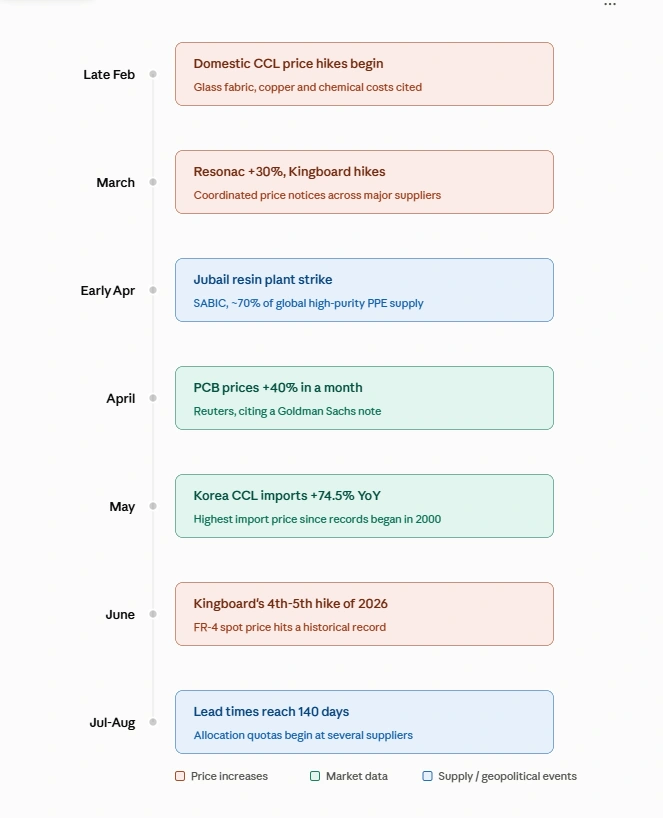
Figure 1: Timeline of the 2026 PCB raw material shortage, February–August
| Period | Event |
|---|---|
| Late Feb 2026 | Smaller domestic CCL producers begin raising prices on standard grades (HB, 22F, CEM-1), citing glass fabric, copper foil, and chemical input costs. |
| March 2026 | Resonac announces a 30%+ price increase across its full CCL and prepreg lineup, effective for March shipments, citing copper foil and glass-cloth constraints. Kingboard and other major producers begin a series of coordinated price notices, with single-week increases of 10-20% on some grades. |
| Early April 2026 | Iran strikes the Jubail petrochemical complex in Saudi Arabia. SABIC, which supplies roughly 70% of the world's high-purity polyphenylene ether (PPE) resin, a base material for PCB laminates, is forced offline and unable to resume normal output. |
| April 2026 | Reuters reports PCB prices surged as much as 40% from March to April alone, citing a Goldman Sachs analyst note. Mitsubishi Gas Chemical follows with a 30% increase across its high-end PCB material range, effective April 1. |
| May 2026 | South Korea's CCL import prices hit $20,728 per ton, a 74.5% year-over-year jump and the highest level since Korea Customs Service records began in 2000. Some Korean PCB makers reportedly place advance orders five times their normal monthly volume to secure supply. |
| June 2026 | Kingboard issues its fourth and fifth price adjustments of the year, with cumulative increases exceeding 50%. Standard FR-4 spot prices in China climb past 230-260 RMB per sheet, a new historical high (versus roughly 110-150 RMB a year earlier). Several producers move to customer quota systems rather than open orders. |
| July-August 2026 | Lead times for advanced laminates reach up to 140 days; standard FR-4 that once shipped in days now takes roughly four weeks from major suppliers. Industry press continues to describe AI demand as the primary bottleneck, with no near-term relief in sight for high-end grades. |
The pattern is important: this wasn't one price shock that faded. It was a compounding sequence, and each stage added new pressure on top of the last.
3. What's actually driving the shortage
3.1 AI server demand is absorbing high-end capacity
AI servers don't just need more PCBs, they need dramatically more expensive ones. The material value inside a single AI server board has climbed from roughly $35,100 to $116,700 as GPU platforms have moved from Nvidia's H100 generation (using M7-grade laminate) to GB200 (M8-grade) and now toward Rubin/GB300 platforms requiring M9-grade material. That's more than a 3x increase in laminate value per unit, and it's pulling premium production capacity away from every other segment of the market, including the standard FR-4 boards used in routers, laptops, and mid-range consumer electronics.
Because high-margin AI-grade material is more profitable for CCL producers to manufacture, factories are prioritizing those orders, which tightens supply for everyone else even when their own demand hasn't changed.
3.2 Upstream material bottlenecks: copper, glass fabric, and resin
A copper-clad laminate is built from three core inputs, and all three are under pressure at once:
- Copper hit a record $13,300 per tonne in January 2026, directly raising the cost of copper foil, plating, and finished laminate across every PCB category.
- Electronic-grade glass fabric, particularly the low-CTE (coefficient of thermal expansion) variants required for high-end boards, is in genuine physical shortage, not just a pricing issue. Major weaver Nittobo has announced plans to roughly triple capacity, but that new supply won't come online until after 2027.
- High-end HVLP copper foil, used for low-loss, high-speed applications, is effectively controlled by three producers, Mitsui Kinzoku, Circuit Foil Luxembourg, and Co-Tech Development, who together account for an estimated 80-90% of global supply. Qualifying a new HVLP foil source can take three to five years, so capacity simply can't respond quickly to demand spikes.
This is why the shortage isn't resolving itself the way a normal price cycle would: two of the three core inputs are capacity-constrained by physics and qualification timelines, not just by price.
3.3 Geopolitical shock: the Jubail disruption
The single event that turned a tightening market into a genuine supply crisis was the early-April strike on Saudi Arabia's Jubail petrochemical complex during the escalation of the Iran conflict. SABIC operates roughly 70% of the world's high-purity PPE resin capacity at that site, a specialty resin used in PCB laminate systems, particularly for higher-performance boards. With SABIC unable to resume output and Gulf shipping disrupted by the broader conflict, PPE availability tightened worldwide almost overnight.
Reuters reported that PCB prices jumped as much as 40% in the single month following the strike, based on Goldman Sachs analysis, and South Korean PCB maker Daeduck Electronics confirmed it had opened price discussions with customers as a direct result. This is the clearest example in this cycle of a single geopolitical event compounding an already-tightening structural market.
4. Not all PCB materials are affected equally
One thing missing from most coverage of this shortage: the impact is not uniform across material grades. If your project uses standard FR-4, your risk profile looks very different than a team specifying M8/M9 high-speed laminate.
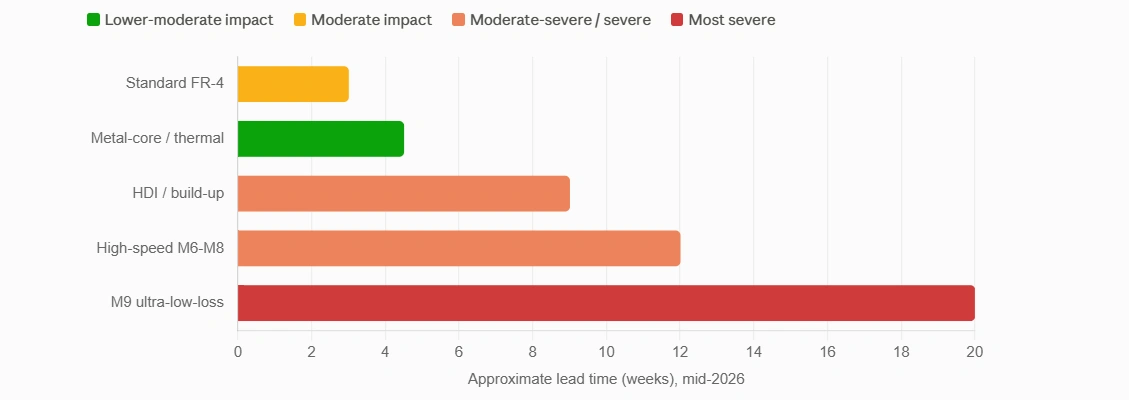
Figure 2: PCB material lead times by grade, mid-2026
| Material type | Typical use case | Impact level | Approximate lead time (mid-2026) |
|---|---|---|---|
| Standard FR-4 | Consumer electronics, general industrial | Moderate, price up, supply tight but available | ~2-4 weeks |
| High-speed/high-frequency (M6-M8) | Networking, telecom, high-layer-count boards | Severe, direct competition with AI server demand | 8-16 weeks |
| M9-grade ultra-low-loss | AI/ML servers, 1.6T switching, advanced GPU platforms | Most severe, allocation-based, limited qualified sources | Up to 140 days, quota-dependent |
| HDI / build-up laminate | Smartphones, wearables, compact high-density boards | Moderate-severe, competes for high-end glass fabric and thin copper foil | 6-12 weeks |
| Metal-core / thermal management substrates | LED, automotive, power electronics | Lower-moderate, less overlap with AI-grade material demand | ~3-6 weeks |
If your design can tolerate a lower-tier material without compromising performance, you're in a materially better position right now than a team locked into a specific high-end grade.
Not sure which tier your design falls into?
A quick DFM review can confirm your material grade and flag any availability risk before you commit to a spec.
5. Regional snapshot: China, Japan, Korea, and the US
-
China
- Domestic CCL leaders including Kingboard, Shengyi Technology, and Nan Ya New Material have issued repeated price notices through 2026, with several moving to quota-based allocation for major customers. Downstream PCB fabricators including Shennan Circuits and Chongda Technologies have followed with their own adjustment notices as material costs pass through.
-
Japan
- Resonac and Mitsubishi Gas Chemical both announced 30%+ increases across CCL and prepreg lines in Q1 2026. Panasonic has gone further, permanently discontinuing production of standard glass-fiber CCL to focus capacity on higher-margin material.
-
South Korea
- Import price data from Korea Customs Service shows the clearest single data point of how severe this cycle is: a 74.5% year-over-year jump to $20,728 per ton by March 2026. South Korean firm Doosan has announced a new CCL plant in Thailand specifically to diversify supply for AI server and data center customers.
-
United States / Global
- Reuters and CNBC coverage has focused on downstream impact: PCB maker TTM Technologies confirmed price increases of 5-25% to customers, and analysts have warned that lower-margin device categories, PCs, routers, mid-range smartphones, have less room to absorb a 40% PCB cost shock than premium products.
6. What this means for your production schedule
Three practical realities buyers are dealing with right now:
- Lead times have shifted the planning baseline. A "standard" 2-3 week laminate lead time in early 2025 is now closer to 4 weeks for FR-4 and can stretch to 140 days for high-end grades. If your project timeline was built on last year's lead times, it's already out of date.
- Quote validity windows are shrinking. With suppliers updating prices weekly in some segments, many manufacturers can no longer hold a quote for 30 days the way they once could. Expect shorter validity periods and build that into your budgeting cycle.
- Allocation, not just price, is now the constraint. For M8/M9-grade materials in particular, some suppliers are capping how much any single customer can order regardless of price, meaning early commitment matters more than price negotiation.
A simple way to assess your own exposure: if your project depends on a single high-end material grade with a tight production window and no qualified alternate, you're in the highest-risk category. If you're using standard FR-4 with some schedule flexibility, your exposure is manageable with normal planning discipline.
Want a second opinion on your exposure?
Send us your stackup and timeline and we'll flag material risk before it becomes a schedule problem.
7. How to protect your project: a buyer's action checklist
- Confirm material availability before you release for production, not after PO placement. A DFM review that includes a materials availability check can catch a problem while there's still time to act.
- Qualify alternate materials in advance. Know which laminate grades can substitute for your primary spec without compromising electrical or thermal performance, and get sign-off before you need it, not during a delay.
- Standardize stackups across product lines where possible. Using common materials across multiple designs improves both inventory efficiency and your leverage with suppliers.
- Move to forecast-based ordering. Suppliers are prioritizing customers who commit early. If your volume allows it, sharing a rolling forecast, even an informal one, measurably improves allocation priority.
- Talk to your fabricator early, not just your material supplier. An experienced manufacturing partner with multiple qualified material sources can often absorb volatility that a single-source relationship can't.
At NextPCB, we've been managing this by maintaining relationships across multiple qualified CCL suppliers rather than depending on a single source, and by flagging material risk to customers during the DFM stage, before it becomes a schedule problem. If your project is sensitive to lead time or material grade, our engineering team can walk through alternate options before you commit to production.
None of this makes the underlying market easy, costs are up and lead times are longer than either of us would like. But a shortage like this is exactly the kind of problem a manufacturing partnership is supposed to solve. It rewards planning over panic: the customers who loop us in early, who are open to a qualified alternate material, and who share a realistic forecast are, in practice, the ones who keep hitting their production dates through this cycle. That's the part we'd want any buyer reading this to take away, this is a market to plan around, not one to be paralyzed by.
8. Outlook: when will the shortage ease?
Most industry sources point to relief beginning in the second half of 2027, and even that timeline is uneven across material categories:
- Glass fabric stays constrained until Nittobo's expanded capacity comes online, which isn't expected before 2027.
- HVLP copper foil remains the tightest link given three- to five-year qualification cycles for new sources, don't expect meaningful new supply before 2028 in the most advanced grades.
- PPE resin could ease sooner if Jubail operations normalize, but that depends on the broader geopolitical situation rather than a predictable industrial timeline.
Signals worth tracking if you want to gauge when things are turning: the frequency of CCL price notices slowing down, standard FR-4 lead times returning toward 2-3 weeks, and copper prices stabilizing below record levels.
9. Is this connected to the broader electronic component shortage?
Yes, but it's a related problem, not the same one. The PCB raw material shortage covered in this article is a board-level issue, it affects copper, glass fabric, and resin, the physical inputs that become the bare board itself. The broader electronic component shortage is a part-level issue affecting semiconductors, memory (DRAM/NAND), MCUs, and passives that get assembled onto that board.
Both are being driven by the same root cause, the scale of AI infrastructure investment in 2026, but they involve different supply chains, different bottlenecks, and different mitigation strategies. If your project is exposed to component-level shortages as well as material shortages, they need to be planned for separately.
For a full breakdown of the semiconductor, memory, and passive component shortage affecting BOM planning in 2026, see our companion article: Shortage of Electronic Components in 2026: Causes and Sourcing Strategies.
10. FAQ
Is there a PCB shortage in 2026?
Yes. Copper-clad laminate prices have risen 20-40%+ across grades in 2026, and lead times for high-end materials have extended to as long as 140 days, driven primarily by AI server demand and a geopolitical disruption to a major resin supplier.
Will there be a semiconductor shortage in 2026?
Related but distinct, AI infrastructure demand is also straining memory chip and semiconductor supply, contributing to broader electronics price pressure separate from the PCB material shortage. See our companion article for details.
Why is there a shortage of electronic components?
Component-level shortages are driven by the same AI data center demand surge that's affecting PCB materials, but they hit different supply chains, chip fabrication capacity, memory production, and passive component manufacturing. Read the full breakdown in our companion article.
When will PCB material prices stabilize?
Most industry estimates point to the second half of 2027 for early relief, with the tightest categories, HVLP copper foil and low-CTE glass fabric, likely remaining constrained into 2028.
How can I reduce the impact of the CCL shortage on my project?
Confirm material availability during DFM review rather than after order placement, qualify alternate material grades in advance, and work with a manufacturing partner that sources from multiple qualified CCL suppliers rather than a single source.
Sources: Reuters, CNBC, Goldman Sachs research notes, Prismark market data, London Metal Exchange, Korea Customs Service, and public price notices from Kingboard, Resonac, Mitsubishi Gas Chemical, and Panasonic.