NextPCB Capabilities
Printed Circuit Boards
NextPCB Capabilities
Printed Circuit Boards
 PCB Assembly
 Layer Buildup
 SMD-Stencils
 PCB Design-Aid & Layout
 Mechanics
 Quality
 Drills & Throughplating
 Factory & Certificate
 PCB Assembly Factory Show
Certificate
PCB Assembly Factory Show
Certificate

Support Team
Feedback:
support@nextpcb.com


If you've placed a PCB order recently and noticed the quote looks different from what you got three months ago — longer lead times, higher unit costs, or a note about material availability — you're not imagining things, and you're not alone. Across the industry, engineers and procurement teams are running into the same wall: boards that used to ship in two weeks now take four, and prices on certain layer counts and finishes have crept up more than once this year.
This isn't a case of one supplier raising margins. It's a structural supply-demand imbalance that started upstream — in copper foil and glass cloth production — and is now working its way down to every PCB order, from prototype runs to high-volume production. The pattern echoes what happened with Nexperia's discrete semiconductors in late 2025: a low-cost, easy-to-overlook component became the bottleneck that stalled entire production lines. PCB materials are following a similar script in 2026.
Here's what's actually driving it, what it means for your next order, and what you can do to keep your project on schedule.
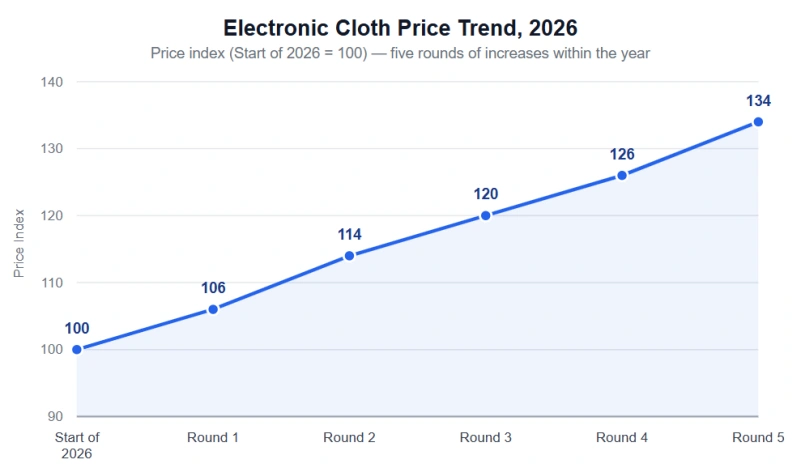
A few data points explain why this feels different from a normal seasonal price adjustment:
| Indicator | 2026 Status |
|---|---|
| Electronic (glass) cloth pricing | Multiple price increases within the year, pushing per-meter cost noticeably above 2025 levels |
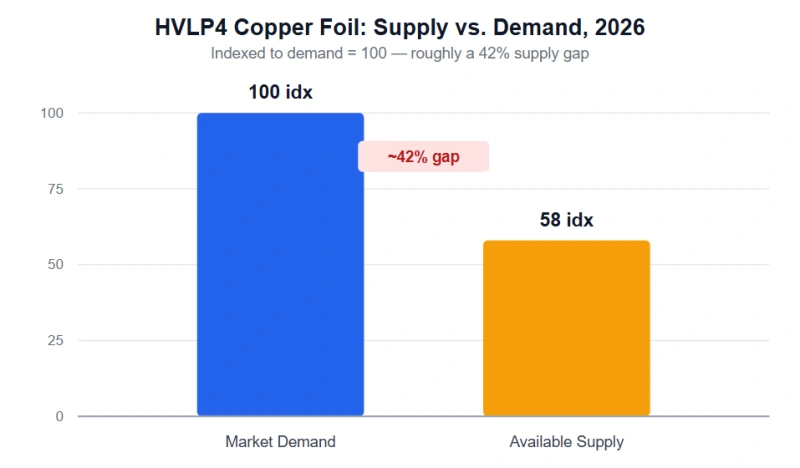
| HVLP4-grade copper foil | Supply gap estimated at roughly 40%+ of demand |
| Industry-wide inventory | Down to some of the lowest levels seen in recent years; some material categories effectively out of stock at times |
| Leading fabricators' utilization | Running near full capacity, with order books extending well into the following year for certain board types |
None of this is speculation from a single source — it's consistent with what fabricators, distributors, and industry analysts have been reporting throughout the year. When the raw material layer is this tight, the effect ripples through every stage of PCB production.
The single biggest new variable in 2026 is AI server demand. A typical AI server board uses several times more PCB material than a conventional server, and because of the layer counts, high-speed materials, and precision required, the value of each board is many times higher too. That combination means AI-related orders are consuming a disproportionate share of fabrication capacity relative to their unit count.
For a PCB manufacturer, an AI server order and a standard industrial control board order both compete for the same production lines and the same upstream materials. When one segment of demand grows this fast, it doesn't just add volume — it reshuffles who gets priority, and smaller or standard orders can end up waiting longer simply because the queue ahead of them has changed.
Even if capacity were unlimited, there's a harder constraint underneath it: the raw materials themselves are in short supply.
High-performance copper foil — particularly the HVLP4 grade used in high-speed and high-layer-count boards — requires specialized production equipment with long lead times of its own. New capacity can't be brought online quickly, which is why the gap between what's demanded and what's available has widened rather than closed, even as more manufacturers try to invest in expansion.
Glass cloth faces a similar equipment bottleneck. The specialized weaving and coating machinery used to produce electronic-grade cloth can take a year or more to deliver once ordered, meaning any capacity added today won't meaningfully ease the market until well into the future. In the meantime, cloth suppliers have pushed through repeated price increases, and buyers report difficulty securing consistent volumes even at the higher price.
Translated into practical terms, here's what engineers and buyers are actually experiencing right now:
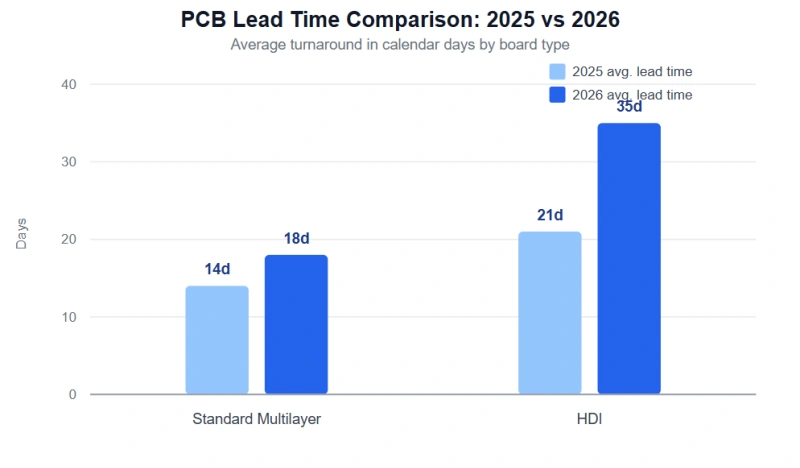
In other words, the impact isn't uniform — it depends heavily on what you're ordering and who you're ordering it from.
You can't control the upstream material market, but there are concrete steps that reduce your exposure to it:
Want a second set of eyes on your current design before you place your next order? Our engineering team offers a free DFM check that flags material and stack-up choices that could affect your lead time.
We won't claim the industry-wide shortage doesn't touch us — it touches every fabricator sourcing the same upstream materials. What we can control is how we plan around it: maintaining working inventory on the material grades our customers use most, communicating realistic lead times upfront rather than after the fact, and working with customers early when a spec change could avoid a bottleneck entirely.
If you have a project on a tight timeline, the earlier you loop in an engineer to review material availability, the more options you have.
Talk to one of our engineers about your current timeline and get a realistic read on lead times for your specific board.
The main driver is a shortage of upstream materials — particularly high-performance copper foil and electronic-grade glass cloth — combined with a sharp rise in demand from AI server production, which consumes significantly more PCB material and capacity per unit than traditional electronics.
Because the equipment used to produce copper foil and glass cloth takes a long time to manufacture and install, new capacity won't come fully online in the near term. Most industry forecasts suggest tight supply will continue through at least the next several quarters.
Higher-layer-count boards, HDI designs, and boards specifying high-speed or high-performance laminates are affected most, since they rely more heavily on the constrained material grades. Standard multilayer boards using common materials are comparatively more stable.
Order or confirm material availability early, build in flexibility on laminate and copper grade where your design allows it, and work with a fabricator that can give you a clear, current answer on material inventory rather than a generic lead-time estimate.
Price and lead-time pressure on PCBs isn't likely to disappear overnight — the root causes sit upstream, in equipment cycles that take time to resolve. But with early planning, flexible specs, and a fabricator that's transparent about material availability, you can keep your project moving instead of getting caught in the bottleneck.
Get an instant quote or talk to a PCB engineer about your current timeline.
By Liu Wei, Senior Engineer at NextPCB
— 10+ years of industry experience in production optimization and supply chain management, ISO13485 certified.
Still, need help? Contact Us: support@nextpcb.com
Need a PCB or PCBA quote? Quote now