

 Surface
Julia Wu - Senior Sales Engineer at NextPCB.com

 NextPCB Capabilities
Printed Circuit Boards
NextPCB Capabilities
Printed Circuit Boards
 PCB Assembly
 Layer Buildup
 SMD-Stencils
 PCB Design-Aid & Layout
 Mechanics
 Quality
 Drills & Throughplating
 Factory & Certificate
 PCB Assembly Factory Show
Certificate
PCB Assembly Factory Show
Certificate

Support Team
Feedback:
support@nextpcb.com


If you've followed tech and supply-chain news lately, you've likely seen PCB and CCL (copper-clad laminate) suppliers making headlines alongside every AI server story — material shortages, multiple rounds of price hikes, lead times stretching from weeks to months. It's a bit counterintuitive: a PCB looks like a fairly ordinary component, a board with printed circuits on it. So why is it suddenly caught up in the AI infrastructure boom?
The answer is simple: the PCB inside an AI server isn't remotely the same product as the one inside your laptop or phone. This piece walks through how this price surge actually travels — from raw materials all the way down to the products where buyers feel the impact.
Copper-clad laminate (CCL) is the core substrate a PCB is built on, and it typically accounts for more than 30% of a PCB's total manufacturing cost. CCL itself is made by pressing together three upstream inputs — electronic-grade glass fabric, resin, and copper foil.
Any disruption at any point in that chain moves straight down the line: raw material price increases push up CCL prices, which push up PCB prices, which push up the price of whatever the PCB ends up in — servers, phones, cars. In 2026, every link in that chain has been under pressure at the same time.
For a full data breakdown of the underlying material shortage — copper, resin, and glass fabric constraints, sourced from Reuters, Goldman Sachs, Prismark, and direct supplier price notices — see NextPCB's PCB Raw Material Shortage in 2026: Full Timeline, Data, and How to Protect Your Production Schedule.
PCBs in a conventional server and PCBs in an AI server aren't comparable products — not in layer count, not in material grade. As AI chip compute keeps scaling up, motherboards need denser routing, higher current density, and signal integrity that holds up at much higher frequencies. All of that pushes both the technical difficulty and the material cost of the board up sharply.
| Comparison | Conventional Server | AI Server (2026 mainstream configuration) |
|---|---|---|
| PCB layer count | Typically 6–16 layers | 20+ layers, up to 70–100 layers at the high end |
| CCL consumption | Baseline | ~5–7x a conventional server |
| PCB value per unit | ~$35,100 | ~$116,700 (+233%) |
| Typical lead time | 2–3 weeks | 8–12 weeks; some high-layer-count boards can't get a confirmed date at all |
| Material grade required | Standard FR-4 | Ultra-low-loss, high-frequency CCL (M7 → M8 → M9 material generations) |
(Figures compiled from multiple industry research reports and trade press; actual numbers vary by model and vendor.)
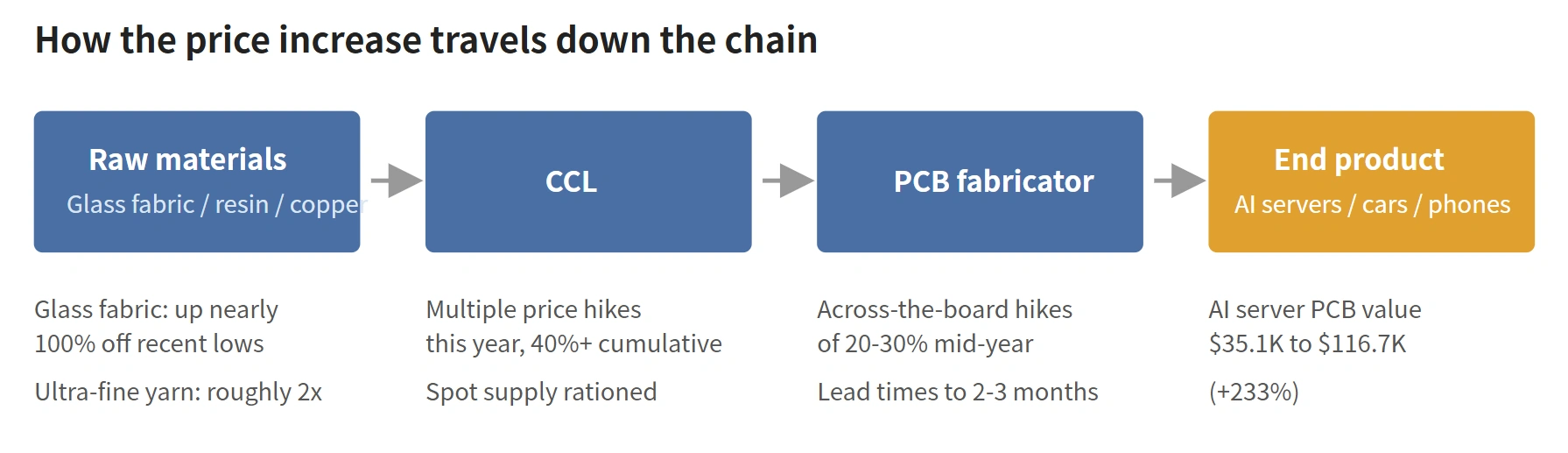
Beyond the headline numbers, a few details from the industry make the situation more concrete:
This tightness isn't confined to PCB substrates. Memory, MLCCs, and a wide range of components are seeing similar allocation dynamics driven by the same AI infrastructure buildout — see NextPCB's Shortage of Electronic Components in 2026: Causes and Sourcing Strategies for the broader picture beyond bare boards.
Yes, and it already has. In the automotive sector, PCB prices had risen 12–17% by the first quarter of 2026, and several automakers in China have raised end prices, with per-vehicle increases equivalent to roughly $280–$1,400. LED display modules have also seen one-week price jumps of 10–15%. Foldable phones — which rely on rigid-flex boards, multilayer FPC, and SLP-grade (substrate-like PCB) materials — are similarly exposed, and this pattern is showing up across major phone markets globally, not just one region.
That said, the pressure isn't uniform. Analysts generally expect price elasticity to snap back faster for low- and mid-tier consumer electronics and standard industrial PCBs, while AI servers, automotive electronics, and high-speed communications — the segments with the tightest performance requirements — are likely to keep commanding a structural premium. The more commodity the board, the less room there is for the price increase to stick; the more specialized and scarce the material grade, the more it holds.
Multiple research firms are converging on a similar read: this isn't a short-lived price spike, it's a supercycle created by structural demand growth colliding with hard capacity limits on the supply side. The consensus expectation is that the tight market persists at least through 2027, with some analysts pointing to the second half of 2027 before conditions meaningfully ease.
If you're placing PCB orders in this environment — whether it's a high-layer-count board tied to AI infrastructure or a routine commercial design — the practical question isn't just "how much more will this cost," but whether your stackup and material grade can still be sourced inside your project's timeline.
NextPCB's guide on How to Protect Your PCB Project From the 2026 Material Shortage walks through concrete steps design and procurement teams can take before release — from building a materials-availability check into DFM to talking to your fabricator earlier in the design cycle. If your bill of materials also includes MLCCs or other passives, Passive Component Shortage 2026: MLCC Lead Times, Supply Chain Risk and Design Mitigation covers the same kind of design-stage mitigation for that side of the BOM.
Want to know exactly where your project stands before you commit to a stackup? Upload your Gerber files to NextPCB's online quote and order page for a real-time price and lead-time check — so you're planning around confirmed numbers instead of last quarter's assumptions.
Industry analysts and financial press are actively debating this. The consensus for now: prices likely stay elevated, possibly climb further, over the next two to three quarters — but longer term, PCB pricing is expected to split rather than move up as one block. Standard FR-4 and mid-to-low-tier consumer PCBs should see elasticity return faster, while AI server, automotive, and high-speed communications boards keep a structural premium. In short: the increase on commodity boards is cyclical; the tightness on high-end boards looks more like a lasting shift.
This is a question sourcing teams globally keep coming back to. The core advice is to lock in capacity and lead times early, especially for high-layer-count or HDI orders that require advanced fabrication capability — the number of factories that can actually build these boards is limited, and most of that capacity is already committed to AI-related orders. Even if your requirement is a plain 2–10 layer board with no AI connection at all, material-side cost increases (copper, gold, resin) still flow through and are hard to fully avoid.
This is a real concern for smaller teams. Some fabricators have indeed shifted production priority toward higher-margin AI and automotive orders, which has stretched lead times for routine prototyping and small-batch runs. In that environment, working with a platform that keeps prototyping workflows standardized and backed by committed capacity makes scheduling more predictable — for example, uploading Gerber files directly to NextPCB's online quote and order page shows real-time lead time and pricing rather than requiring back-and-forth confirmation by email.
In a market where capacity is this constrained, catching a design issue before submission saves a rework cycle you may not have room for. NextPCB's free online Gerber viewer lets you upload your files and check routing, stackup, and outline against your intent — no software install required — so you can confirm the file is clean before it enters a queue.

Still, need help? Contact Us: support@nextpcb.com
Need a PCB or PCBA quote? Quote now