

 NextPCB Capabilities
 PCB Assembly
 Layer Buildup
 SMD-Stencils
 PCB Design-Aid & Layout
 Mechanics
 Quality
 Drills & Throughplating
 Factory & Certificate



Monitoring is one of the most practical categories in the maker world: instead of building something for the novelty of it, these projects exist to answer a question — is the terrarium too dry, is anyone at the door, has the power draw spiked. The four builds below tackle very different monitoring problems, from garden birdhouses to home electricity, and each links back to its original build log with schematics, firmware, and source files.
- In This Article
- 1. Flexible Birdhouse Camera System for Multiple Nests
- 2. Sentra — The Smartest DIY CCTV Camera
- 3. IoT Based ESP32 Smart Terrarium
- 4. IoT Energy Meter With ESP32, LoRa — Web Monitoring
1. Flexible Birdhouse Camera System for Multiple Nests
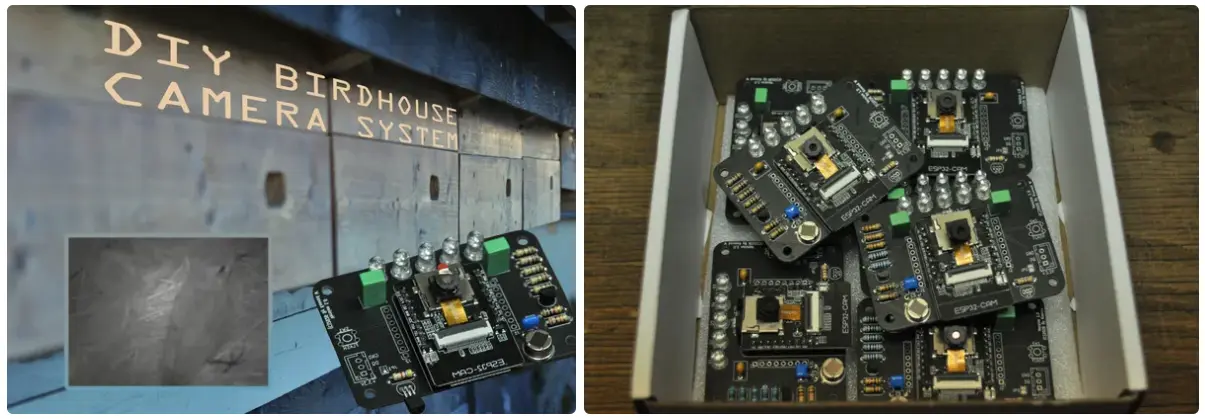
Most DIY birdhouse cameras are built around a single box, which becomes a problem the moment you have more than one nest to watch. This project takes a network approach instead: a flexible camera node design that can be deployed across several birdhouses at once, feeding back to a shared monitoring point rather than requiring a separate standalone setup for each box.
The idea of designing for “one camera node, many deployments” rather than one fixed installation is a pattern worth borrowing for any distributed sensing project — wildlife monitoring, remote environmental sensors, or anything else where you need the same node repeated across several physical locations.
Components:
- Camera Node Module (per birdhouse)
- Wireless Connectivity for Remote Monitoring
- Weatherproof Housing
Note: the project’s public write-up does not disclose a specific MCU or camera sensor part number, so the list above reflects the described system architecture rather than exact component references.
Full build log on Instructables, with the camera node source code on GitHub.
2. Sentra — The Smartest DIY CCTV Camera
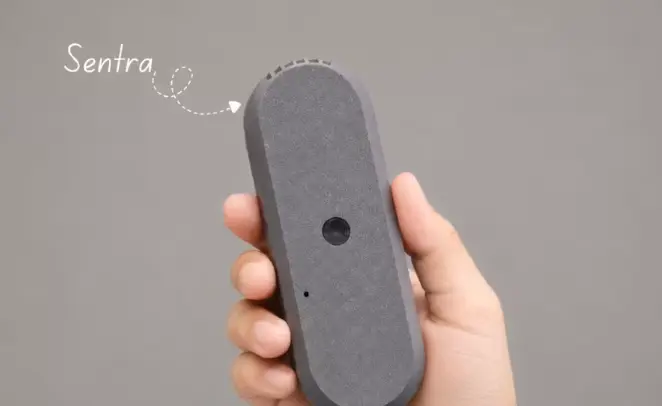
Sentra packs live Wi-Fi video streaming, continuous SD card recording, motion detection, automatic night vision, real-time sound monitoring, and voice announcements into a single battery-powered enclosure — the kind of feature list that would normally mean stitching together several separate modules. Here it all runs through one ESP32-S3 and an OV3660 camera sensor, with images captured directly in JPEG format and buffered in PSRAM to keep the frame rate usable while streaming.
The dashboard is a good detail for anyone building their own connected camera project: it is hosted as a static web page rather than requiring an app install, and simply connects to the camera’s IP address once both are on the same network — a much lower-friction setup path than building and maintaining a dedicated mobile app.
Components:
- ESP32-S3
- OV3660 Camera Sensor
- microSD Card Slot
- Battery Power with Rechargeable Cell
Full build log on Hackster.io.
3. IoT Based ESP32 Smart Terrarium
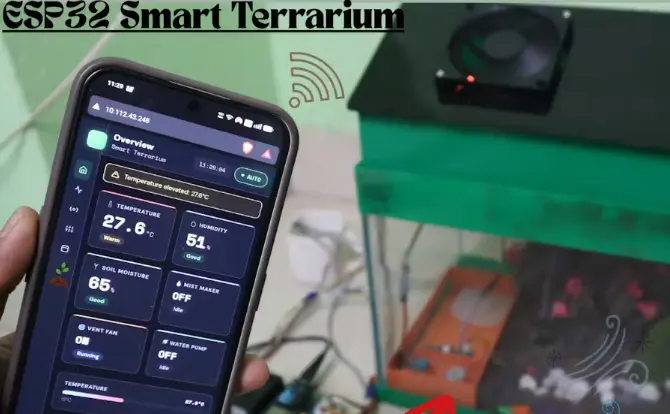
A terrarium needs three things kept in balance — temperature, humidity, and soil moisture — and this build automates all three with a single ESP32. A DHT11 sensor and mist maker are mounted together in a 3D-printed holder so the humidity reading is taken right where the mist is released, and three relay channels handle the fan, water pump, and mist maker independently, each triggered by its own threshold.
The web dashboard is a genuinely useful reference for anyone building a similar automated enclosure: it shows live readings and historical graphs for all three variables, supports a manual override mode alongside full automation, and lets you schedule misting events independently of the humidity sensor for plants that need it on a fixed timetable.
Components:
- ESP32
- DHT11 Temperature/Humidity Sensor
- Soil Moisture Sensor
- 3-Channel Relay Module (Fan, Pump, Mist Maker)
- 3D-Printed Sensor Housing
Full build log on Hackster.io, source code on GitHub.
4. IoT Energy Meter With ESP32, LoRa — Web Monitoring
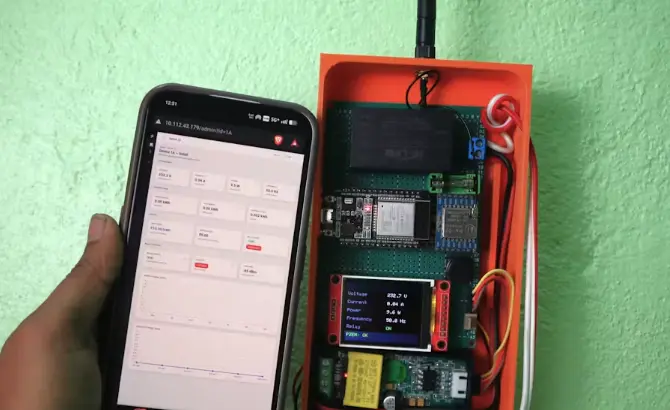
Wi-Fi-based energy monitors run into an obvious limit: they only work where Wi-Fi reaches. This project swaps that dependency for LoRa, splitting the system into two ESP32 units — a transmitter at the meter that reads voltage, current, power, and energy through a PZEM004T module and displays them on a TFT screen, and a receiver that can sit kilometers away, catching the LoRa packets and hosting a web dashboard for remote monitoring and load control.
The two-node, long-range split is the real takeaway here: any time Wi-Fi coverage is the bottleneck — a remote farm building, an outbuilding, a large property — this transmitter/receiver LoRa pattern is directly reusable for other sensor types, not just energy metering.
Components:
- ESP32 (×2, transmitter and receiver)
- PZEM004T Energy Metering Module
- SX1278 LoRa Module
- TFT Display (Transmitter), OLED Display (Receiver)
Full build log on Hackster.io, source code on GitHub, and a companion guide on Instructables.
Building Something Similar?
If you are prototyping an IoT monitoring project of your own, NextPCB’s free online Gerber Viewer and DFM tool is worth running your design through before ordering, and the NextPCB Accelerator program covers PCBA costs for qualifying open-source hardware projects.