NextPCB Capabilities
Printed Circuit Boards
NextPCB Capabilities
Printed Circuit Boards
 PCB Assembly
 Layer Buildup
 SMD-Stencils
 PCB Design-Aid & Layout
 Mechanics
 Quality
 Drills & Throughplating
 Factory & Certificate
 PCB Assembly Factory Show
Certificate
PCB Assembly Factory Show
Certificate

Support Team
Feedback:
support@nextpcb.com


Choosing the right automotive‑grade PCB supplier in 2026 requires far more than comparing prices. With vehicle electronics growing in complexity—from EV power management to ADAS and infotainment—the choice of manufacturer directly determines product reliability, safety, and certification success. This guide provides a structured framework for engineers and procurement teams to evaluate, compare, and partner with the best advanced PCB manufacturers. It integrates technical, regulatory, and operational insights so your next automotive project meets the highest global standards.
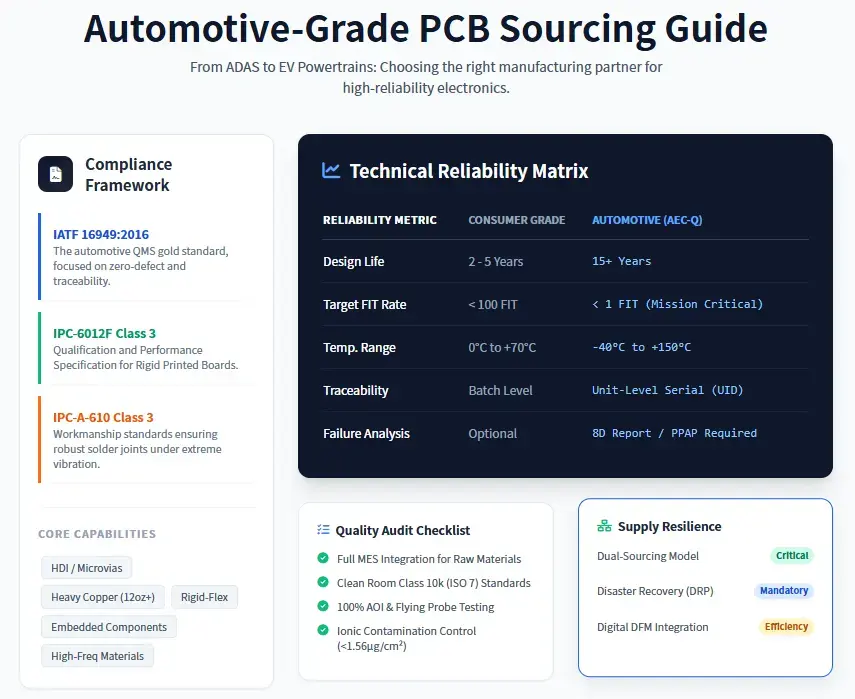
Automotive-Grade PCB Sourcing Guide: A technical overview comparing consumer-grade and AEC-Q automotive-grade printed circuit boards across key reliability metrics, accompanied by compliance standards (IATF 16949:2016, IPC-6012E Class 3, IPC-A-610 Class 3), a quality audit checklist, and supply chain resilience requirements.
Every effective supplier evaluation begins by clearly defining your PCB’s performance and compliance requirements. Automotive boards must withstand extreme heat, vibration, and humidity while maintaining signal integrity over years of service. Key design parameters include substrate materials (FR‑4, polyimide, metal cores), multi‑layer stackups, high‑temperature ratings, and rigorous impedance control.
Automotive PCB fabrication is governed by international standards that ensure consistency and traceability:
|
Technical Criterion |
Key Requirement |
Related Standard |
|---|---|---|
|
Thermal resistance |
–40°C to +150°C operation |
IPC‑6012F |
|
Vibration tolerance |
10–2000 Hz endurance |
IATF 16949 |
|
Solder joint reliability |
High‑temperature fatigue testing |
IPC‑A‑610 Class 3 |
|
Process traceability |
Serialized build records |
ISO 9001 / IATF 16949 |
Defining these specifications first helps shortlist suppliers capable of delivering to automotive‑grade expectations rather than general electronics standards.
Once requirements are clear, evaluate each candidate’s technical scope. Look for suppliers experienced in high‑complexity board fabrication that aligns with your design goals. Advanced automotive applications increasingly depend on technologies such as:
|
Capability |
Certification |
Testing Equipment |
Automotive Project Experience |
|---|---|---|---|
|
HDI, blind/buried vias |
IATF 16949, UL |
AOI, flying‑probe |
>10 EV projects |
|
Rigid‑flex multilayer |
ISO 9001 |
X‑ray, impedance test |
Dashboard modules |
|
Heavy copper up to 12 oz |
IATF 16949 |
Thermal shock, ICT |
Motor controller PCBs |
Where possible, review case studies or production data that prove consistent delivery for automotive OEM or Tier‑1 clients. NextPCB’s experience spans such complex projects, from EV power systems to advanced driver modules, supported by in‑house testing and rapid feedback mechanisms.
> Browse our High Tg PCB Capabilities
During the RFQ process, always request current certification copies with clear validity and scope. Confirmation of IATF 16949 compliance is a non‑negotiable factor—it ensures the supplier follows globally recognized automotive quality systems covering every production stage.
In parallel, evaluate how each manufacturer supports Design‑for‑Manufacturing (DFM). DFM software automatically checks layout data for manufacturability constraints such as minimum drill tolerances, solder mask clearances, and stackup consistency—catching issues before they reach fabrication.
NextPCB’s HQDFM performs over 1,200 checks for Gerber, ODB++, and KiCad files, providing real‑time production feedback within minutes. This collaboration between design and manufacturing reduces revisions, minimizes risks, and shortens time‑to‑market.
IATF 16949 compliance is a non-negotiable factor. In parallel, evaluate how each manufacturer supports Design-for-Manufacturing (DFM). NextPCB’s HQDFM performs over 1,200 checks for Gerber, ODB++, and KiCad files, providing real-time production feedback within minutes.
Quality assurance in automotive PCB manufacturing hinges on consistent in‑process verification. Reliable suppliers document each control step and provide traceable results. Key methods include:
Ask for representative process logs or PPAP (Production Part Approval Process) reports validating that control measures meet automotive acceptance levels. Reviewing defect data, yield statistics, and traceability tags provides assurance that the supplier’s process is robust and repeatable. NextPCB maintains detailed traceability and free prototype functional testing to help teams verify reliability early.
Before ramping to full production, run a pilot batch with explicit test plans covering electrical, thermal, and environmental performance. The first‑article acceptance step confirms the product aligns with all design and quality requirements.
Track any failure or scrap data and follow up on corrective actions. Key automotive validation checks include:
|
Validation Test |
Purpose |
Typical Acceptance Criteria |
|---|---|---|
|
Thermal cycling |
Assess solder fatigue and delamination |
≤0.1% failure after 1000 cycles |
|
Vibration testing |
Evaluate mechanical durability |
No trace breaks or cracks |
|
Electrical continuity |
Verify open/short conditions |
100% pass |
|
Functional test |
Confirm complete circuit operation |
As per OEM spec |
This data proves manufacturing readiness while eliminating latent process weaknesses before mass production. NextPCB supports pilot and NPI runs with full validation testing, ensuring that small-batch results scale reliably to volume production.
Supply stability is as critical as quality. A resilient automotive PCB supplier should maintain transparent raw‑material traceability, in‑house inventory, and dual‑source models for key inputs such as laminates and surface finishes.
Supply chain resilience refers to the supplier’s ability to anticipate, resist, and recover from disruptions through alternative sourcing, serialized traceability, and contingency planning. Evaluate warehouse capacity, transportation partners, and change‑control systems to gauge reliability.
Sustainability programs and responsible chemical management also play into long‑term OEM compliance, especially as global automotive supply chains move toward stricter carbon and recycling goals. NextPCB’s integrated digital manufacturing platform enhances transparency and shortens delivery cycles while maintaining stable material availability worldwide.
By 2026, automotive electronics will increasingly leverage high‑frequency materials, embedded components, and digital‑fabrication workflows that close the gap between EDA tools and production. Suppliers supporting these innovations will help you scale faster and stay compliant with next‑generation requirements.
When vetting manufacturers, distinguish between transactional vendors and integrated engineering partners.
|
Vendor Type |
Typical Approach |
Value to Automotive Teams |
|---|---|---|
|
Transactional fabricator |
Quote‑to‑order fulfillment |
Limited process support |
|
Engineering partner |
Co‑design, instant DFM, prototyping and NPI help |
Accelerates validation and launch |
NextPCB exemplifies the partnership model—offering instant DFM insight, rapid prototyping, and full IATF 16949: 2016 certification for automotive PCB manufacturing, compliant with automotive quality systems recognized in the United States, Germany, Italy, France, and Japan.

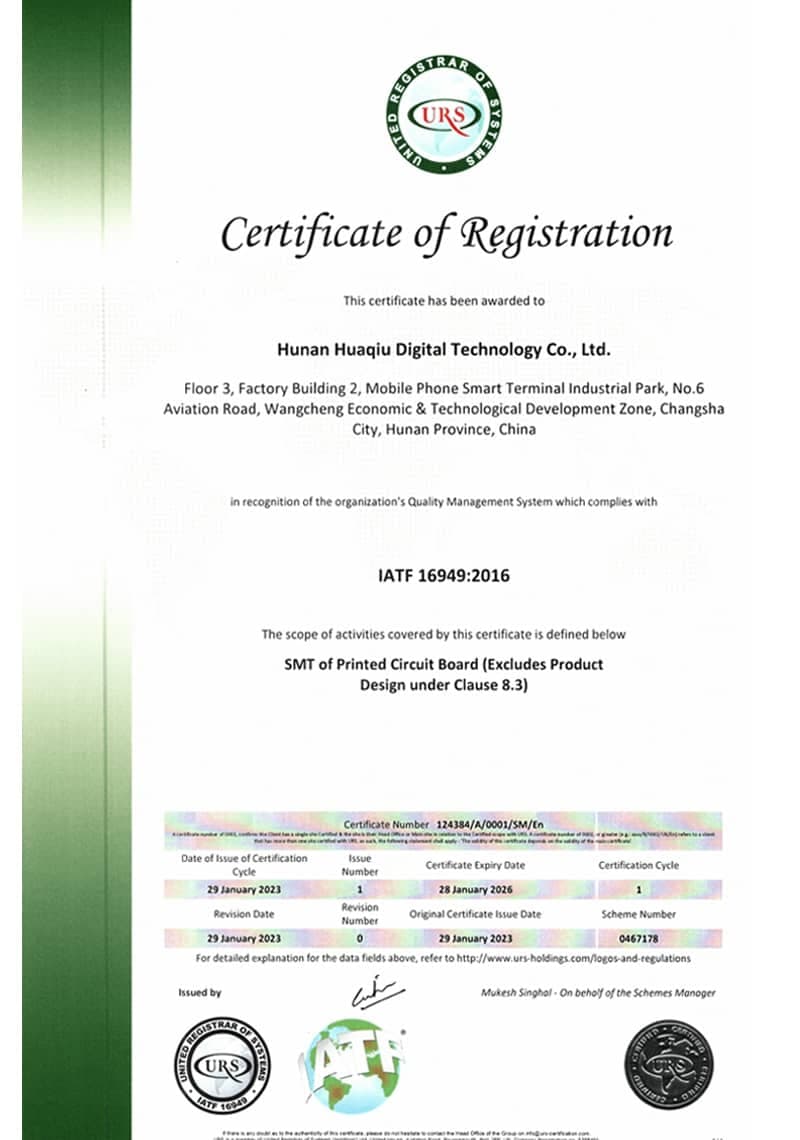

IATF 16949 and ISO 9001 are essential. NextPCB is certified for automotive PCB manufacturing according to IATF 16949: 2016, ensuring compliance with international automotive quality systems.
> Read More: Does Your PCB Supplier Have a Real Accountability Process? Here's What to Look For
AOI, X‑ray, ICT, flying‑probe, and environmental stress tests confirm reliability for automotive conditions. NextPCB applies these methods with documented traceability.
Assess multi‑sourcing, traceability, and inventory capacity. Digital manufacturers like NextPCB maintain stable material supply and global logistics visibility.
Use advanced DFM tools such as HQDFM to identify manufacturability issues before fabrication and align with production tolerances. >> Automotive PCB Design: IPC-6012DA, AEC-Q200 and What Makes Car-Grade Boards Different
Automotive standards like IATF 16949 and IPC‑6012F impose stricter traceability, environmental, and reliability requirements due to the demanding conditions of vehicular operation.
This 2026 guide provides a clear roadmap for sourcing automotive‑grade PCB manufacturers capable of delivering high‑reliability, certified boards that meet global standards. With robust certification, advanced capability, and transparent quality systems, partners like NextPCB help engineering teams accelerate development and build the future of automotive electronics with confidence.
>> Explore More
Still, need help? Contact Us: support@nextpcb.com
Need a PCB or PCBA quote? Quote now