PCB Assembly
Julia Wu - Senior Sales Engineer at NextPCB.com

 NextPCB Capabilities
Printed Circuit Boards
 Process Capabilities
 PCB Design-Aid & Layout
 Quality
 Drills & Throughplating
 Factory & Certificate
 PCB Assembly Factory Show
Certificate

Support Team
Feedback:
support@nextpcb.com



Ask anyone what powers the AI boom and they will say GPUs. But a GPU is useless without the parts around it: capacitors that steady its supply, power devices that convert hundreds of amps, connectors that move data at 224G per lane, optical modules that join racks together, and cooling hardware that keeps it all alive. Those parts are bought from the same distributors, and assembled on the same kinds of boards, as the components in your industrial, medical, automotive or networking product.
That is why AI demand is no longer only an "AI company" problem. When high-end parts are pulled toward data centers, lead times and prices move for everyone. This article focuses on where the pressure is greatest, with the most space given to three areas that get less attention than they deserve: 48V power devices, 224G connectors and optical modules. For topics we have already covered in depth, we link to those guides instead of repeating them.
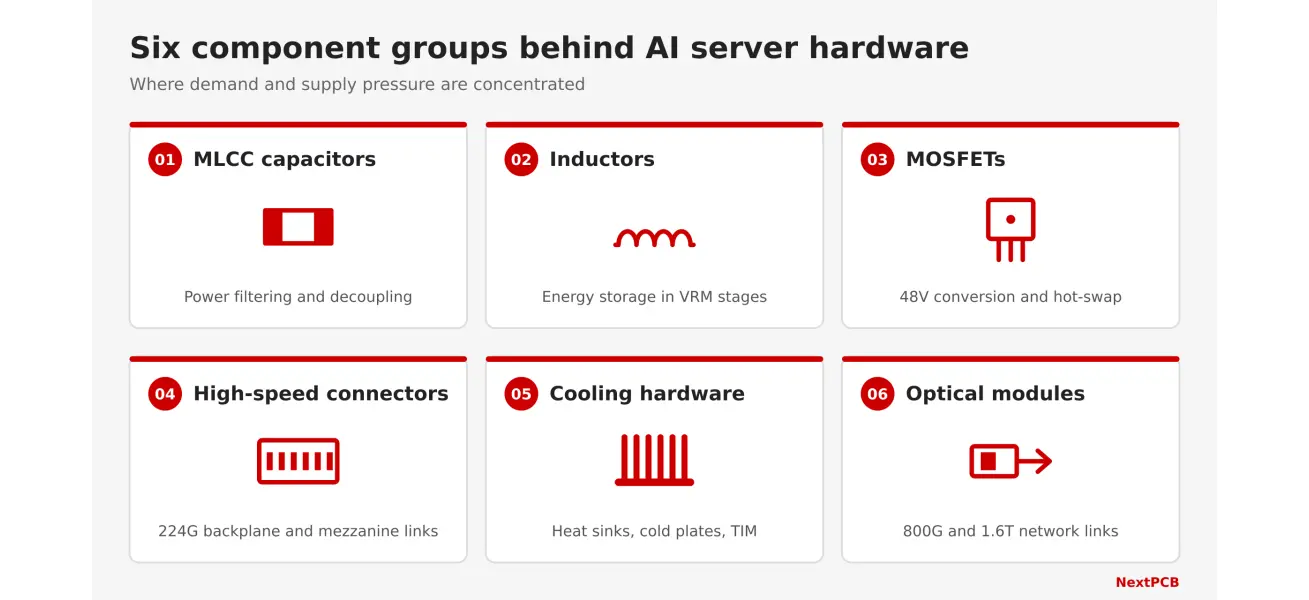
| Component group | Why demand is rising | Where to read more |
|---|---|---|
| MLCC capacitors | Thousands per accelerator board for decoupling; tight supply of high-capacitance parts | MLCC for AI server power delivery |
| Inductors and magnetics | High-current VRM and bus-converter stages | Power inductor selection and placement |
| MOSFETs and power devices | 48V conversion and hot-swap protection (covered below) | This article |
| High-speed connectors | 224G backplane, mezzanine and near-ASIC cable systems (covered below) | This article; see also 112G PAM4 board design |
| Heat sinks and thermal materials | Rack power density is pushing liquid cooling; thermal hardware is a reported bottleneck | Thermal management and liquid cooling integration |
| Optical modules | 800G today, 1.6T ramping (covered below) | This article |
MLCCs. Figures attributed to Murata put an ordinary server at roughly 2,200 to 4,000 MLCCs and an NVIDIA GB300-class AI server at about 30,000. TrendForce reported that book-to-bill ratios at Murata, Samsung Electro-Mechanics and Taiyo Yuden reached 1.30, 1.31 and 1.25 in late June, the highest since the pandemic, and said the fourth quarter will show whether the high-end segment becomes a full shortage. Distributor reporting has AI-related passive prices up 15% to 35% this year. For selection, sizes and decoupling strategy, read our MLCC guide; for sourcing tactics, see our article on the passive component shortage.
Inductors. High-current shielded and flat-wire inductors are harder to make than standard ferrite parts, and lead-time trackers saw inductors appear on watch lists as an early sign of wider passive tightening. Footprint, copper weight and thermal planning are covered in our power inductor guide.
Cooling. Flex notes that liquid cooling has become a necessity at the power levels of the latest AI processors, and Sourceability's Q3 lead-time report calls thermal management a key bottleneck, with lead times and prices expected to rise through Q4. Board-level techniques such as thermal vias, copper coins and stiffeners are covered in our guides on thermal management and liquid cooling integration.
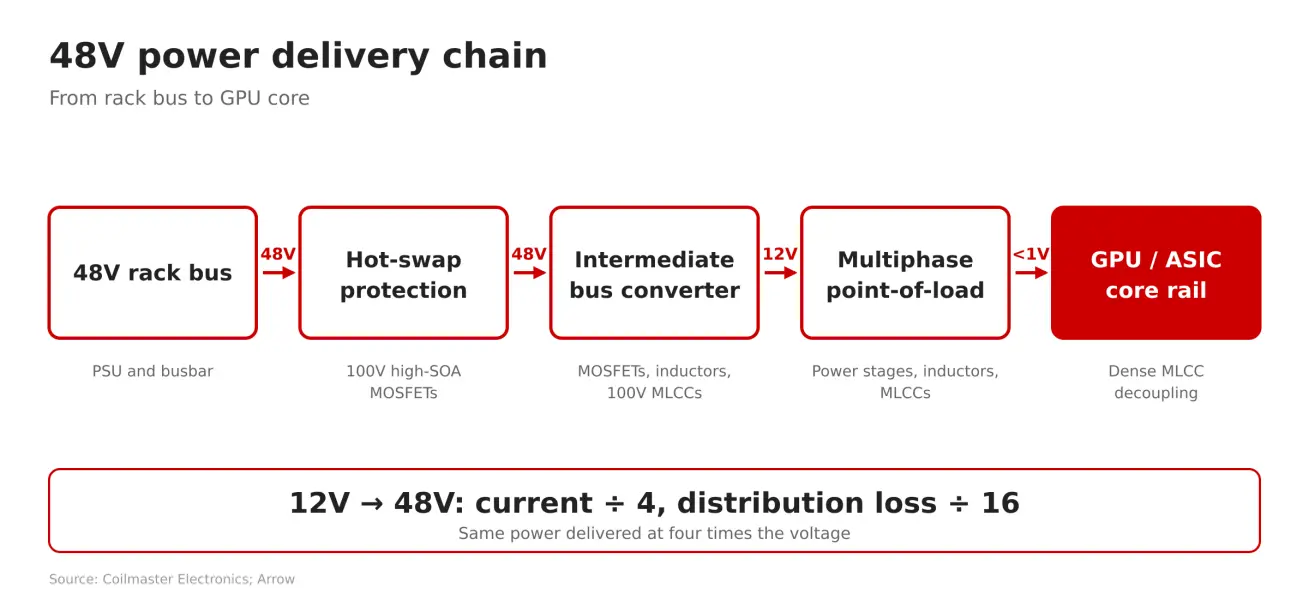
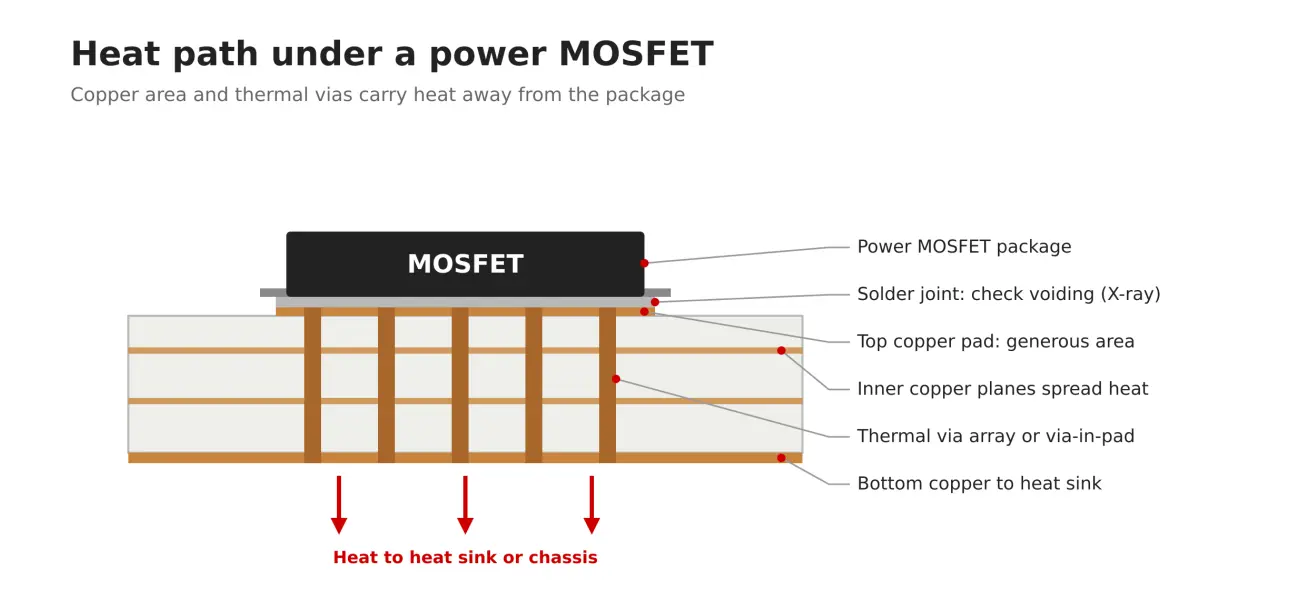
One of the quietest but most consequential changes in AI hardware is the move from 12V to 48V distribution. A magnetics supplier's technical note puts it plainly: quadrupling the voltage cuts current to a quarter and distribution losses by a factor of sixteen. In practice, a 48V bus feeds an intermediate bus converter that steps down to 12V, followed by multiphase point-of-load stages that supply the processor core, as described in Arrow's overview of AI power conversion.
Semiconductor makers have responded with parts built for this architecture:
What it means for your build:
At 224G PAM4, the connector is no longer a passive detail. As Altium's guidance on 224G design puts it, the connector and cable system become part of the channel from day one. The industry has moved quickly to support this. Molex offers a 224G portfolio that includes a genderless backplane system, a near-ASIC connector-to-cable system and an enhanced mezzanine board-to-board connector. TE Connectivity offers its own 224G cabled backplane and board-mount line.
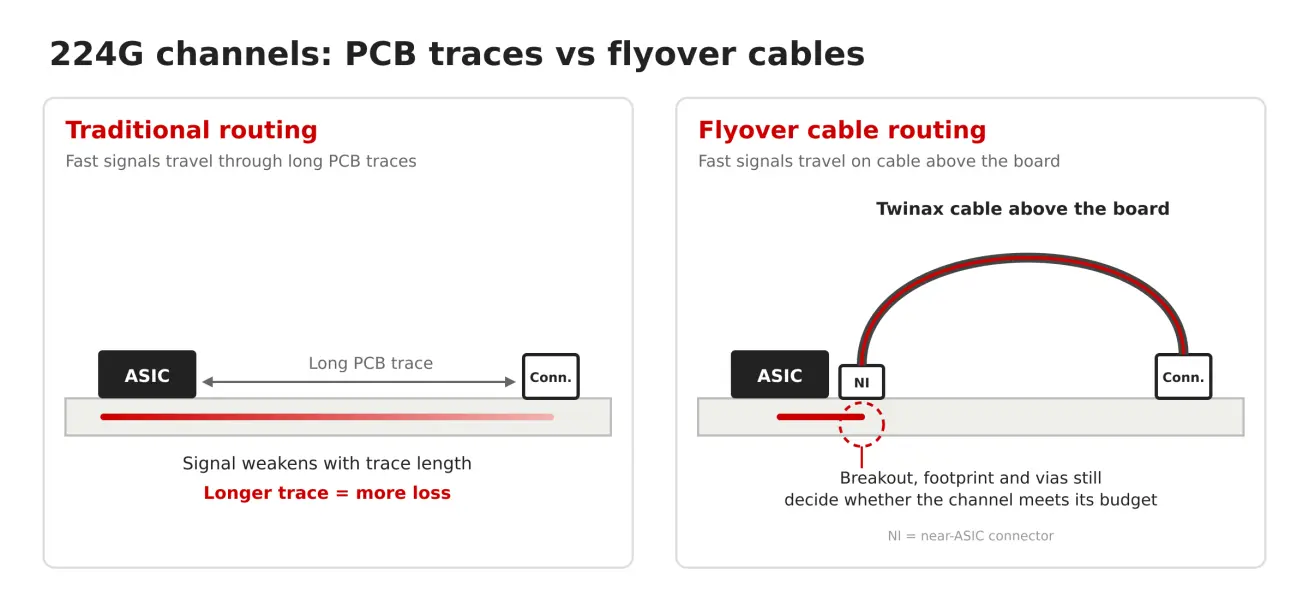
A notable design pattern is the "flyover" or near-chip cable: rather than running the fastest signals through long PCB traces, designers carry them above the board on twinax cable and attach it close to the ASIC. This lowers loss, but it does not make the board easier. The breakout region, the connector footprint and the nearby vias still decide whether the channel meets its budget. Molex also supports PCIe Gen 6 at 64 Gbps with its NextStream internal I/O family, a reminder that even "slower" internal links are getting tighter.
What it means for your build:
For material and stack-up choices at these data rates, see our guides on 112G PAM4 board design and high-speed PCB materials.
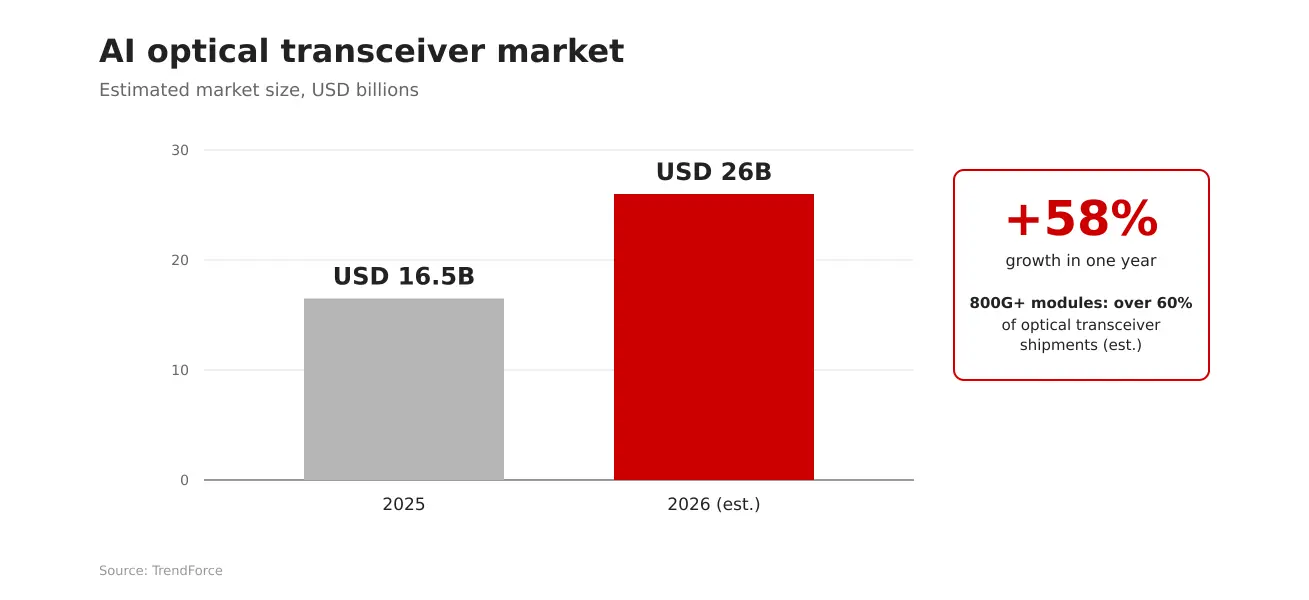
An AI cluster is only as useful as the network that joins it, and optics are scaling fast. Cignal AI reported that 400G and 800G module shipments nearly quadrupled in a year to more than 20 million units in 2024, with revenue above USD 9 billion. TrendForce now estimates the market for AI-focused optical transceivers will grow from about USD 16.5 billion in 2025 to USD 26 billion in 2026, and expects 800G-and-above modules to account for more than 60% of shipments this year.
Architecture is driving the numbers. TrendForce projects that Google's TPU deployments alone could generate demand for more than 6 million 800G-plus modules this year, and notes that moving a cluster from 800G to 1.6T can be done by swapping in faster modules rather than rebuilding the system. Looking further out, silicon photonics and co-packaged optics shift more of the work to wafer-level processes, and TrendForce sees this pulling new players, including outsourcing partners in Southeast Asia, into AI optical communications.
What it means for your build:
These component changes sit on top of a board story. According to TrendForce, NVIDIA's Rubin generation uses a 24-layer HDI switch tray with M8U-class materials, while some interface and midplane boards use M9-class materials with up to 104 layers. Industry commentary suggests such boards will be hybrid constructions that use premium materials only where the loss budget demands them. That is also why PCB capacity and laminate supply are tightening, which we explain in why AI demand is pushing PCB prices up. For stack-ups and via structures, see our HDI guide, and for an overview of what sits inside these systems, What Is an AI Server?
| Risk | What to do |
|---|---|
| Long-lead capacitors, inductors and power devices | Run a BOM availability check before layout freeze; flag high-capacitance, 100V and high-SOA parts first |
| Single-source dependency | Qualify alternates with the same footprint and ratings, and record them in the BOM |
| Connector and cage footprints | Use vendor-recommended footprints and share datasheets with your manufacturer before layout |
| Thermal surprises | Plan copper, thermal vias, stiffeners and heat-sink mounting at stack-up stage |
| Price swings between quote and build | Confirm pricing and stock at order time; consider partial or full turnkey sourcing to lock parts |
NextPCB is not a hyperscale rack builder, and this article does not claim we build the most extreme boards on the market. Where we fit is the broad group of AI-adjacent and high-reliability products: accelerator and edge-AI cards, power boards, networking and test hardware, and the prototypes and pilot runs that come before them.
Working on a design that leans on tight-supply parts or demanding signal integrity? Request a quote and send your BOM and stack-up for a manufacturability and sourcing review.
No. Analysts describe the tightness as concentrated in high-end and AI-grade parts. Many general-purpose components remain available, which is why checking each part number matters.
Higher bus voltage changes the ratings you need for MOSFETs, capacitors and protection circuits, and it affects spacing rules on the board. Those higher-rated parts are often the ones with the longest lead times.
Not necessarily. Match connector and module speed to your real bandwidth need and upgrade path. For many deployments, 800G is the practical choice today, with 1.6T as a planned upgrade.
Before layout is final. Stack-up, impedance targets, connector footprints and part availability are far cheaper to adjust on paper than after boards are built.

Still, need help? Contact Us: support@nextpcb.com
Need a PCB or PCBA quote? Quote now