NextPCB Capabilities
 PCB Assembly
 Layer Buildup
 SMD-Stencils
 PCB Design-Aid & Layout
 Mechanics
 Quality
 Drills & Throughplating
 Factory & Certificate



Quick answer
- Kingboard, a major copper clad laminate (CCL) supplier, has been reported to raise prices eight times in 2026. The latest round, reported on October 14, targets laminate and prepreg built on thin glass cloth (2116 and finer).
- Glass cloth itself rose again in October, and suppliers say large new capacity is not expected before the end of 2027.
- Laminate is only part of a board's cost, so a laminate increase reaches your quote as a smaller percentage, and usually with a delay.
- Your exposure depends on which prepreg styles are in your stack-up. That is worth confirming before your next order.
If a PCB quote came back higher than last quarter's, or a fabricator shortened its quote validity, you are probably seeing a raw-material cycle rather than a one-off. This article walks through what has been reported, how much of a board's cost laminate represents, why quotes move later than material prices, and what you can do about it. For the wider supply picture, see our guide to the 2026 PCB raw material shortage.
About the data. We have not seen the original price notices from Kingboard. Dates and percentages below come from financial media reports and, where noted, from company statements to reporters. Analyst forecasts are labeled as forecasts. Arithmetic examples are illustrations, not NextPCB pricing.
1. What the latest laminate price notices actually say
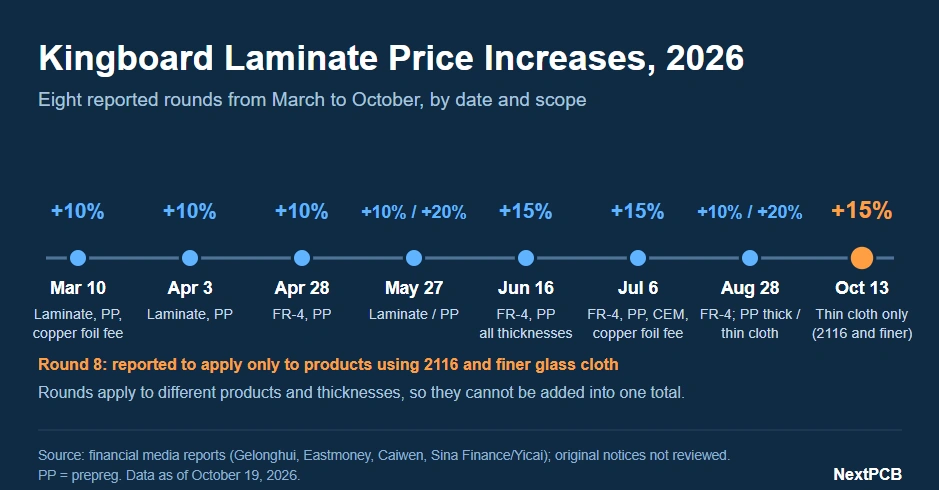
Kingboard: eight rounds in 2026
Media tallies list four earlier rounds in 2025 as well, so the "round number" you see in headlines depends on where the count starts. This table counts 2026 only.
| # | Date | Scope and size of increase (as reported) |
|---|---|---|
| 1 | Mar 10 | Laminate, prepreg (PP) and copper foil processing fee: +10% |
| 2 | Apr 3 | Laminate and PP: +10% |
| 3 | Apr 28 | FR-4 and PP: +10% |
| 4 | May 27 | Laminate +10%, PP +20% |
| 5 | Jun 16 | FR-4 and PP, all thicknesses: +15% |
| 6 | Jul 6 | FR-4 +15%, PP +15%, CEM +10%, plus a higher copper foil processing fee |
| 7 | Aug 28 | FR-4 +10%; PP with thick cloth (7628 and above) +10%, thin cloth +20% |
| 8 | Oct 13 (reported Oct 14) | Only laminate and PP using 2116 and finer cloth: +15% |
Sources: Gelonghui via QQ News (rounds 1–4), Eastmoney and Caiwen News (round 5), Gelonghui, reporting a Citi note (round 6), Sina Finance / Yicai (round 8).
Two details matter for round 8. A reporter's follow-up call reported that Kingboard did not raise thick-cloth products in this round. And Citi has said it expects another increase of roughly 10% in November or December (Futu News). That is a forecast, not an announcement.
Do not add the rounds up to a single "total increase." Because each rate applies to different thicknesses and cloth types, cumulative figures vary widely between media outlets and cannot be applied to every board.
Other laminate suppliers
- Panasonic: a notice dated August 6 raised standard multilayer laminate and prepreg by 30% for shipments from September 1, and low-loss materials (MEGTRON, XPEDION) by 15% (Jiemian).
- Nan Ya Plastics: +20% to +25% from September 1 (Xinhua Finance via 10jqka).
- Resonac: +30% from March 1, as reported by Taiwan News.
2. Why glass cloth is the pressure point
Glass cloth is a core ingredient of FR-4 laminate and prepreg. In October, domestic Chinese producers reported another round of increases: about 1.5 yuan per meter for 7628, 3,000 yuan per ton for G75 yarn, and about 2.5 yuan per meter for thin cloth such as 2116 and 1080, and several leading producers confirmed these to reporters (Cailian Press). In early September, 7628 traded at roughly 11.5–12.1 yuan per meter (Securities Daily). Citi estimates the year-to-date rise at 118%–165%, depending on the product.
Relief is not imminent. Industry sources quoted by Cailian Press say building new glass cloth capacity takes about 18 months, and large-scale capacity is expected only toward the end of 2027. Citi also notes that thin cloth has been rising faster than thick cloth (roughly 2.5 versus 1.5–1.6 yuan per meter per month in September and October).
3. How much of a PCB's cost is laminate?
Industry research summaries put raw materials at about 60% of the cost of a typical PCB, with copper clad laminate at about 30% of total PCB cost (Stockstar research summary). Within the laminate, one dated industry breakdown (2021) shows copper foil at roughly 40–43%, resin at about 26% and glass cloth at about 19–20% (Qianzhan). Because glass cloth has since roughly doubled, treat those internal shares as directional only. Shares are also higher for thicker, high-layer-count and AI-grade boards, and sources do not agree on exact figures.
Illustration (arithmetic only): board cost increase ≈ laminate share × laminate price increase.
- 30% share × 20% laminate increase ≈ 6% higher board cost
- 30% share × 100% laminate increase ≈ 30% higher board cost
Your real number depends on layer count, laminate grade, copper weight, surface finish and volume, so use this to sanity-check a quote rather than predict one. For the other drivers, see our PCB cost guide.
4. Why your quote moves later than the material price
- Locked contracts. Reports describe PCB makers absorbing the increases in the first half because of long-term pricing with customers, which squeezed margins (Securities Times).
- Repricing at delivery. Some board makers have started to base new orders on the material cost at delivery time, not at order date (Economic Observer).
- Customer segments differ. The same report says communications and automotive customers began accepting 20%–30% increases from July, and some urgent orders rose by more than 40%, according to an analyst. Treat this as market commentary, not a price list.
In practice, a quote that looked stable in spring may not hold in Q4, and a repeat order can price higher than the original.
5. Is your stack-up exposed? A quick self-check
- List the prepreg styles in your stack-up (for example 7628, 2116 or 1080). Round 8 was reported to apply to 2116 and finer cloth. We have no source showing which board types are more affected, so confirm with your fabricator's engineers.
- Check your laminate grade. Standard FR-4, high-Tg and low-loss materials have been repriced differently. Our material selection guide explains when each grade is justified.
- Compare quotes on the same basis: same stack-up, material, finish and quote validity date.
- Look at your schedule. If a design is final, ordering sooner or consolidating volume may reduce exposure to further increases. If it is not, a material review now is cheaper than a respin later.
Get a quote with the material confirmed up front
Send us your Gerber files and target stack-up. We will check the materials and layer structure with you before you commit.
Request a PCB quoteFrequently asked questions
Will PCB prices come down soon?
Suppliers cited by Cailian Press do not expect large new glass cloth capacity before the end of 2027, and Citi forecasts a further laminate rise this winter. Nobody can promise a date for relief.
Does a 15% laminate increase mean a 15% higher quote?
No. If laminate is about 30% of board cost, a 15% laminate rise is roughly 4.5% on the board, before any other changes. See section 3.
Why do different articles give different totals for Kingboard's increases?
Each round applies to different products and thicknesses, and media count from different start dates. We list the individual rounds instead.
Sources
- Kingboard rounds: Sina Finance; 10jqka; QQ News; Eastmoney; Caiwen News; Gelonghui (Citi note); Futu News
- Other suppliers: Jiemian; Xinhua Finance
- Glass cloth: Cailian Press; Securities Daily
- Cost structure and pass-through: Stockstar; Qianzhan; Securities Times; Economic Observer