Blog / PCB Mass Production Guide: Key Steps from Prototyping to Scaling Up
PCB Mass Production Guide: Key Steps from Prototyping to Scaling Up
Posted: February, 2025Last Updated: February, 2026Writer: Robin
Share:
In the PCB industry, whether users have completed pcb prototyping or have yet to start, pcb mass production is a critical phase that requires careful planning and deep consideration. This article provides practical advice on pcb mass production from two perspectives: for users who have completed pcb prototyping and those who have not, helping you achieve the optimal balance of quality, efficiency, and cost at high volumes.
For Users Who Have Completed PCB Prototyping: How to Transition Smoothly to Mass Production?
For users who have finished pcb prototyping, the goal of pcb mass production is to rapidly and stably scale up the design validated in small batches to large-scale production. However, mass production is not just about replicating quantity, it is a comprehensive challenge involving cost, yield rate, supply chain security, and compliance. Here are four key steps for a smooth transition from design verification to mass production:
1. Evaluate Prototyping Results and Optimize Design
The primary purpose of the pcb prototyping phase is to validate the feasibility and functionality of the design. Before moving to pcb mass production, a comprehensive evaluation of the prototyping results is essential:
Performance Validation: Ensure the PCB's performance meets expectations, including signal integrity, power stability, and heat dissipation.
Process Compatibility: Check for design flaws (e.g., small pads, dense routing) that may not be apparent in small batches but could significantly impact yield in large-scale production.
Material Compatibility: Confirm that the selected materials (e.g., substrate, surface treatment) are suitable for pcb mass production, avoiding interruptions due to material shortages or high costs.
2. Deep Communication with PCB Manufacturers
Some people may choose small PCB factories for prototyping, while pcb mass production requires selecting PCB manufacturers with scaling capabilities. When switching PCB manufacturers, pay attention to:
Quality and Safety Compliance Certification: The factory must be verified to hold ISO 9001 and ISO 14001 certification. Industry-specific certifications are required for specialized fields, such as IATF 16949 for automotive electronics and ISO 13485 for medical electronics. Products must possess UL certification (crucial for US/Canada exports) and comply with RoHS/REACH environmental directives to ensure global market compliance. View NextPCB's Certifications
Process Consistency: Ensure that the process parameters for mass production are consistent with those during prototyping to avoid performance issues due to process differences.
Equipment Compatibility: Confirm that the manufacturer's production equipment supports your design requirements (e.g., HDI, blind/buried vias).
Delivery Times and Costs: The delivery time and cost of mass production are core considerations; clarify production cycles and quotation details with the manufacturer.
Packaging Protection: Mass production PCB transport is different from prototype. Moisture-proof vacuum packaging, desiccant placement, and outer box strength need to be specified to prevent oxidation or physical damage during sea/air transport process.
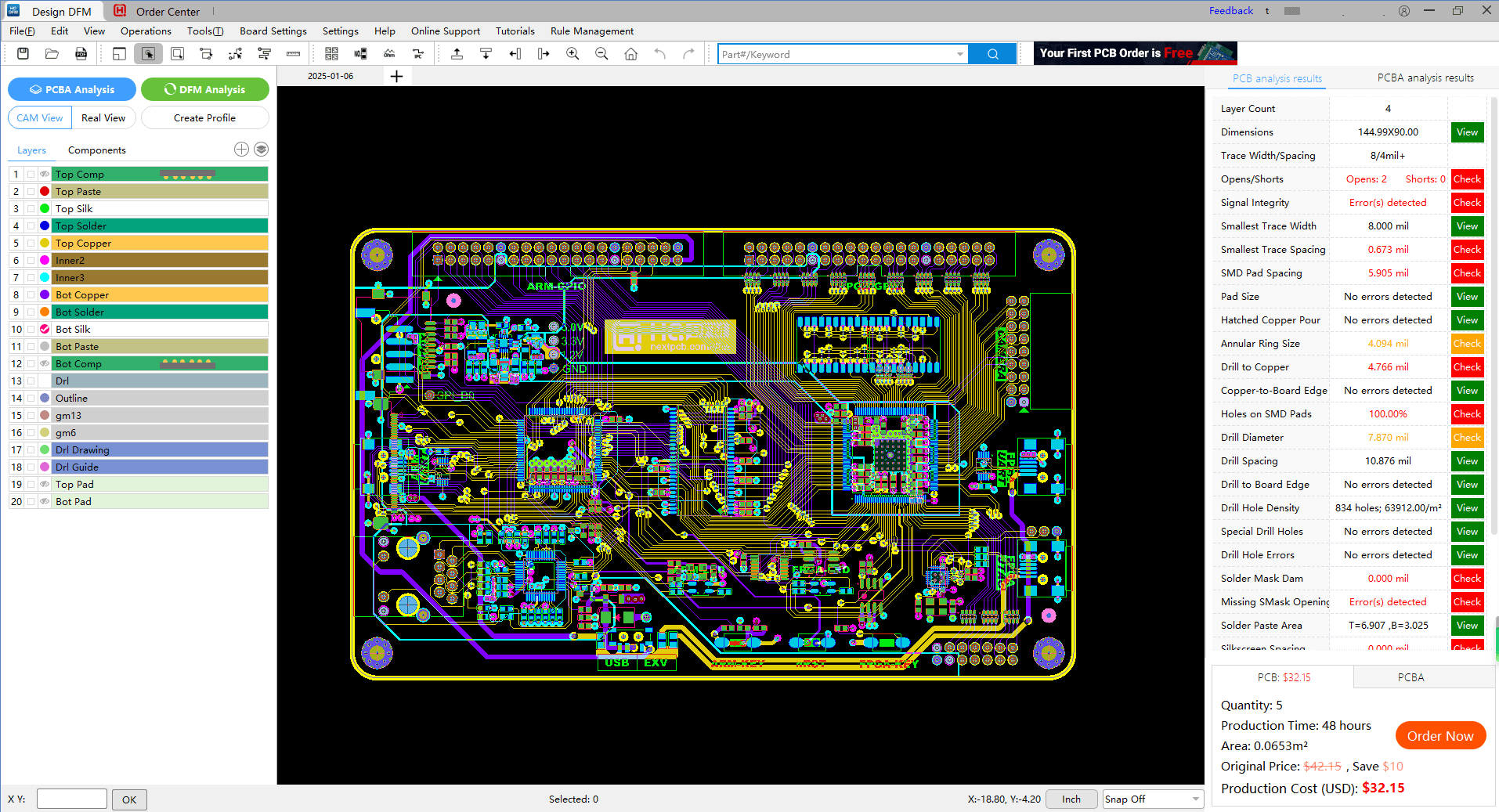
3. Implement Design for Manufacturability (DFM) Optimization
DFM is a core component to ensure smooth mass production. DFM analysis can help identify and address potential issues in advance:
Pad and Routing Design: Optimize pad sizes and routing spacing to ensure compatibility with mass production equipment.
Lamination and Drilling Design: Plan the lamination sequence and drilling locations reasonably to reduce material waste during production.
Test Point Design: Add necessary test points to facilitate quality inspection during mass production.
Quality control in PCB mass production is more complex than in the prototyping phase, requiring the establishment of a comprehensive quality management system:
First Article Inspection (FAI): Conduct a thorough inspection of the first article sample before mass production to ensure it matches the design.
Process Monitoring: Use Automated Optical Inspection (AOI) and X-ray inspection to identify soldering defects or short circuits in real time.
Reliability Testing: Include thermal cycling tests, vibration tests, and electrical performance tests to ensure product stability in extreme environments.
For Users Who Have Not Started PCB Prototyping: How to Plan for PCB Mass Production in Advance?
For users who have not yet begun PCB prototyping, considering PCB mass production early can help avoid potential issues during the design phase and reduce subsequent costs. Here are key recommendations:
1. Define Product Requirements and Goals
Before starting the design, clarify the product's functional requirements, target market, and budget range. For example:
Product Type: Is it a consumer electronic product, industrial equipment, or medical device? Different fields have varying performance requirements for PCBs.
Estimated Volume: What is the expected scale of mass production? This will directly influence material and manufacturer selection.
Cost Control: How to optimize the design to reduce production costs while ensuring performance?
2. Choose Design Solutions Suitable for PCB Mass Production
Considering the feasibility of mass production during the design phase can significantly reduce the cost of later adjustments:
Standardized Design: Use standardized components and design specifications whenever possible to minimize customization needs.
Modular Design: Decompose complex circuits into multiple modules to facilitate future maintenance and upgrades.
Scalable Design: Ensure the design can adapt to potential future performance upgrades or feature expansions.
3. Collaborate Early with Manufacturers
Before prototyping, establish contact with potential mass production PCB manufacturers to gain valuable insights:
Process Consultation: PCB manufacturers can recommend suitable processes and materials based on your design requirements.
Cost Estimation: Understand the cost structure of PCB mass production in advance to help optimize your design.
Delivery Planning: Learn about the PCB manufacturer's production capacity and delivery times to ensure alignment with your project schedule.
4. Simulation and Testing
Before PCB prototyping, using simulation software for circuit performance simulation and thermal analysis can help identify potential issues early:
Signal Integrity Analysis: Ensure stable performance of high-speed signal lines to avoid signal degradation and interference.
Thermal Management Analysis: Optimize heat dissipation design to prevent performance degradation or component damage due to overheating.
Reliability Analysis: Simulate product performance under different environmental conditions to ensure durability.
Conclusion
PCB mass production is a complex but crucial process. For users who have already enjoyed the prototype services, the focus is on optimizing design and selecting a reliable PCB manufacturer; for those who have not yet prototyped, planning for mass production in advance can help avoid potential issues during the design phase. Regardless of the stage, keeping up with industry trends and technological innovations is key to enhancing competitiveness. Especially when switching manufacturers, ensuring process consistency and quality stability is essential. Choosing a manufacturer with scalable capabilities and confirming their equipment compatibility and production capacity helps effectively avoid potential performance issues and unnecessary risks, ensuring smooth mass production.
1. How to minimize the cost per board during mass production?
The largest cost item in mass production is usually the material utilization rate.
Panelization Optimization: Adjust the spacing or orientation of the panel to minimize the waste rate of the production panel.
Process Downgrading: Check if high-cost processes (like blind/buried holes, thick copper, high number of layers) are truly necessary. If a 6-layer board can be optimized to a 4-layer board, or if the line width and spacing can be controlled above 0.1mm (4mil), the cost will significantly decrease.
2. Why do tests passed in prototype stage show impedance mismatches in mass production?
In prototype production, impedance control is typically in a "Best Effort" mode. However, in mass production, variations in the dielectric constant (Dk), consistency of copper thickness, and etching undercut can affect impedance.
Solution: Before mass production, request an impedance calculation report from the factory and ask to add impedance coupons at the panel edge for batch testing.
3. What is the AQL standard in PCB production?
Acceptable Quality Level is key in mass production sampling inspections. It is impractical to conduct comprehensive laboratory tests (like cross-section tests) on every board. The IPC-A-600 standard is typically used to set sampling ratios according to the product application class (Class 1, 2, 3) to determine the acceptance of a batch.
4. Why limit the size of vias in mass production?
Although modern processes can achieve very small diameters (like 0.15mm), in the production of tens of thousands of boards, these tiny holes can increase drill breakage rates and uneven plating.
Recommendation: Unless necessary, production designs should aim to increase hole diameter tolerance. This improves yield and significantly shortens drilling processing time.
5. When should one switch from Flying Probe testing to Bed of Nails testing?
Flying Probe Testing: Suitable for prototypes and small batches production; does not require fixtures, but testing each board takes longer.
Bed of Nails Testing (ICT): Suitable for mass production. While it incurs fixture costs, testing each board takes only seconds. When production quantities exceed 500-1000 units, the cost and time advantages become very apparent.
6. What are the risk differences between "tenting vias" and "via plugging/filling" in mass production?
In the prototype stage, simple tenting vias generally pose no issues. However, in mass production, residual chemicals in tenting vias could lead to long-term reliability issues. For high-density boards, it is recommended to explicitly require via plugging/filling processes to ensure impedance flatness and corrosion resistance.
7. What is a "Golden Sample" and what is its role?
A Golden Sample is a finalized prototype that has passed all functional tests, meets all quality benchmarks, and has been formally approved by the customer. It serves as the absolute reference standard for mass production. In the event of a quality dispute or performance deviation during batch production, the Golden Sample is used as the definitive benchmark for arbitration regarding aesthetics, dimensions, and electrical performance.

 NextPCB Capabilities
 Process Capabilities
 PCB Design-Aid & Layout
 Quality
 Drills & Throughplating
 Factory & Certificate
 PCB Assembly Factory Show
Certificate
PCB Assembly Factory Show
Certificate






 PCB Assembly