

 NextPCB Capabilities
 PCB Assembly
 Layer Buildup
 SMD-Stencils
 PCB Design-Aid & Layout
 Mechanics
 Quality
 Drills & Throughplating
 Factory & Certificate

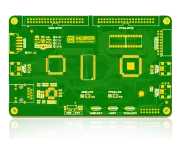
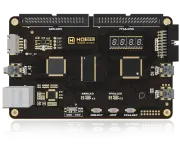


Transparent PCB is no longer a lab curiosity or a hobbyist novelty — it's a real, manufacturable board category with defined material specs, established quality standards, and live commercial applications. A transparent PCB (also called a transparent circuit board) uses an optically clear laminate in place of standard opaque FR4, so the substrate itself — not just the finish — is see-through, with copper traces and components visible against a clear background.
This is a different technology from the glass substrate used in advanced semiconductor packaging. Glass substrate replaces the organic core layer inside a chip package to solve warpage and interconnect-density problems at the die level. Transparent PCB is a board-level product — a resin-based laminate engineered for optical clarity rather than semiconductor-grade precision — and it's already accessible for real product designs today, not years away on a commercialization roadmap.
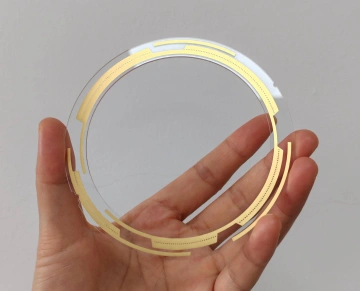
Transparent PCB ring-shaped circuit board held in hand, showing copper traces visible through the clear substrate
What Makes a PCB "Transparent" — Material Basics
Transparent PCBs are built on halogen-free, optically clear resin laminates rather than the glass-fiber-reinforced epoxy used in standard FR4. Because the resin itself needs to transmit light rather than just insulate, formulations are engineered differently from conventional laminate — trading some of FR4's raw mechanical toughness for optical performance. Current transparent PCB laminates are typically available across a wide thickness range, from ultra-thin flexible films up to several millimeters for rigid boards, which is why transparent PCB technology spans both rigid and flexible board categories.
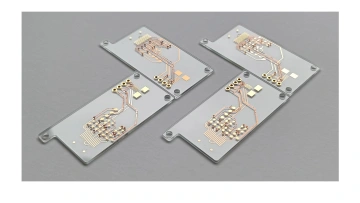
Four rigid transparent PCB boards on a gray background showing visible copper circuit traces
Typical Performance Characteristics
Performance varies by specific formulation, but current transparent PCB materials generally fall within these ranges:
| Property | Typical Range |
|---|---|
| Glass transition temperature (Tg) | ~105–135°C |
| Thermal decomposition temperature | ≥305°C |
| Light transmittance | ~55–90%, depending on thickness and formulation |
| UV barrier | Up to ~85% |
| Dielectric constant (Dk) | ~3.9–4.0 |
| Dissipation factor (Df) | ~0.016–0.025 |
| Flexural strength | ~330–430 MPa |
| Moisture absorption | ~0.15–0.8% |
| Halogen content | Halogen-free compliant (Cl and Br each well under industry RoHS-aligned thresholds) |
These figures are meant to give a realistic planning baseline — for a specific project, actual values depend on the exact laminate and layer stack chosen, so we'd recommend confirming specs directly for your design.
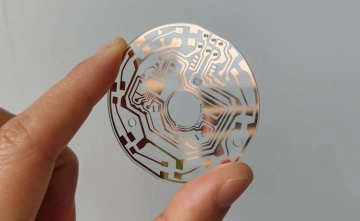
Close-up of a circular transparent PCB with intricate copper circuit traces held between two fingers
Real-World Applications
Transparent PCB adoption today clusters around a few recurring use cases:
- Exposed-design keyboards and input devices: where the circuit itself becomes part of the visual design language rather than being hidden inside an enclosure.
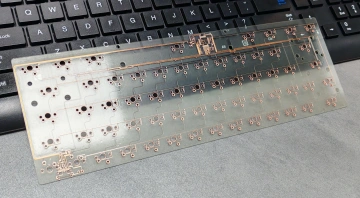
Transparent keyboard PCB with visible circuit traces placed on top of a physical keyboard
- Wireless charging coil boards: where transparency lets the coil and supporting circuitry sit visibly inside a translucent housing.
- Branded power and control boards: where a visible PCB communicates a premium or tech-forward product identity at the point of sale or in packaging.
- RF and optical pass-through applications: where the board needs to physically sit in the light or signal path without blocking it.
Why Transparent PCB Isn't a Drop-in FR4 Replacement
It's tempting to treat transparent PCB as "FR4, but see-through" — it isn't, and treating it that way leads to design problems late in the process. A few real trade-offs worth planning around upfront:
- Multilayer feasibility varies by design and needs to be confirmed case by case. Rigid transparent PCBs can support multilayer stacks, and flexible transparent boards can as well, but the achievable layer count depends on your specific thickness, flexibility, and material requirements — it isn't a fixed number that carries over directly from standard FR4 layer-count assumptions. If your design needs a specific layer count, especially in a flexible form factor, it's worth confirming feasibility with our team early rather than assuming parity with standard flex PCB.
- Visual defects are inspection criteria, not just cosmetic issues. Because the substrate itself is visible, quality standards for transparent PCB explicitly define acceptable limits for things like embedded impurities, surface dents, and visible scratches — defects that would simply be invisible (and irrelevant) on an opaque FR4 board. This means transparent boards carry inspection requirements that don't exist in standard PCB manufacturing at all.
- The cost premium is real and structural, not just a market-positioning markup. Optically clear laminate is a lower-volume, more specialized material than standard FR4, and the added visual-inspection step increases process overhead. Budgeting for a meaningful per-unit premium over standard FR4 from the start avoids surprises later in sourcing.
Is Transparent PCB Right for Your Project?
Transparent PCB makes sense when the board itself is part of the product's visual identity — exposed-design consumer electronics, premium branding, or applications where something physically needs to see or be seen through the board. It's generally the wrong choice on cost grounds for purely functional applications hidden inside an opaque enclosure, where standard FR4 will do the same electrical job at a fraction of the cost.
Because transparent PCB projects tend to be design-specific — thickness, layer count, and finish all depend heavily on the end application — this isn't really a self-serve, instant-quote category the way a standard two-layer FR4 board is.
If you're evaluating transparent PCB for an upcoming design, the fastest path is talking directly with our team about your specific layer count, thickness, and finish requirements. Contact our sales team, or if you'd rather skip the back-and-forth, you can book a 30-minute call directly with a sales manager to walk through your project.
Frequently Asked Questions
Is transparent PCB as durable as standard FR4?
Not entirely — transparent laminates generally trade some mechanical toughness for optical clarity, so flexural strength and moisture resistance can run somewhat lower than high-performance FR4 grades. For most exposed-design applications this is a reasonable trade-off, but it's worth confirming against your specific mechanical requirements.
What thickness options are available?
Transparent PCB materials are currently available across a wide range, from thin flexible films up to several millimeters for rigid boards. Exact options depend on the specific application — contact our sales team with your target thickness and we can confirm feasibility.
Can transparent PCB support multilayer designs?
Multilayer transparent PCB — rigid or flexible — is available, but layer count and feasibility depend heavily on your specific design and thickness requirements. Because this varies case by case, we recommend confirming multilayer feasibility directly with our team before finalizing your layer stack.
How does pricing compare to standard PCB?
Transparent PCB carries a real cost premium over standard FR4, driven by specialized material and additional visual-inspection requirements. Because pricing depends heavily on your specific design, the most accurate way to get a number is to talk directly with a sales manager about your project.
Can I get a prototype sample?
Yes — prototyping is the recommended first step for any transparent PCB project given how design-specific the material and process requirements are. Reach out to our sales team to discuss prototype options for your design.
Transparent PCB is one branch of the broader transparent substrate landscape we cover in this series — see our companion articles on glass substrate, through-glass via (TGV) technology, and glass core substrate vs. glass interposer for the semiconductor-packaging side of this technology family.