

 NextPCB Capabilities
 PCB Assembly
 Layer Buildup
 SMD-Stencils
 PCB Design-Aid & Layout
 Mechanics
 Quality
 Drills & Throughplating
 Factory & Certificate



TL;DR — RJ45 is the industry-standard 8-pin modular connector behind virtually every Ethernet link, from office LANs to industrial automation networks. This guide walks through connector construction, T568A/B wiring, Cat5e–Cat8 selection, common failure modes, and when it makes engineering sense to move from off-the-shelf patch cables to a custom cable assembly. At the end, you'll find a direct link to get an engineering quote for a custom RJ45 harness, with a 1-piece minimum order.
1. What Is an RJ45 Connector
RJ45 (short for "Registered Jack 45") is an 8-position, 8-contact modular connector that has become the de facto interface for twisted-pair Ethernet. Its physical dimensions are governed by the IEC 60603-7 connector family, while pinout and electrical performance requirements trace back to the ANSI/TIA-568 cabling standards.
A few design characteristics explain why RJ45 has outlasted earlier interfaces like coaxial Ethernet and RJ11 telephone jacks:
- Four twisted pairs (8 conductors) that are naturally suited to differential signaling at full-duplex Gigabit speeds and beyond.
- A modular IDC (insulation displacement) termination, which lends itself well to both field termination and high-volume automated crimping.
- A reliable mechanical latch, typically rated for 750+ mating cycles under IEC 60512 test conditions.
RJ45 today shows up far beyond the office network — it's built into industrial Ethernet hardware (including M12-coded variants), CCTV and PoE camera systems, telecom equipment, and increasingly, in-vehicle networking.
2. Anatomy of an RJ45 Connector
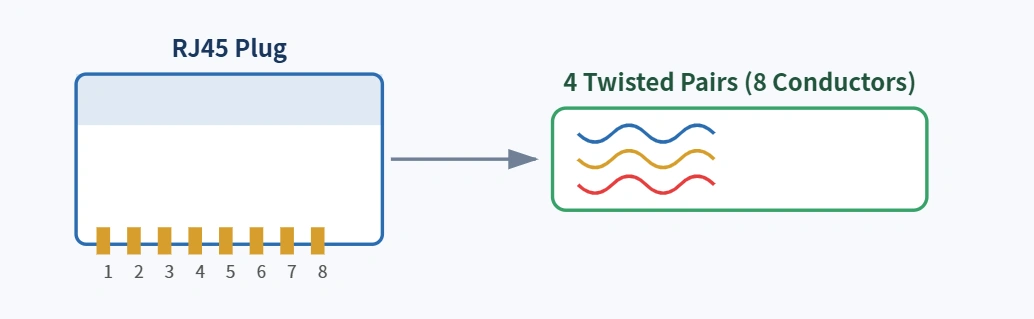
Figure 1. Inside an RJ45 plug, eight numbered pins (1–8) terminate to four twisted pairs of conductors.
3. T568A vs. T568B Wiring Standards
T568B is the more widely used standard in commercial installations across North America and much of the world, while T568A tends to show up in government/military specs and some residential wiring codes. Electrically, the two are identical — the only difference is that the orange and green pairs swap positions. What matters is consistency: both ends of a straight-through link need to use the same standard. A crossover cable, by contrast, deliberately uses A on one end and B on the other.
| Pin | T568A Color | T568B Color | Signal (100/1000BASE-T) |
|---|---|---|---|
| Pin 1 | White/Green | White/Orange | BI_DA+ / TX+ |
| Pin 2 | Green | Orange | BI_DA- / TX- |
| Pin 3 | White/Orange | White/Green | BI_DB+ / RX+ |
| Pin 4 | Blue | Blue | BI_DC+ |
| Pin 5 | White/Blue | White/Blue | BI_DC- |
| Pin 6 | Orange | Green | BI_DB- / RX- |
| Pin 7 | White/Brown | White/Brown | BI_DD+ |
| Pin 8 | Brown | Brown | BI_DD- |
Engineering note: Gigabit and higher speeds (1000BASE-T, 2.5G/5G/10GBASE-T) use all four pairs for bidirectional differential transmission. A single marginal pair connection can noticeably degrade link stability or force a lower auto-negotiated speed — which is exactly why factory-terminated harnesses lean on continuity and crimp-consistency testing rather than a visual check alone.
4. RJ45 Cable Categories Compared
Bandwidth, shielding, and reach vary considerably across RJ45 cable categories. The table below summarizes the practical engineering parameters defined across the TIA/EIA-568 standards family:
| Category | Bandwidth | Typical Max Speed | Shielding | Common Use |
|---|---|---|---|---|
| Cat5e | 100 MHz | 1 Gbps (100 m) | Usually unshielded (UTP) | Office and home networks |
| Cat6 | 250 MHz | 1 Gbps (100 m) / 10 Gbps (≤55 m) | UTP or FTP | Enterprise access-layer, data center edge |
| Cat6a | 500 MHz | 10 Gbps (100 m) | Shielded (F/UTP, S/FTP) | High-density server rooms, industrial Ethernet |
| Cat7 | 600 MHz | 10 Gbps (100 m) | Dual-shielded (S/FTP) | High-EMI environments, structured cabling |
| Cat8 | 2000 MHz | 25/40 Gbps (≤30 m) | Shielded (S/FTP) | Short-reach data center rack-to-rack links |
Connectors can also be specified by male/female orientation, straight-through vs. crossover wiring, shielded vs. unshielded housing (for EMI suppression), and ruggedized/waterproof variants with locking threads for outdoor or industrial use. Industrial automation and outdoor telecom gear, in particular, tend to call for reinforced RJ45 connectors that can shrug off vibration, dust, and moisture.
5. Where RJ45 Connectors Are Used
Figure 2. RJ45 connectors are used across enterprise networking, industrial automation, telecom, and automotive applications.

RJ45 also turns up regularly in security and surveillance systems (NVRs, PoE cameras), networked medical devices, and building automation — projects where cable neatness, EMI immunity, and long-term reliability matter enough that a custom-terminated cable assembly usually outperforms a generic patch cable pulled off a shelf.
6. What to Consider When Sourcing RJ45 Cables
| Factor | What It Means | Engineering Recommendation |
|---|---|---|
| Cable category | Cat5e / Cat6 / Cat6a / Cat7 / Cat8 | Choose based on target bandwidth and run length, with some headroom for future needs |
| Shielding | UTP / FTP / S/FTP | Favor shielded constructions near motors, VFDs, or other high-EMI sources |
| Connector orientation | Straight or 90° right-angle | Right-angle RJ45 plugs help relieve strain in tight enclosures |
| Length & tolerance | Custom length, single- or double-terminated | Specify a clear length tolerance up front for volume builds to avoid install-time surprises |
| Jacket material | PVC / TPE / LSZH | Low-smoke, zero-halogen (LSZH) jackets for outdoor or flame-retardant requirements |
| Ingress protection | IP65 / IP67 / IP68 | Locking, waterproof RJ45 connectors for outdoor and industrial installs |
| Certifications | UL listing, IEC 60332 flame rating, etc. | Confirm target-market certification requirements early, especially for export |
7. Troubleshooting Common RJ45 Issues
Most RJ45 link problems in the field fall into a handful of recognizable patterns. Working through them roughly in this order tends to save time:
- Link won't negotiate, or drops intermittently. Start with the termination itself — inconsistent pinout between ends, an improperly seated crimp, or oxidized/loose contacts are the usual suspects.
- Speed caps below the rated Gigabit/10G value. Could be an undersized cable category (running 10G over Cat5e, for example), a run that's too long, or an improperly grounded shield introducing crosstalk.
- Sporadic packet loss. Often traced to a marginal crimp on a field-terminated cable subjected to vibration; industrial installs benefit from switching to a locking, ruggedized connector.
- Elevated error rates near EMI sources. Close proximity to VFDs, motors, or similar interference sources calls for shielded cable with the shield properly grounded (single- or double-ended, per the applicable standard).
- Contact oxidation outdoors or in humid environments. IP67/IP68-rated RJ45 connectors with proper sealing are the fix here.
Hand-terminated cables offer flexibility, but they rarely match a factory-built cable assembly on consistency, long-term reliability, or repeatability at volume — which matters a lot on any OEM program with yield targets.
8. Off-the-Shelf Patch Cables vs. Custom Cable Assemblies
| Consideration | Off-the-Shelf Patch Cable | Custom Cable Assembly |
|---|---|---|
| Length & connector fit | Fixed lengths, often trimmed or adapted on-site | Built to the exact length, connector type, and angle your design needs |
| Consistency & yield | Varies by batch and supplier | Factory-terminated to standards such as IPC/WHMA-A-620 |
| Environmental fitness | Generally generic, limited ingress protection | Shielding, jacket material, and IP rating all specified to fit the application |
| Volume production | Sourced piecemeal from multiple vendors | One supplier covers prototype through production |
| Integration with final assembly | Requires secondary assembly | Can be terminated directly on the PCBA line |
For products where the cable is embedded in the final enclosure — and where appearance and reliability both need to be consistent batch after batch — a custom cable assembly is typically the more defensible engineering choice.
9. Custom Cable Assembly & Wire Harness Services at NextPCB
As a natural extension of its PCB and PCBA manufacturing services, NextPCB now offers custom cable assembly and wire harness manufacturing, covering 11 cable and harness types — including RJ45 Ethernet cables — so engineering teams can move from prototype to production with a single supplier.
Capabilities at a Glance
| Category | Details |
|---|---|
| Supported connectors | RJ45, RJ11, M12 (Ethernet); plus JST, Molex, Hirose, IDC, RF connectors, USB, D-Sub, and M8/M12/M16/M23/M40 industrial connectors |
| Wire specifications | AWG32–AWG10, with a range of UL-certified wire styles including UL1007, UL1015, UL1061, and UL1571 |
| Jacket materials | PVC, TPE, silicone, XLPE, PE, PTFE, FEP, PUR, rubber, LSZH |
| Ingress protection | IP65 / IP67 / IP68 options for outdoor and industrial use |
| Minimum order | 1 piece — well suited to prototyping and design validation |
| Production ceiling | No upper limit — from first-article samples through full OEM volume |
| Workmanship standard | Crimping, stripping, and soldering processes aligned with IPC/WHMA-A-620, produced in ISO 9001-certified facilities |
| PCBA integration | Cable termination and connector mating can be done directly on the PCBA line, reducing downstream assembly work |
Why Engineering Teams Choose NextPCB for Cable Assembly
- Configure and quote online — a guided form captures full specifications up front, cutting down on back-and-forth that eats into lead time.
- One workflow, prototype through production — no need to switch suppliers between validation and volume manufacturing.
- Tight coupling with PCBA — customers already running PCBA through NextPCB can extend the same production line to include cable termination and harness integration.
- Backed by a mature manufacturing base — built on China's established cable and harness supply chain, balancing turnaround time with cost.
Need a custom RJ45 cable or harness built to spec? Submit your connector type, length, shielding, and IP rating requirements and get an engineering quote — 1-piece minimum, prototype to production. Get a Cable Assembly Quote
For a fuller look at supported cable types and technical capabilities, see the NextPCB Custom Cable Assembly & Wire Harness Service page.
FAQ
What's the minimum order quantity for a custom RJ45 cable assembly?
NextPCB's cable assembly service has a 1-piece minimum, so you can validate a design or run a small engineering test batch without committing to a large order.
Can RJ45 termination be integrated directly into a PCBA build?
Yes. NextPCB can perform cable termination, connector mating, and harness routing directly within the PCBA production process, reducing the secondary assembly work needed after boards arrive.
Are shielded and waterproof RJ45 options available?
Yes — you can specify UTP, FTP, or S/FTP shielding based on your EMI environment, along with IP65/IP67/IP68-rated connectors and jacket materials for outdoor or wet environments.
Does production follow recognized workmanship standards?
Yes. Crimping, stripping, and soldering are performed to IPC/WHMA-A-620 workmanship standards, in facilities certified to ISO 9001.
Is there a maximum quantity for production runs?
No — NextPCB supports everything from first-article prototypes to full-scale OEM production volumes.
Sources & references: Technical content in this article draws on publicly available requirements from the TIA/EIA-568 structured cabling standards, the IEC 60603-7 connector standard, and the IPC/WHMA-A-620 cable and wire harness workmanship standard, combined with the current published capabilities of NextPCB's Custom Cable Assembly & Wire Harness service. If you spot something that needs updating, reach out at support@nextpcb.com.