NextPCB Capabilities
 PCB Assembly
 Process Capabilities

 Quality
 Drills & Throughplating
 Factory & Certificate



Injection Mold Steel Guide: How to Choose Between P20, 718H and S136
The steel you choose for an injection mold decides how many parts it can make, how well it polishes, how it handles corrosive resins and how much the tooling costs. Most projects end up with one of three names on the quote: P20, 718H or S136. This guide compares them, adds NAK80, H13 (SKD61) and beryllium copper, and shows how to match each steel to your resin, volume and surface finish.
Why Mold Steel Matters
Mold steel is a tooling decision you make once and live with for the whole project. It affects four things:
- Tool life: how well the cavity resists wear and fatigue over many cycles.
- Surface quality: how finely the cavity can be polished to your target SPI grade.
- Corrosion resistance: some resins release corrosive gases, and humid storage can rust a mold.
- Cost and lead time: harder or stainless steels cost more and may need heat treatment after machining.
The goal is not to buy the "best" steel. It is to match these four factors to your part.
Mold Steel Comparison at a Glance
| Steel | Typical hardness | Polish | Corrosion resistance | Best for | Relative cost |
|---|---|---|---|---|---|
| P20 (1.2311) | 28-34 HRC, pre-hardened | Good | Low | General housings and structural parts | Low |
| 718H (1.2738) | 33-38 HRC, pre-hardened | Good to very good | Low | Larger molds, more consistent polish | Low to medium |
| S136 (modified 420 stainless) | 48-52 HRC after hardening | Excellent (mirror) | High | Transparent parts, SPI A finishes, PVC | High |
| NAK80 | 37-43 HRC, pre-hardened | Excellent | Low to medium | Fine polish or texture without heat treatment | Medium to high |
| H13 / SKD61 (1.2344) | 44-52 HRC, hardened | Good | Low to medium | High volume, glass-filled resins | Medium to high |
| Beryllium copper | About 38-42 HRC | Good | Medium | Cooling inserts for hot spots | High |
Hardness and cost are typical industry ranges. They vary by supplier and heat-treatment condition, so confirm them against your supplier's material certificate.
P20 and 718H: The General-Purpose Choices
P20 is the default tool steel for plastic molds. It is supplied pre-hardened, so the mold can be machined to final dimensions without a separate heat treatment. That keeps cost low, lead time short and distortion risk small.
718H is a modified P20 with added nickel. It offers more uniform hardness through thick sections, better polishability and more stable machining, which makes it a common upgrade for larger molds or when surface quality matters more.
Good for: housings, enclosures and brackets in ABS, PC/ABS, PP, PE and unfilled nylon, from prototypes up to low and medium volumes (commonly a few hundred thousand shots, depending on resin and design).
Limits:
- Neither steel is corrosion resistant. Cavities can rust in humid storage, and corrosive resins can pit them.
- Abrasive glass-filled resins wear them faster.
- For SPI A-1 or A-2 mirror finishes, a harder, finer steel is usually the better choice.
S136: Stainless Steel for Mirror Polish and Corrosive Resins
S136 is a modified 420 stainless steel. It is supplied annealed, machined to shape, then heat-treated to about 48-52 HRC. The result is a hard, corrosion-resistant steel that takes a mirror polish.
Choose S136 when you have:
- Transparent parts in PC or acrylic, where small polish flaws are visible.
- SPI A-1 to A-3 finishes.
- PVC, or other resins that release corrosive gases during molding.
- Humid environments, or long storage between production runs.
- High-volume runs that need long tool life.
Trade-offs: S136 costs more in material and machining, and heat treatment after machining adds time and a small risk of distortion. It is usually overkill for a small ABS run with a matte finish.
NAK80, H13 (SKD61) and Beryllium Copper
NAK80
NAK80 is a pre-hardened, precipitation-hardening steel at around 40 HRC. It polishes to a very fine finish and takes texture well, and because it arrives hardened, it avoids heat-treatment distortion. It is a good fit for cosmetic parts with fine polish or texture requirements.
H13 (SKD61)
H13 is a hot-work tool steel hardened to roughly 44-52 HRC. SKD61 is its JIS equivalent. It resists wear and heat cycling, so it suits high-volume production and glass-filled or mineral-filled resins that erode softer steels.
Beryllium copper
Beryllium copper is a copper alloy with very high thermal conductivity. It is normally used as inserts or core pins in hot spots to cool them faster, which can reduce cycle time and warpage. It is not used as the main mold steel, it costs more, and it needs safe machining practices because beryllium dust is hazardous.
How to Choose Mold Steel for Your Project
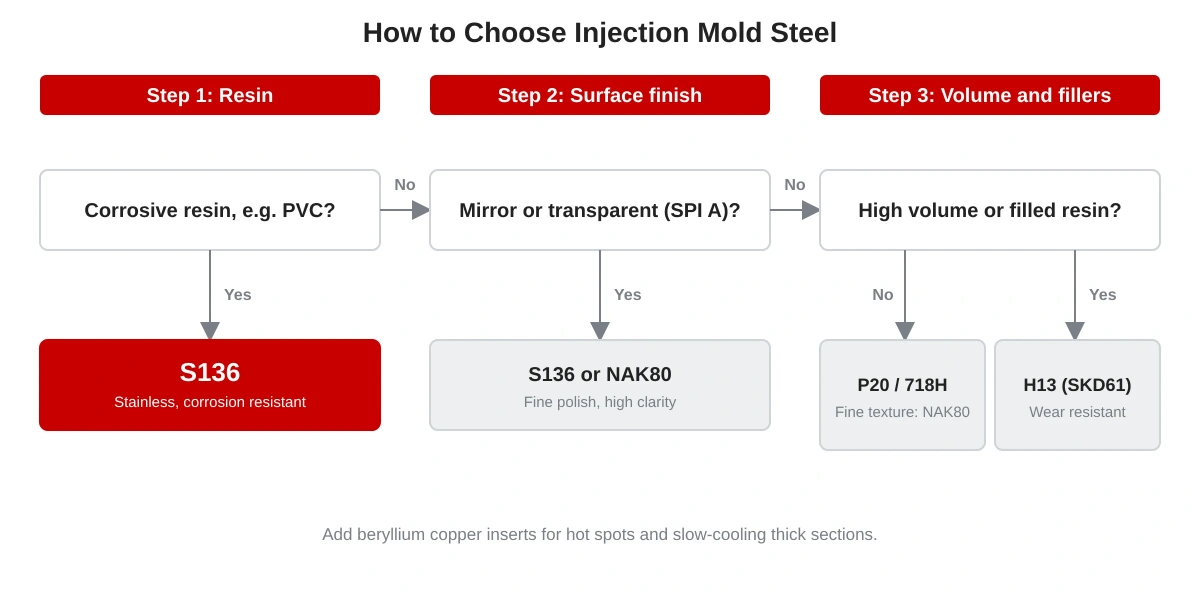
Decide in this order: resin first, surface finish second, volume third.
| Your situation | Suggested steel |
|---|---|
| ABS or PC/ABS housing, matte or semi-gloss (SPI B or C), small to medium volume | P20 or 718H |
| Larger mold, or you need consistent polish across the cavity | 718H |
| PVC, or a resin known to release corrosive gases | S136 |
| Transparent PC or acrylic, SPI A-1 to A-3 mirror finish | S136 or NAK80 |
| Fine texture or textured SPI D finish on cosmetic parts | P20, 718H or NAK80 |
| Glass-filled nylon or another abrasive resin at high volume | H13 (SKD61) or another hardened steel |
| Hot spots or thick sections that cool slowly | Add beryllium copper inserts |
Know Your Mold Steel? Get Your Quote.
Enter P20, 718H, S136 or another steel in the Mold Material field. Reply within 1 working day.
Get an Injection Molding Quote
Not sure which steel fits? Email our team with your resin, finish and volume.
How to Specify Mold Steel in a NextPCB Quote
In the NextPCB injection molding quote, enter your requirement in the Mold Material field, for example S136, 718H or P20. Other steels, such as NAK80, H13, SKD61 or beryllium copper, can be entered in the same field.
If you are not sure, fill in your expected annual volume, material and SPI finish as completely as you can. A sales representative reviews every request and replies within 1 working day. These starting points can help:
| Expected annual volume | Typical starting point |
|---|---|
| Up to 10,000 pcs | P20 or 718H |
| 10,000-50,000 pcs | 718H, or NAK80 / S136 if finish or resin demands it |
| 50,000-100,000 pcs | 718H, NAK80 or S136, depending on resin and finish |
| 100,000 pcs or more | S136, H13 (SKD61) or another hardened steel |
Volume alone does not decide the steel. A corrosive resin or a mirror finish can call for S136 even at low volume.
Common Mold Steel Mistakes
- Using S136 for a small, matte ABS run. You pay for polish and corrosion resistance the part never uses.
- Using P20 for PVC. Corrosive gases pit unprotected tool steel.
- Ignoring fillers. Glass-fiber or mineral fillers wear soft steel quickly, whatever the volume.
- Specifying a mirror finish on a soft steel. The polish may not hold up, so match steel to SPI grade.
- Choosing hardened steel on a tight schedule. Heat treatment adds time, so pre-hardened steel can be faster if the part allows it.
FAQ
Is 718H better than P20?
Generally yes. 718H has more uniform hardness in thick sections, better polishability and more stable machining, and it costs slightly more. For small molds with simple surfaces, P20 is often sufficient.
Is S136 stainless steel?
Yes. S136 is a modified 420 martensitic stainless steel with about 13 percent chromium, which gives it corrosion resistance and lets it take a mirror polish.
Which mold steel is best for transparent parts?
S136 is the usual choice because it takes a mirror polish and resists corrosion. NAK80 is an alternative when you want a fine polish without heat treatment. Final clarity also depends on the SPI grade, polishing quality and resin.
Can I use P20 for PVC?
It is not recommended. PVC can release corrosive gases during molding, which pit unprotected tool steel. S136 is the safer choice.
What is SKD61 equivalent to?
SKD61 is the JIS designation for a steel equivalent to AISI H13 (1.2344).
How many shots will a mold last?
It depends on the steel, resin, part design and maintenance. As a rough guide, pre-hardened P20 or 718H molds serve low to medium volumes, commonly up to a few hundred thousand shots, while hardened steels such as S136 and H13 are used when you expect higher volumes. Abrasive filled resins shorten tool life on any steel.
Does mold steel change the price of the part?
It changes the tooling cost first. Steel price, machining time and heat treatment all raise the cost of the mold, which is spread over every part you make. A harder steel can lower the per-part cost at high volume because it lasts longer, but it is rarely worth it for small runs.
Which mold steels can I specify in the NextPCB quote form?
Enter your requirement in the Mold Material field, for example S136, 718H or P20. Other steels, such as NAK80, H13, SKD61 or beryllium copper, can also be entered there, and a sales representative will review your request.
Get an Injection Molding Quote
Upload your 3D model, choose your material and SPI finish, and specify your mold material. A sales representative reviews your request and replies within 1 working day.