

 NextPCB Capabilities
 PCB Assembly
 Layer Buildup
 SMD-Stencils
 PCB Design-Aid & Layout
 Mechanics
 Quality
 Drills & Throughplating
 Factory & Certificate



"Waterproof" isn't a single spec — it's a range, and picking the wrong point on that range is one of the most common ways outdoor or industrial hardware fails in the field. An IP65-rated cable that's actually submerged will let water in; an IP68 assembly for a product that only ever sees rain is often unnecessary cost. Here's how to match the rating, material, and sealing method to what the product actually faces.
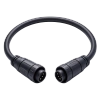
These are 3 of the 11 cable and wire harness types NextPCB manufactures — see the full comparison guide for external connector types like USB, D-Sub, and RF coaxial.
IP Ratings, Explained Plainly
IP (Ingress Protection) ratings use two digits: the first for solid particle protection (dust), the second for water. For cable assemblies, the second digit is usually the deciding factor:
- IP65 — protected against water jets from any direction. Suitable for rain, splashing, and washdown-adjacent environments, but not submersion.
- IP67 — protected against temporary submersion up to 1 meter for up to 30 minutes. Covers most outdoor and occasional-immersion use cases.
- IP68 — protected against continuous or deeper submersion, per the manufacturer's specified depth and duration. Needed for equipment that's regularly or permanently underwater.
The right rating depends on what actually happens to the product, not the worst case you can imagine — over-specifying adds cost and sometimes unnecessary bulk without a real benefit.
Insulation & Jacket Material Comparison
The sealing rating only holds if the material around it can handle the environment over time:
- Silicone — excellent flexibility across a wide temperature range, good for outdoor equipment that sees temperature swings
- TPE — flexible, reasonably priced, solid all-around outdoor performance
- PUR (Polyurethane) — strong abrasion and chemical resistance, well suited to equipment that gets dragged, coiled, or physically stressed outdoors
- Rubber — durable and flexible, common in heavier-duty outdoor and marine applications
How Sealing Actually Gets Achieved
An IP rating on paper depends on execution, not just material choice:
- Sealed connector housings with gaskets or O-rings at the mating interface
- Overmolding or potting at the cable-to-connector transition, which is often the weakest point in an otherwise-rated assembly
- Continuous jacket integrity along the cable run — any nick, cut, or improperly sealed splice compromises the whole rating
Common Mistakes to Avoid
Rating the connector but not the cable-to-connector joint. A sealed connector doesn't protect against water entering where the cable enters the connector body if that transition isn't also sealed or overmolded.
Choosing IP65 for an application that actually submerges. Splash-rated hardware fails quickly if the real-world use case involves standing water or submersion, even briefly.
Ignoring UV and temperature exposure alongside water resistance. Outdoor cables face sun and temperature cycling as much as moisture — a water-rated jacket that degrades under UV will eventually fail anyway.
Treating IP68 as automatically better. Higher ratings often mean thicker jackets, more rigid cables, and higher cost — appropriate when needed, unnecessary when the product never actually submerges.
Where Waterproof Assemblies Are Used
- Outdoor equipment and signage
- Marine electronics
- Agricultural and environmental sensors
- Washdown-rated industrial machinery
Many waterproof builds use M-series connectors — see our EU industrial (M8/M12/M16) guide — or need higher-current wiring covered in our power cable assembly guide.
Frequently Asked Questions
Is IP68 always better than IP67?
Not necessarily "better" in a way that matters for every application — IP68 handles deeper and/or longer submersion than IP67's standardized 1-meter/30-minute test, but if a product only ever faces splashing or occasional shallow immersion, IP67 already covers it, and paying for IP68 adds cost without a real performance benefit. The right rating should match the actual threat the product faces, not default to the highest number available.
Does an IP67-rated connector mean the whole cable assembly is IP67?
Not automatically. The IP rating on a connector only covers the connector itself when properly mated — the point where the cable enters the connector body has to be sealed separately (through overmolding, potting, or a gasketed boot), and it's a commonly overlooked weak point where an otherwise well-rated assembly can still let water in.
Is an IP-rated connector still waterproof when it's unplugged?
Generally, no — most IP ratings apply only to the connector in its mated (connected) state. An open, unmated connector port is a common failure point if left exposed outdoors, which is why unused ports on IP-rated equipment are typically fitted with a sealed dust cap.
Does a higher IP rating also mean better protection against high-pressure washdown spray?
Not necessarily — IP68 is about submersion depth and duration, while high-pressure, high-temperature spray protection is covered by a separate rating (IP69K). An assembly can pass IP68 submersion testing and still fail a IP69K-style high-pressure spray test, so if a product will face pressure washing, that specific requirement should be called out separately rather than assumed from an IP68 rating.
Why did my "waterproof" cable fail after months outdoors even though it passed testing initially?
A rating that held on day one can still fail over time if the material degrades under UV exposure or temperature cycling, or if the cable jacket gets nicked or abraded during installation — the IP rating describes the assembly's sealing under test conditions, not a lifetime guarantee against all forms of physical or environmental wear.
Get a Custom Waterproof Cable Assembly Quote
NextPCB builds waterproof cable assemblies across IP65, IP67, and IP68 rating levels, with material and sealing method matched to your actual operating environment — from a single prototype to full production volumes.
Confident IP65, IP67, or IP68 is the right rating for your environment? Configure your waterproof cable assembly →
Still weighing whether you actually need submersion protection, or just splash resistance? Over-specifying and under-specifying are both common here — describe your real-world exposure (rain, washdown, submersion depth/duration) and our team will recommend the right rating before you quote.
Need it paired with a sealed board build? Waterproof cable integration can be handled alongside your turnkey PCBA order. Visit the Cable Assembly Services page for full capabilities, or browse the NextPCB homepage for our full range of services.