

 NextPCB Capabilities
 PCB Assembly
 Layer Buildup
 SMD-Stencils
 PCB Design-Aid & Layout
 Mechanics
 Quality
 Drills & Throughplating
 Factory & Certificate



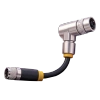
Walk onto any modern factory floor and most of the sensor, actuator, and machine-to-machine wiring you'll see uses M-series circular connectors — the European industrial automation standard. Their round, threaded design isn't just tradition; it solves specific problems standard connectors don't: vibration resistance, sealed environments, and fast, reliable field connections. Here's how to choose the right size and configuration.
These are 3 of the 11 cable and wire harness types NextPCB manufactures — see the full comparison guide for external connector types like USB, D-Sub, and RF coaxial.
What Are M-Series Connectors?
The "M" designation refers to the connector's threaded diameter in millimeters — M8, M12, M16, M23, and M40 are the sizes NextPCB supports. Each size trades off physical footprint against pin count and current-carrying capacity:
| Size | General Profile | Typical Use |
|---|---|---|
| M8 | Smallest, fewer pins | Compact sensors, proximity switches |
| M12 | Most common industrial size | Sensors, actuators, field I/O — the de facto automation standard |
| M16 | Larger, more pins or higher current | Equipment needing more conductors or higher power per connector |
| M23 | Larger still | Higher-current motor and power connections |
| M40 | Largest | Heavy industrial power and multi-pin applications |
M12 in particular has become the default choice across factory automation because it balances size, pin count, and durability well enough to cover most sensor and I/O connections.
Why M-Series Instead of a Standard Connector?
Threaded locking. Unlike snap-fit or friction-fit connectors, the threaded coupling nut on M-series connectors resists vibration loosening — critical on equipment that runs continuously with motors, conveyors, or moving machinery nearby.
Sealing. Many M-series assemblies are built to IP65/IP67-class sealing, protecting the connection from dust, coolant, and washdown exposure common on factory floors.
Field-reliable mating. The circular, keyed design makes it hard to mate connectors incorrectly, even when a technician is working by feel in a crowded control cabinet.
Common Mistakes to Avoid
Choosing pin count without headroom. Industrial designs get modified and expanded over time — specifying a connector with the exact pin count needed today, and no spares, often means a redesign later.
Ignoring the coupling nut's torque spec. Under-tightened M-series connectors lose their sealing and vibration resistance even though they appear "connected."
Mismatching IP rating between the connector and the cable jacket. A sealed connector paired with a cable jacket that isn't rated for the same environment creates a weak point the connector rating doesn't cover.
Assuming M12 fits every application by default. It's the most common size, but higher-current or higher-pin-count needs are better served by M16, M23, or M40 — sizing down just to save space can undercut the current or pin capacity the design actually needs.
Where EU Industrial Assemblies Are Used
- Factory automation sensors and actuators
- Industrial robotics
- Field I/O and PLC wiring
- Machine-to-machine power and data connections
M-series assemblies are often paired with IP-rated sealing — see our waterproof cable assembly guide for material and rating selection. For networked automation equipment, see our Ethernet cable assembly guide.
Frequently Asked Questions
What's the real difference between M8 and M12 connectors besides size?
Beyond the 8mm vs. 12mm thread diameter, M8 connectors are generally limited to lower current (roughly in the 3–5A range) and fewer pin-count options, making them suited to compact sensor and proximity-switch wiring. M12 connectors typically support higher current (commonly cited up to around 16A depending on the series), more pin-count and coding options, and are used more broadly across sensors, actuators, industrial Ethernet, and fieldbus connections — which is why M12 has become the default choice for most general industrial automation wiring.
Do I need M16, M23, or M40 instead of M12?
Step up from M12 when the application needs more current-carrying capacity than M12 comfortably provides, more pins than M12's typical range supports, or a physically larger, more rugged interface for heavier industrial equipment. M16 and larger sizes are common on higher-power motor and machine connections where M12's current and pin limits become a real constraint rather than a convenience trade-off.
Does an M12 connector automatically mean the assembly is waterproof?
Not automatically — M-series connectors are commonly available in IP65/IP67-rated versions, but the rating has to be confirmed for the specific connector and cable assembly, and it only holds if the cable jacket and connector-to-cable transition are sealed to a matching standard. A connector rated IP67 doesn't make the whole assembly IP67 if the cable jacket or overmolding isn't part of that same sealed system.
What does "coding" mean on an M12 connector, and why does it matter?
Coding refers to a mechanical keying pattern (commonly labeled A, B, C, D, X, and others) that physically prevents connectors from being mated incorrectly and also generally indicates which type of signal or power the connector is intended for (standard I/O, higher-speed Ethernet, or power-focused configurations). Specifying the wrong coding for the intended use is a common cause of connector-mating problems discovered during installation rather than during design.
Why did my M12 connector fail even though it looked properly connected?
A common cause is an under-tightened coupling nut — the connector can appear seated and even pass a quick visual or tug check while still being below the torque needed to maintain its rated sealing and vibration resistance. Confirming coupling nut torque against the connector's spec, rather than "hand tight," is the more reliable check in vibration-prone installations.
Get a Custom EU Industrial Cable Assembly Quote
NextPCB builds M8, M12, M16, M23, and M40 cable assemblies with connector mate verification against your BOM before production, from a single prototype through full production volumes.
Know your connector size, pin count, and coding? Configure your M-series cable assembly →
Need this to mate with an existing sensor, panel, or piece of field equipment? Getting coding and pin count wrong is the most common M-series mistake — send our team the existing connector's datasheet or BOM and they'll confirm an exact match before you quote.
Pairing this harness with a control board build? M-series termination can be integrated into the same production run as your turnkey PCBA order. See the Cable Assembly Services page for full capabilities, or browse the NextPCB homepage for our full range of services.