NextPCB Capabilities
Printed Circuit Boards
NextPCB Capabilities
Printed Circuit Boards
 PCB Assembly
 Layer Buildup
 SMD-Stencils
 PCB Design-Aid & Layout
 Mechanics
 Quality
 Drills & Throughplating
 Factory & Certificate
 PCB Assembly Factory Show
Certificate
PCB Assembly Factory Show
Certificate

Support Team
Feedback:
support@nextpcb.com


In the PCB manufacturing process, the selection of the base PCB material directly affects the reliability, electrical performance, manufacturability, service life of the final product, and cost. Among them, FR-4 is the most widely used copper-clad laminate material. As electronic products move toward higher reliability, higher density, and lead-free PCB manufacturing, and as one of the world's largest CCL (Copper Clad Laminate) suppliers, Shengyi Technology has developed high-performance materials such as S1000H and S1000-2M based on the FR-4 system. These two materials have become important choices in fields including automotive electronics, communication equipment, and industrial control, and can effectively meet the requirements for heat resistance and reliability across different layer counts and application scenarios.
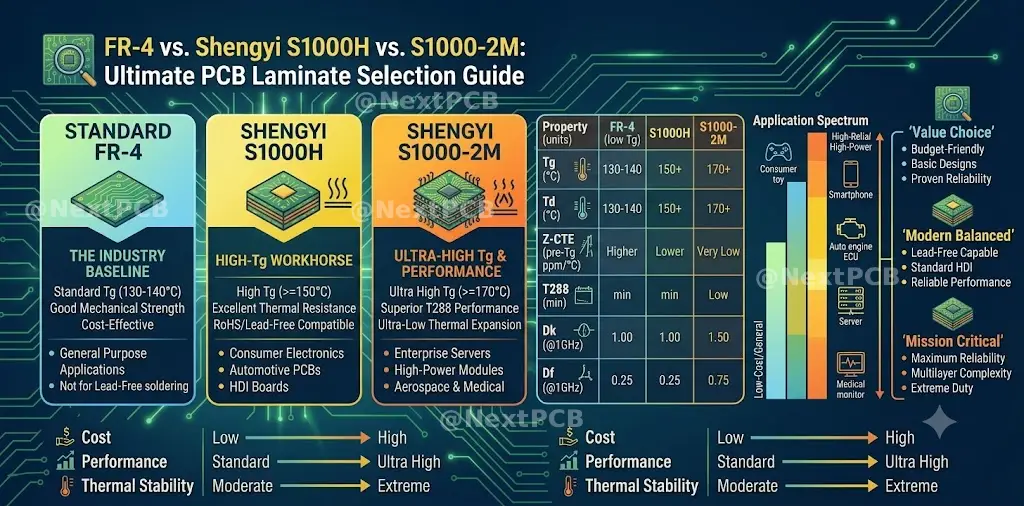
image from gemini
FR-4 stands for "Flame Retardant 4," which represents a flame-retardant grade 4 glass-reinforced epoxy copper-clad laminate (CCL). Its core components are epoxy resin and woven fiberglass cloth, laminated together under high temperature and pressure. The reason this material has become the absolute mainstream in the PCB industry lies in its excellent balance of performance, cost, and processability.
As electronic technology advances toward high density, high reliability, and lead-free manufacturing, the limitations of traditional standard FR-4 materials have become increasingly prominent:
Precisely due to these challenges encountered in multilayer high-density interconnect (HDI) designs and modern high-temperature lead-free processes, the market has driven the development of numerous upgraded, high-performance FR-4 derivative materials (such as Shengyi S1000H and S1000-2M with high Tg and high Td. These variants satisfy the stringent requirements of high-end electronic equipment for high-temperature reliability and signal transmission.
Shengyi S1000H is a high-performance, lead-free compatible FR-4 copper-clad laminate developed by Shengyi Technology. As one of the benchmark products in the high-end FR-4 segment, S1000H is positioned to achieve an optimal balance among cost, thermal reliability, and processability. Its official Tg (glass transition temperature), measured by DSC, is 155°C, placing it in the mid-Tg range. While meeting high-reliability requirements, it also maintains excellent processability, making it an ideal choice for both standard and high-reliability multilayer PCB designs.
S1000H Core Features
Reference: Shengyi Technology Co., Ltd. (n.d.). S1000H Lead-free Compatible FR-4 Material. Retrieved July 7, 2026, from Shengyi Official Website
S1000-2M can be regarded as an ultra-high Tg, high-performance lead-free compatible FR-4 laminate further optimized and upgraded from S1000H. Through formulation adjustment and the addition of inorganic fillers, it delivers comprehensive enhancements in thermal stability, reliability, and signal integrity for more demanding applications. It is the preferred choice for complex multilayer boards, HDI boards, or designs with extreme requirements for thermal reliability.
Ultra-High Heat Resistance (High Tg & Td)
Very Low CTE (Coefficient of Thermal Expansion) and High Through-Hole Reliability
Excellent CAF (Conductive Anodic Filament) Resistance
Improved High-Frequency / Low-Loss Performance
Owing to its superior thermal reliability and signal integrity, S1000-2M is primarily used in:
Reference: Shengyi Technology Co., Ltd. (n.d.). S1000-2M
| Property Dimension | FR-4 (General Purpose) | S1000H | S1000-2M |
| Core Positioning | Industry standard, general purpose | Mid-Tg, lead-free compatible | High-Tg, high-performance |
| Tg (Glass Transition Temperature) | Low (130°C - 140°C) | Mid-high (≥ 150°C) | Ultra-high (≥ 170°C) |
| Td / Thermal Decomposition / T288 | Poor (~300°C - 320°C), prone to delamination | Excellent (~348°C) | Outstanding (~355°C, strongest resistance to continuous high temperature) |
| Z-CTE (Coefficient of Thermal Expansion) | Large | Small | Ultra-small (highest via reliability) |
| Lead-Free Assembly Process | Not recommended / restricted to simple single/double-sided boards | Fully compatible, mainstream choice | Perfectly compatible, preferred for harsh environments |
| Layer Count Capability | Primarily 1 - 4 layers | 4 - 12 layers and HDI | 12+ layers, high layer-count boards, complex HDI |
| Relative Cost | Economical (Baseline) | Moderate | Higher |
| Key Characteristics | High cost-effectiveness, mature processing | Low CTE, good CAF resistance | Exceptional thermal resistance, superior via reliability, excellent CAF resistance |
| Flammability Rating | UL 94 V-0 | UL 94 V-0 | UL 94 V-0 |
| Typical Applications | Consumer electronics, ordinary single/double-sided boards | Computers, instrumentation, automotive electronics, industrial control | High layer-count boards, communications, automotive, high-end electronic equipment |
In actual PCB design and manufacturing, material selection is not about absolute "good or bad" but rather about "fitness for purpose." A comprehensive balance must be struck among application scenarios, technical requirements, and budgets. The following are the three mainstream selection guides:
Typical Scenarios: Consumer toys, LED products/light strips, home appliance control boards, double-sided boards with moderate operating temperatures, or general electronic equipment.
Recommended Material: Standard FR-4
Selection Logic:
Typical Scenarios: 4 to 10-layer lead-free multilayer boards, conventional automotive components (such as ECU control boards), industrial control systems, smart home devices, and communication peripherals.
Recommended Material: Shengyi S1000H
Selection Logic:
Typical Scenarios: High-end servers, high-density data center equipment, high layer-count core boards, and harsh industrial environments with high-temperature, high-vibration, and long-lifespan requirements (such as engine compartments).
Recommended Material: Shengyi S1000-2M
Selection Logic:
| Base Material Model | Core Performance Tags | Applicable Layer Count | Soldering Process | Typical Application Areas |
| Standard FR-4 | Cost-oriented / Basic performance | 1–2 layers | Lead soldering / Low-temperature | Consumer electronics, smart toys, basic home appliances |
| S1000H | Lead-free compatible / Industry standard | 4–10 layers | Lead-free reflow soldering | Automotive components, industrial control, communication terminals |
| S1000-2M | Low CTE / Ultra-high thermal stability | 10+ layers / High density | Multiple lead-free reflow cycles | Servers, high-density data centers, extreme-environment industrial control systems |
In summary, these three material grades form a clear performance ladder. Understanding their differences is the first step in PCB material selection and an important guarantee for ensuring the final product quality and reliability.

Check PCB Price Based Fr4 / S1000H / S1000-2M
Yes, absolutely. For heavy copper PCBs (copper thickness ≥ 3 oz) or thick multi-layer boards (> 2.4 mm), Z-axis expansion during thermal shock is the biggest enemy of plated through-holes (PTH). S1000H, with its low Alpha-1 CTE (45 ppm/°C), significantly reduces stress on PTH corners, making it a reliable and cost-effective choice for industrial power supplies and automotive applications meeting IPC Class 3.
While both are lead-free compatible (260°C+ processing), S1000-2M offers superior T288 time-to-delamination (≥ 30 minutes compared to S1000H's ≥ 15 minutes). If your PCBA requires multiple reflow cycles (e.g., double-sided SMT + wave soldering + selective soldering/rework), S1000-2M provides a much higher safety margin against delamination and blistering.
They are considered Standard-Loss to Mid-Loss materials.
However, for ultra-high-speed interfaces like PCIe Gen 5/6, USB4, or 112G SerDes, you should look into dedicated Low-Loss or Ultra-Low-Loss laminates like Panasonic Megtron 6 or TUC TU-872.
It's primarily about availability and cost-efficiency in Asian supply chains. Shengyi is one of the world's largest laminate manufacturers. For quick-turn PCB prototyping or mass production in Asia, S1000H is widely stocked by almost every fabricator. Swapping Isola 370HR to Shengyi S1000H (given client approval) can often cut material lead time by 2-3 weeks and reduce raw material costs by 15-25% without sacrificing reliability.
Still, need help? Contact Us: support@nextpcb.com
Need a PCB or PCBA quote? Quote now