

 NextPCB Capabilities
 PCB Assembly
 Layer Buildup
 SMD-Stencils
 PCB Design-Aid & Layout
 Mechanics
 Quality
 Drills & Throughplating
 Factory & Certificate



Not every cable assembly is about connecting a device to the outside world. A lot of the wiring inside a product just needs to move signal or power a short distance internally — between a board and a display, one board and another, or a sensor and its controller. Three cable types cover most of this internal territory: FFC, IDC, and terminal cable. They're often confused because they all solve "connect these two points inside the enclosure," but they're built very differently and suit different situations.
These are 3 of the 11 cable and wire harness types NextPCB manufactures — see the full comparison guide for external connector types like USB, D-Sub, and RF coaxial.
FFC (Flat Flexible Cable)

FFC is a thin, flat ribbon of parallel conductors, built specifically for tight, low-profile spaces where a round cable can't bend the way the enclosure needs it to. It's the standard choice for connecting displays, camera modules, and printer heads — anywhere the routing path is narrow, flat, or needs repeated flexing without fatigue.
Choose FFC when: the connection needs to fit a low-profile space, bend around a tight enclosure path, or flex repeatedly (like a hinge or moving assembly).
IDC (Insulation Displacement Connector)
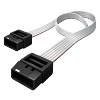
IDC terminates ribbon cable by piercing the insulation directly with the connector's contacts, instead of stripping and soldering each wire individually. That makes it fast and highly consistent to produce at volume — which is exactly why IDC shows up so often in board-to-board and board-to-panel connections inside mass-produced electronics.
Choose IDC when: you're connecting multiple parallel signal lines internally (not a single flex point) and want fast, repeatable termination at production volume.
Terminal Cable
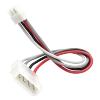
Terminal cable assemblies use crimped terminals to connect wires directly to board headers or to other wires, without a molded connector housing. They're the most flexible and lowest-cost option of the three, useful for general-purpose internal wiring — sensor leads, point-to-point board connections, or anywhere a full connector housing is more than the connection actually needs.
Choose terminal cable when: the connection is simple, doesn't need a keyed housing, and cost or routing flexibility matters more than a locking connector interface.
Side-by-Side Comparison
| FFC | IDC | Terminal Cable | |
|---|---|---|---|
| Best for | Tight, low-profile, or flexing routes | Parallel signal lines, volume production | General-purpose, simple point-to-point wiring |
| Flex tolerance | High — designed to flex | Low — meant for fixed routing | Depends on wire insulation, generally low-to-moderate |
| Termination speed at volume | Moderate | Fast, highly consistent | Moderate, depends on terminal type |
| Typical use | Displays, cameras, printer heads | Board-to-board, board-to-panel ribbon links | Sensor wiring, board-to-wire, general interconnects |
Common Mistakes to Avoid
Using FFC where the path doesn't actually need to flex. FFC costs more to route correctly than a simpler wire — if there's no bend or repeated flex requirement, IDC or terminal cable is often a better fit.
Choosing terminal cable for high-volume ribbon connections. Individually crimped terminals don't scale as consistently as IDC does for multi-conductor parallel connections at production volume.
Underestimating IDC's fixed-routing limitation. IDC ribbon cable isn't built for repeated flexing — if the connection point moves (a hinge, a sliding tray), FFC is the better choice even though IDC might look similar at a glance.
Where These Interconnects Are Used
- FFC: displays, camera modules, printers, compact consumer electronics
- IDC: internal PCB-to-PCB links, embedded systems, mass-produced electronics
- Terminal cable: sensor wiring, general board-to-wire connections, low-cost internal interconnects
Need a panel-mount connector for the external side of the enclosure? See our D-Sub cable assembly guide for secure, screw-locked external connections.
Frequently Asked Questions
What's the actual difference between FFC and FPC?
FFC (Flat Flexible Cable) uses flat parallel copper conductors laminated between plastic film — essentially a simple flexible wire ribbon. FPC (Flexible Printed Circuit) is a step up: copper traces etched onto a flexible substrate the way a rigid PCB's traces are etched, which allows more complex routing, controlled impedance, and even mounted components. If a connection is purely parallel conductors between two points, FFC is usually sufficient and lower-cost; if the routing needs to be more complex than parallel lines, FPC is the better fit.
What does "same side" vs. "opposite side" contacts mean on an FFC?
This describes where the exposed metal contacts sit relative to the flat cable body at each end. "Same side" (sometimes called Type A) means the contacts face the same direction at both ends, used when both mating connectors face the same way. "Opposite side" (Type D) means one end is effectively flipped relative to the other, used when the two connectors face different directions in the assembly. Getting this detail wrong is a common reason an FFC won't seat correctly even though the pitch and pin count are right.
Does FFC pitch really need to match the connector exactly?
Yes — pitch (the center-to-center spacing between conductors) has to match the connector precisely; a cable with slightly different pitch than its mating connector generally won't seat or make reliable contact, even if the overall cable width looks similar. Common pitches include 0.5mm, 0.8mm, and 1.0mm, and they are not interchangeable.
How many times can an FFC be flexed before it wears out?
It depends on the specific cable construction — a standard FFC intended for a largely static installation is typically rated for on the order of thousands of flex cycles, while cables built specifically for repeated dynamic movement (such as robotics or moving mechanical assemblies) can be rated for far more. If a design involves an FFC flexing repeatedly during normal use (not just during assembly), it's worth confirming the flex-cycle rating matches that use case rather than assuming any FFC will hold up the same way.
Why would I choose IDC instead of just using individual crimped wires (terminal cable)?
IDC termination pierces multiple parallel conductors at once without individually stripping and crimping each wire, which makes it faster and more consistent to produce at volume for multi-conductor connections. Terminal cable, by contrast, is more flexible for simple, low-conductor-count, or non-parallel connections, but doesn't scale as efficiently when a design needs many parallel signal lines terminated identically and repeatably.
Get a Custom Internal Interconnect Quote
NextPCB builds FFC, IDC, and terminal cable assemblies from a single prototype to full production volumes, with engineering review to help confirm which type actually fits your internal routing before production starts.
Still not sure which of the three fits your design? That's the most common reason to land on this guide — send our engineering team your routing path, flex requirements, and pin count and they'll recommend FFC, IDC, or terminal cable before you quote.
Already settled on one of the three? Configure your cable assembly →
Building the board these interconnects plug into? Termination can be integrated into the same production run as your turnkey PCBA order. See the Cable Assembly Services page for full capabilities, or browse the NextPCB homepage for our full range of services.