

 NextPCB Capabilities
 PCB Assembly
 Layer Buildup
 SMD-Stencils
 PCB Design-Aid & Layout
 Mechanics
 Quality
 Drills & Throughplating
 Factory & Certificate



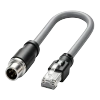
A standard patch cable works fine for an office network. It's a much worse fit for embedded and industrial hardware, where connector orientation, exact length, and noise environment don't match anything sold off the shelf. Custom Ethernet cable assemblies solve the specific problem of getting reliable wired networking into equipment that wasn't designed around a generic cable.
These are 3 of the 11 cable and wire harness types NextPCB manufactures — see the full comparison guide for external connector types like USB, D-Sub, and RF coaxial.
Why Standard Patch Cables Often Don't Fit
- Length — off-the-shelf cables come in fixed increments; internal or panel routing rarely matches those lengths exactly
- Connector orientation — right-angle RJ45 connectors, or specific keying for panel-mount applications, aren't part of a standard patch cable
- Noise environment — equipment near motors, power electronics, or RF sources needs shielding a consumer cable isn't built for
- Physical durability — industrial settings need jackets and strain relief rated for flexing, vibration, or outdoor exposure that consumer cables don't address
Shielded vs. Unshielded — Which One Do You Need?
UTP (Unshielded Twisted Pair) relies on the twist rate of the conductor pairs to reject noise, and works well in typical office or low-interference environments.
STP/FTP (Shielded) adds a foil or braided shield around the pairs (or the whole cable), which matters when the cable runs near variable-frequency drives, motors, switching power supplies, or other industrial noise sources. If your equipment lives near any of those, shielded construction is usually the safer default — noise-related dropped packets are hard to diagnose after deployment.
Category Selection
Cat5e, Cat6, and Cat6a cover the range most embedded and industrial applications need, trading off bandwidth and distance performance. Higher categories aren't automatically better for every use case — the right choice depends on the data rates your application actually requires and the cable run length, not just "get the newest category available."
Common Mistakes to Avoid
Defaulting to unshielded in a noisy environment. Networking issues caused by EMI often look like software or protocol problems until someone traces it back to cable shielding.
Not specifying connector orientation early. Straight vs. right-angle RJ45 connectors affect enclosure design — this is far cheaper to lock in before tooling than after.
Treating industrial Ethernet like an office cable run. Vibration, temperature swings, and physical stress in industrial settings call for jacket materials and strain relief that consumer-grade cables aren't built to handle.
Ignoring cable length precision. Excess slack inside a compact enclosure creates routing and interference problems that a correctly-measured custom length avoids entirely.
Where Custom Ethernet Assemblies Are Used
- Industrial automation and networked control systems
- IoT gateways and edge devices
- Embedded systems requiring a reliable wired data link
- Equipment with panel-mount or right-angle connector requirements
Networking equipment on a factory floor often pairs Ethernet with M-series field connectors — see our EU industrial (M8/M12/M16) guide for that side of the build.
Frequently Asked Questions
Do I actually need shielded Ethernet cable, or is unshielded good enough?
It depends on the electrical noise environment: unshielded (UTP) cable performs well in typical office or low-interference settings and is cheaper and easier to install, while shielded (STP/FTP) cable is generally recommended near motors, variable-frequency drives, and other industrial EMI sources. If it's genuinely unclear how noisy an installation environment will be, defaulting to shielded is the safer choice — EMI-related packet loss is often hard to diagnose after the equipment is deployed.
Does a higher cable category (like Cat6a) automatically mean better performance?
Not for every application — category defines bandwidth and speed capability, not shielding or noise resistance, and a higher category than the application's actual data rate needs adds cost without a corresponding benefit. The right category should be chosen based on the data rates and cable run length the design actually requires, not simply "the newest available."
Can I mix shielded and unshielded Ethernet cable in the same installation?
It's generally not recommended — mixing shielded and unshielded segments (or connecting shielded cable to unshielded connectors/equipment) can create a situation that doesn't get the full benefit of either approach, sometimes described as a worst-of-both-worlds result. If shielding is needed anywhere in a run, it's more reliable to keep the shielding consistent (cable, connectors, and grounding) across that full path.
Does shielded cable need special grounding to work correctly?
Yes — shielded cable is generally expected to be properly grounded at the connector/equipment ends to be effective; if it isn't grounded correctly, the shield can, in some cases, act more like an antenna than a noise barrier. This is a real installation detail to plan for, not just a cable-purchasing decision.
Why would I need a right-angle RJ45 connector instead of a standard straight one?
Right-angle connectors are chosen when enclosure space behind the port is limited, or when the cable needs to exit the enclosure at a specific angle to avoid interfering with other components. This is a detail that's much cheaper to lock into a design before enclosure tooling is finalized than to work around afterward.
Get a Custom Ethernet Cable Assembly Quote
NextPCB builds Ethernet cable assemblies to your exact length, category, shielding, and connector orientation requirements — from a single prototype to full production volumes.
Know your category, shielding, and connector orientation? Configure your Ethernet cable assembly →
Not sure whether your installation environment actually needs shielded cable? EMI-related issues are hard to diagnose after deployment, so it's worth confirming upfront — tell our team what's near the cable run (motors, drives, other noise sources) and they'll recommend UTP or STP before you quote.
Need it delivered alongside a networked board build? Ethernet cable integration can be handled in the same production run as your turnkey PCBA order. See the Cable Assembly Services page for full details, or browse the NextPCB homepage for our full range of services.