NextPCB Capabilities
Printed Circuit Boards
NextPCB Capabilities
Printed Circuit Boards
 PCB Assembly
 Layer Buildup
 SMD-Stencils
 PCB Design-Aid & Layout
 Mechanics
 Quality
 Drills & Throughplating
 Factory & Certificate
 PCB Assembly Factory Show
Certificate
PCB Assembly Factory Show
Certificate

Support Team
Feedback:
support@nextpcb.com


OpenAI's recent GPT-6 Astra demo is sending shockwaves through the PCB design community - but perhaps not for the reasons you might think.
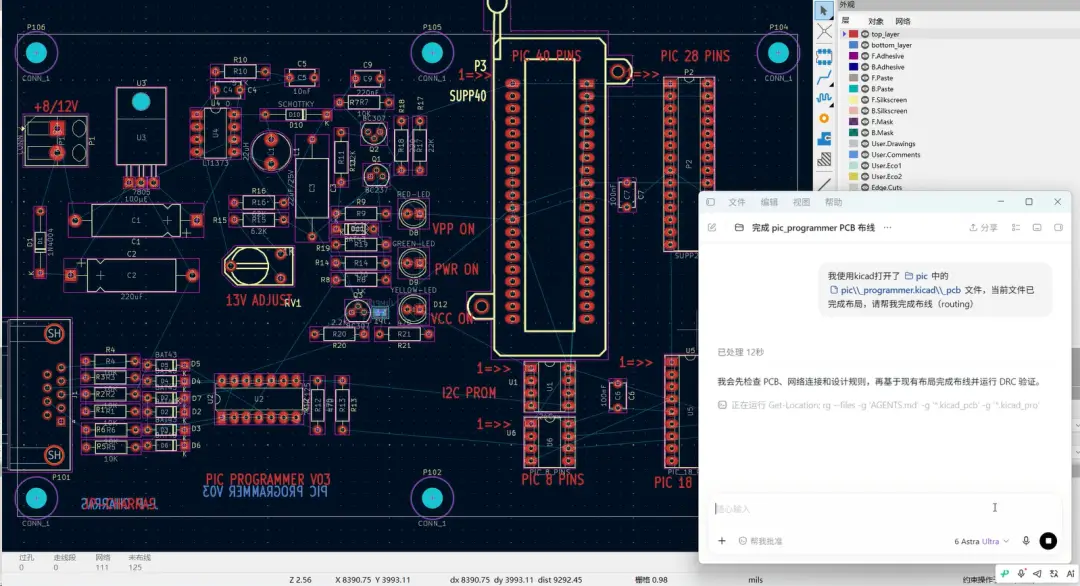
The condensed 15-second replay, presented under Computer Use, showed Astra working in the popular open-source EDA tool KiCad. Components were placed, traces were routed and copper zones were filled as a circuit board gradually took shape.
Screenshot of the GPT-6 Astra demo video under Computer Use
The accompanying text explicitly described "GPT-6 Astra performing printed circuit board layout, turning an electronic schematic into a manufacturable PCB."
That claim alone is enough to provoke very strong reactions with different groups.
- AI advocates rejoice at the prospect of a capable AI autorouter finally appearing on the horizon.
- PCB layout engineers start counting the days until the AI job apocalypse reaches board design.
- Autorouting researchers wonder whether their years of hard work have suddenly been rendered obsolete.
Before you start rewriting your resume, Hubert Hu's findings could help put your feet back on the ground plane.
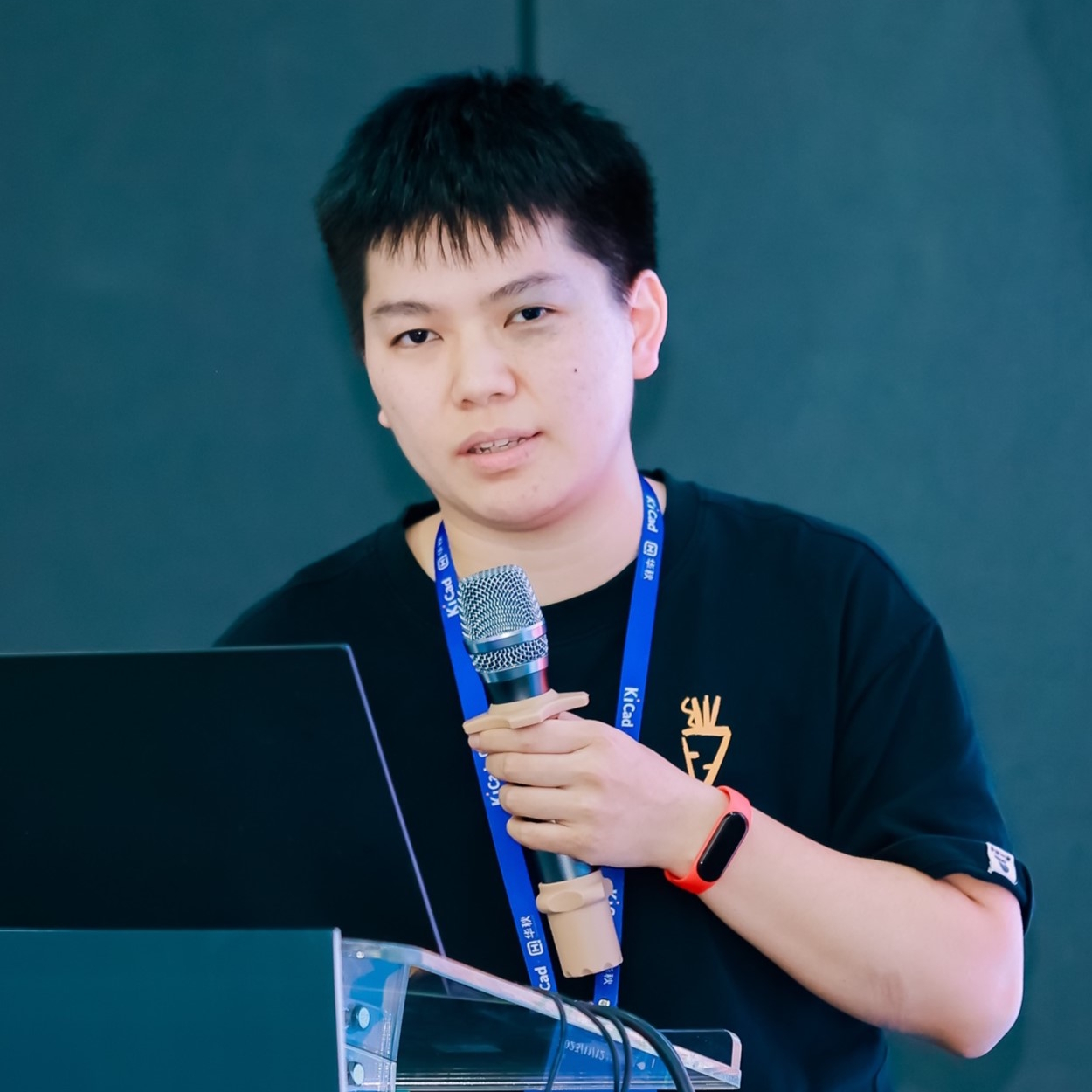
EDA AI expert and NextPCB's Head of Technology, Hubert is a strong advocate of AGI and an automated future for electronics, and welcomes AI agents that make sophisticated engineering tools easier to access and use. However, he was also skeptical about LLMs crossing such a major milestone overnight. To put Astra's PCB routing capabilities to the test, Hubert ran two simple experiments and asked the important question: Who actually did the routing?
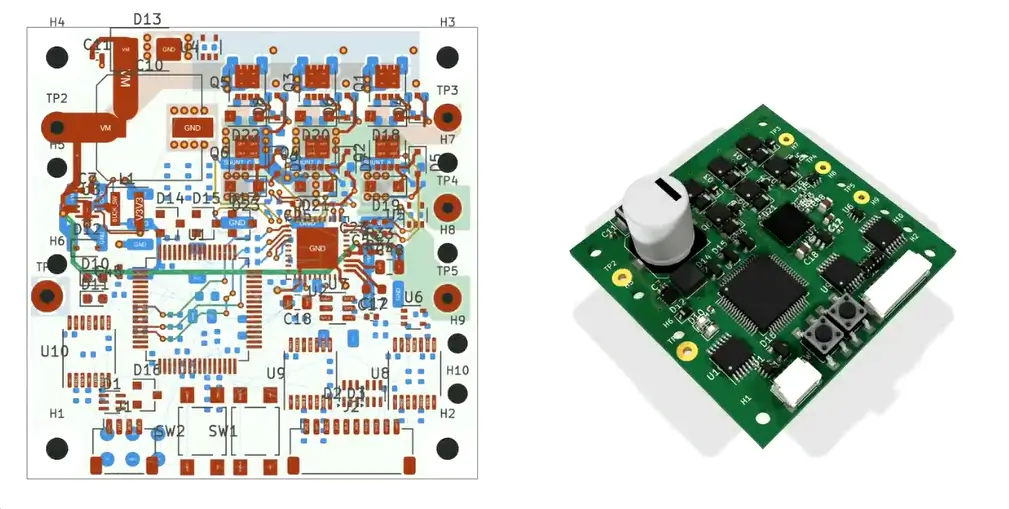
For the first test, Hubert asked Astra to complete the PCB routing without placing any restrictions on how it could accomplish the task. Both experiments used the same environment and started from the same board, with the component placement fixed but not yet routed.
Around 12 minutes later, Astra produced a routed board.
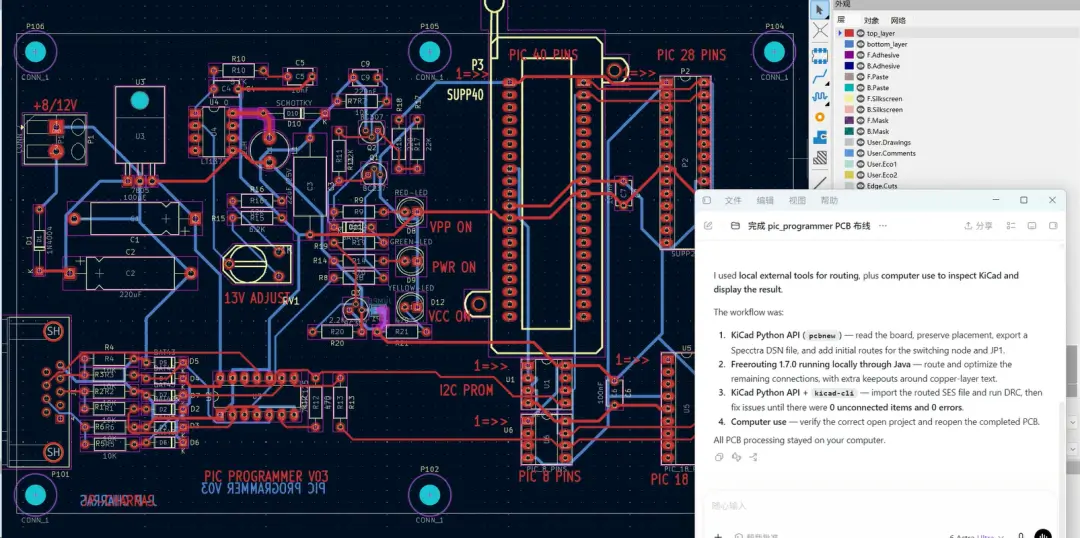
Judging only from the starting point and final result, it would be easy to conclude that the AI had simply "routed the PCB." But the execution history tells a more interesting story. The core workflow was:
KiCad DSN export → Freerouting → SES import back into KiCad
Freerouting is an open-source PCB autorouter with long-established KiCad workflows. DSN is a design interchange format that can be used to pass PCB data to an external router. The resulting SES file can then be imported back into the PCB design environment. In other words, Astra did not independently calculate the routing solution itself.
Freerouting performed the core routing computation. Astra orchestrated the workflow.
Astra had successfully identified a way to complete the task, exported the design from KiCad, passed it to external tools, and brought the resulting routing data back into KiCad. So, you may be thinking GPT-6 Astra cheated. But Hubert notes, "That is still useful."
"An AI agent capable of understanding an engineering task, selecting appropriate tools and coordinating a multi-step workflow could eliminate a considerable amount of manual work. In real engineering environments, that kind of orchestration may ultimately prove extremely valuable. But it is technically different from demonstrating that a general-purpose LLM has independently mastered PCB routing through visual understanding, mouse movements and keyboard input."
A more accurate description of the first test is therefore:
Astra successfully automated a PCB autorouting workflow.
That is not the same as saying:
Astra itself became the autorouter.
There is another important qualification. When the task is described as "completed," that simply means a routing result was produced. It does not automatically mean the PCB was fully validated or ready for production. Freerouting is an autorouting program, not a substitute for full design verification.
For the second test, Hubert kept everything else the same. This time, however, Astra was explicitly instructed not to use external tools. It had to attempt the routing through visual interaction with KiCad using the mouse and keyboard. The result was dramatically different.
After one hour, Hubert manually stopped the run. Astra had completed only three short trace segments. The board was nowhere near fully routed.
The comparison suggests that, in Hubert's test, access to a specialist routing engine was decisive. However, two runs on one PCB are not a comprehensive benchmark. The result does not prove that GUI-only AI routing is impossible, nor does it reveal how OpenAI's original demo was implemented.
As AI moves from chat-based LLMs to agents that can actively control computers, this distinction becomes increasingly important. Many viewers are still unfamiliar with agentic computer use and may naturally assume that if the AI appears to complete a task on screen, the AI itself performed the underlying engineering work. In reality, the model may be controlling the computer while specialist software does the solving.
One of the most important points in this discussion is that Computer Use and tool orchestration are not mutually exclusive. A system can interact with a graphical interface while also invoking code, software libraries, APIs or specialist tools elsewhere in the workflow. So the fact that a demonstration is presented as "Computer Use" does not automatically mean every part of the task was solved through visual interaction with the interface.
There is an even simpler way to illustrate the distinction. Imagine an AI model opens an EDA application, moves the mouse to an Autoroute button and clicks it. The model has interacted with the software entirely through the GUI. But the algorithm deciding where the traces should go is still the routing engine inside the application. The AI clicked the button. The router solved the routing problem.
The interaction method does not tell us where the underlying problem-solving capability resides.
This is why using professional tools should not be dismissed as "cheating." In fact, tool orchestration may be one of the most promising applications of AI in engineering.
AI agents could eventually interpret design requirements, operate multiple engineering applications, coordinate simulations, run checks, compare results and automate workflows that currently require significant manual intervention. But that is a different achievement from replacing the specialist algorithms behind those tools.
There are therefore two distinct forms of progress:
Making specialist engineering tools easier to use.
And:
Improving the underlying ability to solve specialist engineering problems.
Both are important. But they should not be confused. Hubert"s point is more specific:
The demonstration can easily be interpreted as evidence that a general-purpose LLM has mastered PCB routing when the underlying capability may instead depend heavily on specialist engineering tools.
Autorouters already exist. The hard challenge is reliable, high-quality automation across complex boards — not merely completing one example. PCB routing involves NP-hard optimization problems, geometry, topology and electrical constraints. NP-hard does not mean unsolvable. And connecting every net is not the same as validating a production-ready design. This is why the framing matters.
I worry that investors outside EDA will see the demo and ask specialist teams: "Why fund your research when a general-purpose LLM already does this?" That misunderstanding could undervalue the researchers, domain data and specialized tools that make these workflows possible and make the next real breakthrough harder to fund.
AI has enormous potential to change how engineers design electronics. That future should be welcomed. But enthusiasm for AI should not lead us to underestimate the specialist engineering technologies that make many of today's demonstrations possible.
LLMs are not magic.
Industrial AI still depends on domain expertise, high-quality engineering data, specialist software and decades of research into the underlying problems.
The most powerful future may not be one in which AI replaces every engineering tool. It may be one in which AI becomes exceptionally good at understanding which tools to use, when to use them and how to combine them - while new research continues to improve the tools themselves.
So yes, celebrate the automation. But also credit the tools. And keep funding the hard research.

Still, need help? Contact Us: support@nextpcb.com
Need a PCB or PCBA quote? Quote now




 Surface