NextPCB Capabilities
Printed Circuit Boards
NextPCB Capabilities
Printed Circuit Boards
 PCB Assembly
 Layer Buildup
 SMD-Stencils
 PCB Design-Aid & Layout
 Mechanics
 Quality
 Drills & Throughplating
 Factory & Certificate
 PCB Assembly Factory Show
Certificate
PCB Assembly Factory Show
Certificate

Support Team
Feedback:
support@nextpcb.com


Table of Contents
ISO 13485 is the internationally recognized quality management system (QMS) standard for the design and manufacture of medical devices. Its official full title is ISO 13485:2016 Medical devices — Quality management systems — Requirements for regulatory purposes.
According to the official definition by the International Organization for Standardization (ISO), ISO 13485 specifies requirements for a quality management system where an organization needs to demonstrate its ability to provide medical devices and related services that consistently meet customer and applicable regulatory requirements. The current version is the 3rd edition (published in 2016) and was recently reviewed and confirmed in 2025. Therefore, this version remains the current mainstream standard for the global medical device industry for the foreseeable future.
In terms of scope and execution, ISO 13485 applies not only to end-manufacturers but also to suppliers of critical components and services in the medical device supply chain, including companies providing design, development, production, storage, distribution, installation, and maintenance services.
> For more authoritative information, you can visit the official ISO website [ISO 13485:2016 Official Page: www.iso.org/standard/59752.html]
In the R&D and manufacturing of medical devices, supply chain selection is a strategic decision concerning the product's entire lifecycle. It involves not just cost and lead time, but directly determines whether a product can pass audits by regulatory agencies such as the US FDA, EU CE MDR, or China NMPA.
When choosing a Printed Circuit Board Assembly (PCBA) partner, the boundary between consumer-grade and medical-grade is distinct. For example, well-known manufacturers like JLCPCB perform excellently in consumer electronics and rapid prototyping due to their efficiency and cost advantages. However, when faced with the rigorous medical electronics field, the lack of ISO 13485 certification means such general-purpose manufacturers cannot provide the regulatory-compliant traceability and quality management systems required, posing significant risks to the final device's compliance audit.
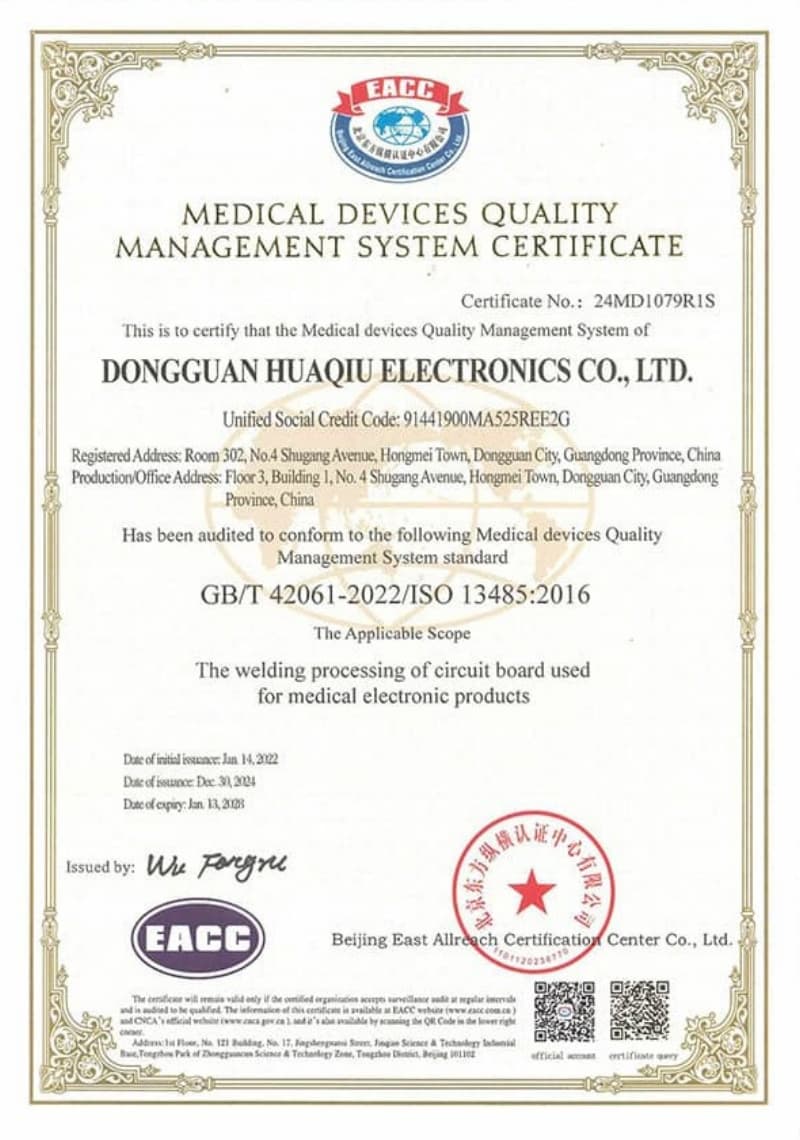
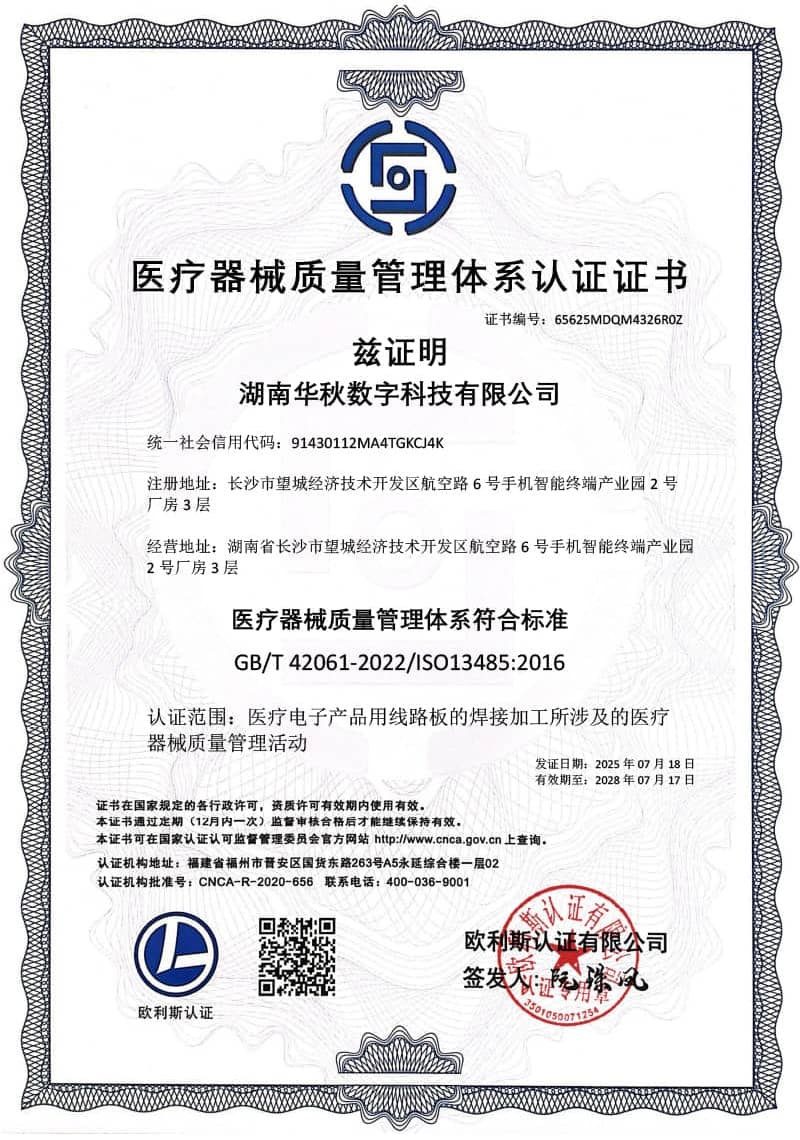
In contrast, to meet the stringent demands of medical customers, NextPCB has invested heavily in system construction. According to the latest certificate obtained by NextPCB's production entity (Dongguan Huaqiu Electronics Co., Ltd.), we have officially passed the GB/T 42061-2022 / ISO 13485:2016 certification. The scope of the certificate explicitly covers "The welding processing of circuit board used for medical electronic products". This confirms that NextPCB possesses officially recognized medical-grade PCBA assembly qualifications, fundamentally addressing compliance pain points and audit risks for medical device customers. You can verify our qualifications at NextPCB Compliance & Certificates. This is not just an endorsement of manufacturing capability, but a rigorous commitment to product traceability and reliability.
Not sure how to vet a supplier's certification claims before committing? See our practical framework for selecting an ISO 13485 PCB assembly partner, including a capability comparison table and a pilot-run validation checklist.
Many startups or companies transitioning into the medical field often underestimate the compliance costs of supply chain management. In an industry with zero tolerance for error, customers face very real pain points. ISO 13485 is a systematic tool to solve these issues.
The Issue: Unlike consumer electronics where a failure might just require a restart, medical electronics (e.g., patient monitors, ventilators, IVD equipment, defibrillators) can cause injury or death if they fail. Solder defects or micro-shorts that go unnoticed in standard testing might trigger catastrophic failures in actual hospital environments due to temperature shifts or electromagnetic interference.
The Solution: ISO 13485 mandates strict "Process Control" and "Process Validation." In a certified PCBA facility, every critical step—solder paste printing, SMT placement, reflow profiles, and wave soldering—must undergo rigorous validation (IQ/OQ/PQ). Any process parameter changes must go through a formal Change Control process, ensuring that electrical and physical reliability remain consistent from the first board to the ten-thousandth.
The Issue: When an adverse event occurs and a recall is initiated, regulatory bodies like the FDA require detailed traceability reports. If a product was made by a non-certified facility, the customer might only be able to trace back to a "PCBA batch," rather than identifying exactly which batch of capacitors or which wafer reel was at fault. This leads to massive, blind recalls and devastating financial losses.
The Solution: Traceability is a cornerstone of ISO 13485. During NextPCB's medical-grade assembly, we implement strict batch management. We record production dates, operators, and test results, and link component Lot Numbers, Date Codes, and supplier info to specific PCBA Serial Numbers (SN). This allows for precise "Forward Traceability" (raw material to finished product) and "Backward Traceability" (finished product to raw material).
The Issue: The global electronics market faces risks from counterfeit or refurbished components. If a medical device includes substandard parts, the consequences are severe. General factories often only check quantity and appearance upon arrival.
The Solution: ISO 13485 imposes strict requirements on supplier selection, evaluation, and control. In a compliant PCBA workflow, procurement is restricted to original manufacturers and authorized distributors. IQC (Incoming Quality Control) not only verifies materials but also conducts electrical sampling, X-Ray inspection, or Decap analysis when necessary to prevent counterfeit parts from entering the production line.
Obtaining certification for "Welding processing of circuit boards for medical electronic products" means the factory must execute standards higher than those used in consumer electronics in several specific areas:
ISO 13485 emphasizes integration with ISO 14971 (Risk Management for Medical Devices). Before production, engineering teams conduct PFMEA (Process Failure Mode and Effects Analysis). For instance, since BGA solder quality cannot be verified visually, the factory must identify this risk and mandate 3D X-Ray inspection as a critical control point to detect voiding, systematically mitigating risks throughout the product lifecycle. For advanced medical applications, specialized techniques such as ISO 13485 certified microvia PCB manufacturing are often employed to ensure signal integrity and device miniaturization.
Medical electronics are sensitive to contamination and ESD (Electrostatic Discharge). Some invasive or high-precision devices require extremely low ionic residue and high Surface Insulation Resistance (SIR). The system requires monitoring of production environments (temp/humidity, ESD systems) and even the cleanliness of compressed air. Post-soldering, PCBA might require ultrasonic cleaning with medical-grade agents followed by ionic contamination testing.
Certified factories usually adopt IPC-A-610 Class 3 (High Performance Electronic Products) for assembly and inspection by default. Class 3 has much stricter tolerances for solder fillet height, hole fill, and component alignment, requiring advanced equipment and IPC-certified operators.
Modern PCBA relies on automated equipment (SMT, AOI, ICT). ISO 13485 requires that any software or automated program impacting product quality must undergo Software Validation before its first use or after any changes. This ensures that SMT coordinates or AOI algorithms do not suffer from bugs that cause systematic misjudgments.
Choosing an ISO 13485 certified PCBA provider like NextPCB offers long-term strategic advantages:
In medical hardware manufacturing, the PCBA is the "brain" and "heart" of the system. Moving from consumer prototyping to medical-grade manufacturing requires a leap across a vast gap of quality management and process accumulation. For R&D firms, low-cost prototype shops are fine for Proof of Concept (POC), but for Clinical Trials (NPI) and mass production, choosing a certified assembly partner is a non-negotiable requirement.
By obtaining ISO 13485 certification for "welding processing," NextPCB has integrated medical-grade quality control into every solder joint. We are committed to providing reliable, traceable, and risk-free PCBA manufacturing support for the medical device industry.
Q1: Do both PCB fabrication and PCBA (assembly) need ISO 13485 certification?
Ideally, yes. For high-risk medical devices, manufacturers usually require the entire supply chain to be compliant. PCBA is particularly critical because it involves component procurement and complex thermal processes, which carry higher risks of introducing defects.
Q2: What is the core difference between ISO 13485 and ISO 9001?
ISO 9001 is a general standard focused on "continuous improvement" and "customer satisfaction." ISO 13485 is specific to medical devices and prioritizes "Risk Management," "Compliance," "Traceability," and "Stability of Processes" over general improvement.
Q3: Must I use an ISO 13485 factory for prototyping?
For early-stage conceptual prototypes, you can use standard factories. However, for engineering validation (EVT/DVT), type testing, EMC testing, or clinical trials, it is strongly recommended to switch to an ISO 13485 facility to ensure the prototypes match the quality system of the final production units.
Q4: NextPCB's certificate mentions "welding processing"; what does this include?
In manufacturing terms, this refers to the full PCBA (PCB Assembly) service, including component procurement (BOM management), IQC, solder printing, SMT, DIP (wave soldering), AOI/X-Ray inspection, cleaning, and functional testing.
Q5: Can we obtain component-level traceability records?
Yes. Under ISO 13485, the factory maintains production records, first-article reports, and detailed material traceability lists. These records are kept for a duration typically exceeding the device's service life and are available for regulatory audits.
Still, need help? Contact Us: support@nextpcb.com
Need a PCB or PCBA quote? Quote now