NextPCB Capabilities
Printed Circuit Boards
NextPCB Capabilities
Printed Circuit Boards
 PCB Assembly
 Layer Buildup
 SMD-Stencils
 PCB Design-Aid & Layout
 Mechanics
 Quality
 Drills & Throughplating
 Factory & Certificate
 PCB Assembly Factory Show
Certificate
PCB Assembly Factory Show
Certificate

Support Team
Feedback:
support@nextpcb.com


Printed Circuit Boards (PCBs) are the brains behind almost every modern device, but they are also highly vulnerable to the environments in which they operate. Whether it's a washing machine, a smart car, or life-saving medical equipment, protecting these sensitive electronics from environmental erosion is critical. This is where pcb conformal coating comes into play.
Conformal coating—also known as circuit board protection oil, anti-moisture paint, or insulating coating—is a protective chemical film applied directly to the PCB assembly. Its primary purpose is to protect the board from harsh environmental factors, thereby improving and extending the service life of the device while ensuring safety and reliability.
In this comprehensive guide, we will explore the core benefits of conformal coatings, dive into their typical applications across various industries, and explain how partnering with a reliable manufacturer like NextPCB can elevate your product's durability.
At its core, a high-quality conformal coating provides the essential "Three Defenses": it renders the board waterproof , moisture-proof , and dust-proof . However, modern applications demand much more.
A well-applied coating creates a robust barrier that offers resistance to:
For engineers looking to make their conformal coating waterproof , selecting the right material and application process is the difference between a product that lasts a decade and one that fails in a month.
The environment dictates the level of protection your board needs. Here is how conformal coating is utilized across five key sectors, addressing specific engineering pain points in each:
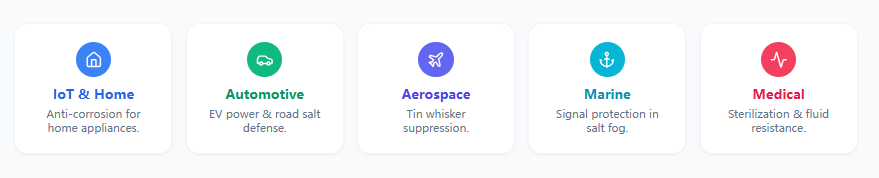
Home appliances and commercial IoT devices face surprisingly harsh daily environments. As Consumer Electronics trend toward extreme miniaturization using High-Density-Interconnect (HDI) PCBs, the spacing between traces shrinks, making them highly susceptible to moisture-induced dendritic growth (dendrites causing micro-shorts).
Conformal coatings protect these densely packed circuits from:
NextPCB's Turnkey PCB Assembly services ensure that your smart devices remain reliable, scalable, and fully protected against daily wear and tear, preventing premature failures in consumer hands.
The automotive sector demands that electronics survive brutal conditions under the hood: exposure to gasoline vapors, brake fluids, corrosive salt spray from winter roads, and extreme thermal cycling (-40°C to +150°C). With the rapid shift toward 800V architectures in Electric Vehicles (EVs) and complex Advanced Driver Assistance Systems (ADAS), reliable conformal coating electronics have become a fundamental safety requirement.
High-voltage EV systems carry a severe risk of arcing and dielectric breakdown if moisture bridges the gap between high-power traces. Thick copper PCBs combined with premium conformal coatings significantly increase the dielectric withstand voltage, preventing catastrophic short circuits. Additionally, coatings protect sensitive silver resistors from sulfur gas corrosion—a notorious cause of automotive sensor failure.
NextPCB is IATF 16949 certified, meaning our Automotive PCBs and Turnkey Assembly services meet the rigorous quality management standards required by top-tier automotive suppliers.
Because of the highly specialized operational environments, aerospace and aviation electronic equipment face the strictest requirements on the planet. Even under conditions of rapid pressurization, depressurization, and intense high-altitude radiation, circuits must maintain flawless performance.
One of the most critical pain points in aerospace is the formation of "tin whiskers"—microscopic conductive filaments that grow from lead-free solders in a vacuum, which can easily short out a satellite or flight control system. Conformal coatings act as a physical barrier to suppress this whisker growth. Furthermore, coatings used in space must meet strict low-outgassing standards (like ASTM E595) to ensure that the chemical film doesn't release vapors that could fog optical lenses or sensors in a vacuum.
Whether navigating a freshwater lake or a highly corrosive saltwater ocean, marine environments are incredibly destructive to unprotected electronics. Constant exposure to salt fog accelerates galvanic corrosion on any exposed copper pad or solder joint.
In marine navigation and communication arrays (often utilizing high-frequency Rogers PCBs), even microscopic moisture absorption can alter the parasitic capacitance of the board, destroying signal integrity. Conformal coatings provide a thick, impermeable moisture barrier that maximizes protection for surface ships and submersible equipment. They prevent rapid oxidation, maintain the necessary dielectric properties, and stop short circuits caused by salt-laden humidity.
Medical electronics often face unique, life-or-death operating environments. Wearable monitors must resist human sweat and body oils, while surgical equipment and diagnostic machines face repeated, aggressive sterilization processes, including harsh chemical wipe-downs (alcohol, bleach) and autoclave cycles (high heat and pressurized steam).
Applying the right coating—often biocompatible variants—protects these critical devices from chemical ingress and moisture degradation. This ensures continuous, stable, and accurate performance for pacemakers, ventilators, and MRI controllers, where unexpected equipment failure is simply not an option.
When manufacturing Medical PCBs, NextPCB adheres strictly to ISO 13485 standards. Our advanced PCB capabilities ensure precision engineering for the most demanding medical requirements.
There are several types of conformal coating materials, including Acrylic (AR), Polyurethane (UR), and Epoxy (ER). However, when dealing with extreme temperatures or flexible circuits, silicone conformal coating (SR) is often the superior choice.
Silicone coatings offer exceptional flexibility, making them ideal for high-vibration environments and Rigid-Flex PCBs. They also possess the widest operating temperature range, performing reliably in both freezing conditions and high-heat scenarios (often up to 200°C). While they can be slightly thicker than acrylics, their stress-relieving properties make them a favorite in the automotive and aerospace industries.
Applying conformal coating for pcb assemblies isn't just an afterthought; it requires careful design considerations. Engineers must clearly define "keep-out" zones in their Gerber files—areas like connectors, test points, and switches that must not be coated, as the insulating paint would disrupt electrical connectivity.
Transitioning from design to a fully coated, assembled board requires a manufacturing partner you can trust. Here is why engineers choose NextPCB:
Yes. Conformal coatings act as thermal insulators. If you are designing Heavy Copper PCBs or Aluminum PCBs for heat dissipation, coating the heat sinks, thermal vias, or power-dissipating components (like high-power LEDs or MOSFETs) can trap heat and lead to thermal failure. Always define clear masking areas for thermal pathways.
Applying a coating adds a dielectric layer over the microstrip or stripline traces, which changes the effective dielectric constant (Dk) and dissipation factor (Df) of the board surface. For High-Speed or Rogers PCBs, this can alter trace impedance and cause signal loss. Designers must account for the coating's dielectric properties during the design phase using an Impedance Calculator.
Capillary action can suck liquid coating into fine-pitch connectors, ruining the electrical contacts. To prevent this, engineers should specify minimum distances between coated areas and keep-out zones. Manufacturers like NextPCB use precision automated spray valves, temporary peelable solder masks, or custom masking boots to strictly protect sensitive components.
Choose Acrylic for general consumer electronics where basic moisture protection is needed; it is cost-effective, cures quickly, and is very easy to remove with solvents for rework. Choose Silicone for harsh environments (automotive, aerospace) where high temperatures (up to 200°C), thermal shock, and vibration are primary concerns.
It depends on the material. Acrylic coatings can be easily dissolved with standard solvents for quick soldering repairs. Polyurethane and Epoxy coatings offer excellent chemical resistance, which unfortunately makes them very difficult to strip (requiring harsh chemicals or mechanical grinding). Silicone can be cut or peeled away for spot repairs, but leaves a residue that must be thoroughly cleaned before re-coating.
Whether you are designing a high-frequency Rogers PCB for a communication tower, a Heavy Copper board for power transmission, or a compact HDI board for an IoT device, conformal coating is the ultimate insurance policy for your hardware.
Don't let environmental factors compromise your hard work. Get an Instant PCB & Assembly Quote from NextPCB today, and let our expert engineers help you build electronics that are truly built to last.
Still, need help? Contact Us: support@nextpcb.com
Need a PCB or PCBA quote? Quote now