Overview
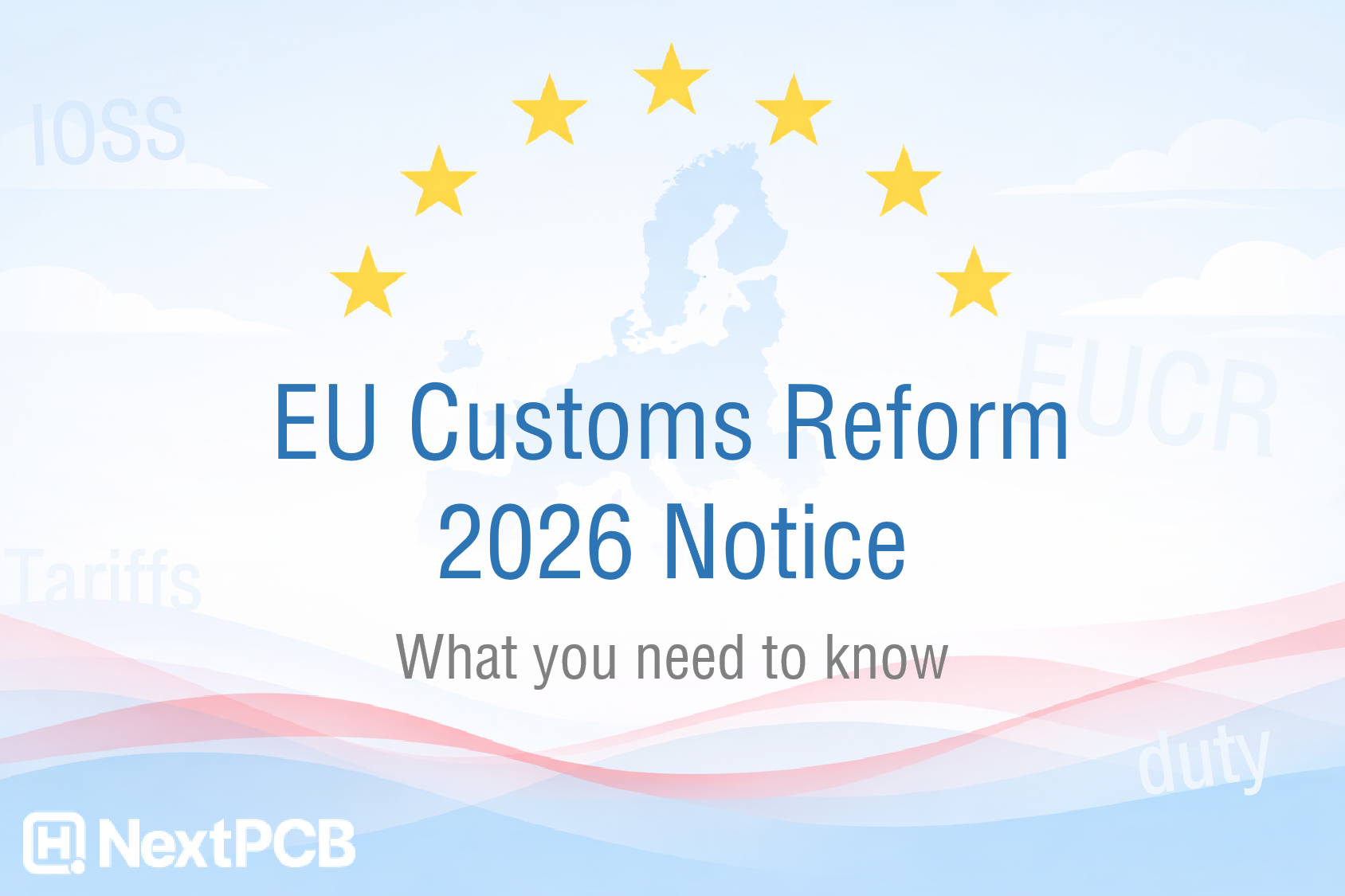
The European Union will implement a major customs policy change on July 1, 2026, removing the long‑standing ≤150 EUR low‑value import duty exemption for goods entering EU member states. Under the new EU Customs Reform (2026/382), all shipments — regardless of order value — will be subject to customs duty clearance.
This update applies to all PCB, PCBA and component orders shipped from NextPCB (including HQ Online) to EU destinations.
Customers should refer to this notice to help prepare for the transition. This page will be updated as new information becomes available.
What Is Changing on July 1
Beginning July 1:
- The ≤150 EUR customs duty exemption is removed.
- All shipments to the EU must be formally declared, and customs duty rules apply to every shipment regardless of value.
- Postal and IOSS consignments valued ≤150 EUR will be subject to a new temporary customs duty of 3 EUR per customs line item until July 1, 2028
Where postal refers to shipments handled by national postal operators such as China Post, EU Post, etc, Non-IOSS courier shipments are subject to formal customs duty rates.
These changes are mandated by the European Union as part of the roadmap towards data-driven EU Customs Reform (EUCR) and streamlined cross-border trade.
Countries Affected
The reform applies only to EU member states.
This includes all 27 countries:
- Austria
- Belgium
- Bulgaria
- Croatia
- Cyprus
- Czech Republic
- Denmark
- Estonia
- Finland
- France
- Germany
- Greece
- Hungary
- Ireland
- Italy
- Latvia
- Lithuania
- Luxembourg
- Malta
- Netherlands
- Poland
- Portugal
- Romania
- Slovakia
- Slovenia
- Spain
- Sweden
Non‑EU countries are not affected, including the United Kingdom, Switzerland, Norway, Iceland, Turkey, and other non‑EU European markets.
How Charges are Calculated and Collected
After the July 1 2026 changes, both VAT and customs duty will be applied on all shipments to EU destinations, regardless of value.
Customs duty
Intrinsic value ≤150 EUR
Postal and IOSS consignments with an intrinsic (excluding shipping) value under 150 EUR will be subject to fixed customs duty of 3 EUR per HS line, or customs line item. This is a temporary transitional measure that is set to be replaced with a new customs duty model in July 1, 2028.
A customs line item is defined by grouping all goods that share the same HS code, product description, and origin into a single line; each unique HS code in the shipment creates one line item.
Intrinsic value >150 EUR
For postal consignments with an intrinsic value greater than 150 EUR, standard customs duty rates apply and IOSS cannot be used.
VAT
VAT rules remain unchanged by the July 1 reform. VAT has already applied to all imports into the EU since 2021, when the previous ≤22 EUR VAT exemption was abolished. The July 1, 2026 changes affect customs duty, not VAT. IOSS can be used to streamline handling and allow for VAT pre-payment.
Handling Fees
Carrier disbursement fees are charged by DHL/UPS/FedEx/postal operators when they advance VAT or duty on behalf of the customer. Carriers apply a service fee — often with a minimum amount — for performing this payment and clearance.
EUCR fees are an EU-level customs handling fee that is expected to be unified in November 2026 as part of the EU Customs Reform. Some EU member states have already introduced their own local customs handling fees.
Consolidating Shipments
To minimize costs during the transition period, we recommend consolidating smaller orders where possible. VAT, customs duty, and handling fees are charged per shipment, and customs line items are grouped by HS code, product description, and country of origin. Similar items shipped together (e.g., multiple PCB orders) often fall under the same HS code and therefore form a single customs line.
For HQ Online component orders, multiple customs line items may be triggered because different component categories often fall under different HS codes. To reduce the number of customs lines, it is advisable to select components that share the same HS code and country of origin, which prevents multiple charges for items that are otherwise similar.
NextPCB IOSS Integration (Now Live)
NextPCB has fully activated IOSS (Import One‑Stop Shop) to streamline import VAT handling for EU customers. IOSS is eligible for non‑business (B2C) shipments ≤150 EUR, allowing VAT to be prepaid at checkout rather than collected on delivery.
Impact of the July 1 EU Customs Reform
Under the new EUCR rules, all low‑value imports (≤150 EUR) are subject to:
- a €3 per customs line duty, and
- VAT calculated on the total customs value,
which makes non‑IOSS shipments significantly more expensive and slower. Without IOSS, carriers must advance VAT and duty to customs, resulting in higher disbursement fees and more manual clearance steps.
IOSS does not change customs duty, but it removes VAT‑on‑import, which is the part of the system most costly and unpredictable for customers.
How NextPCB Applies IOSS
Small‑parcel shipments now automatically use IOSS, ensuring VAT is prepaid and eliminating VAT‑on‑delivery and high carrier handling fees.
Courier shipments (DHL / UPS / FedEx) allow customers to choose whether to clear via IOSS or standard customs, depending on their workflow.
Benefits for EU Customers
Once IOSS is enabled for a shipment:
- VAT is paid upfront at checkout
- Shipments clear customs more quickly
- Carrier VAT handling fees are avoided
- Landed costs become clear and predictable before placing an order
This upgrade ensures a smoother, more transparent import experience for EU customers navigating the July 1 customs changes.
Contact
Thank you for your understanding as these EU‑wide changes take effect. For questions regarding EU shipments, VAT handling, or IOSS processing, please contact your personal account manager or our support team at: support@nextpcb.com
FAQ
Why are these changes being made?
The EU customs reform taking effect on July 1 are being made to modernise EU customs for low‑value imports. The EU is replacing the old duty‑free rule and introducing a temporary €3 duty to manage rising e‑commerce volumes while it builds a new centralised customs system. Once that system is ready, a new long‑term duty model will replace the transitional measure.
Does this affect non‑EU countries?
No. The reform applies only to the 27 EU member states.
Countries like the UK, Switzerland, Norway, and Turkey are not affected.
Does VAT still apply to all imports?
Yes. VAT has always applied to all imports, even before the 2026 reform.
The old VAT exemption (≤22 EUR) ended in 2021 when IOSS was first introduced.
Does IOSS handle or reduce customs duty?
No. IOSS only affects VAT handling. Customs duty is determined by HS‑code rules and the July 1 reform. However, prepaying VAT removes VAT‑on‑import, which becomes slower and more expensive under the new system.
Who can use IOSS?
IOSS applies only to non‑business (B2C) shipments with an intrinsic value ≤150 EUR. Business (B2B) shipments and orders >150 EUR cannot use IOSS. VAT-registered businesses must enter their valid EU VAT number at the checkout to be classified as B2B.
What defines a customs line?
A customs line (also called a customs line item or HS‑line) is the unit customs authorities use to calculate duty under the July 1 reform — including the €3 per‑line duty for low‑value postal/IOSS shipments.
A customs line is created for each group of goods that share the same HS code, product description, and country of origin. Every unique HS code in the shipment becomes one customs line:
HS code — the tariff classification of the product
Product description — items must be described the same way
Country of origin — origin must match
When all three match, items are grouped into one customs line. If any one differs, a new customs line is created.
Examples
20 resistors with HS 8533.21, same description, same origin → 1 customs line
5 ICs with HS 8542.39, same origin → 1 customs line
PCBs (HS 8534.00) + PCBA (HS 8538.90) → 2 customs lines
Therefore consolidating shipments can help reduce overall fees.
How should customers handle the new customs duty?
Customs duty is collected directly by the carrier (DHL, UPS, FedEx, or the national postal operator). These charges are not paid to NextPCB and are not covered by IOSS.
Customers should expect the carrier to request payment before delivery or at delivery, depending on the carrier's workflow.
Can customs duties be refunded if my package is returned?
No. For B2C low‑value shipments ≤150 EUR that have already been released into free circulation, the temporary customs duties charged under the July 1 reform are non‑refundable, even if the parcel is returned.


 NextPCB Capabilities
 PCB Assembly
 Layer Buildup
 SMD-Stencils
 PCB Design-Aid & Layout
 Mechanics
 Quality
 Drills & Throughplating
 Factory & Certificate
 PCB Assembly Factory Show
Certificate
PCB Assembly Factory Show
Certificate
 NextPCB Capabilities
 PCB Assembly
 Layer Buildup
 SMD-Stencils
 PCB Design-Aid & Layout
 Mechanics
 Quality
 Drills & Throughplating
 Factory & Certificate



 Quote now