

Stacy Lu

 NextPCB Capabilities
Printed Circuit Boards
NextPCB Capabilities
Printed Circuit Boards
 PCB Assembly
 Layer Buildup
 SMD-Stencils
 PCB Design-Aid & Layout
 Mechanics
 Quality
 Drills & Throughplating
 Factory & Certificate
 PCB Assembly Factory Show
Certificate
PCB Assembly Factory Show
Certificate

Support Team
Feedback:
support@nextpcb.com


Tear down any modern smartphone or high-end GPU, and you'll be greeted by a sea of microscopic 0201 or even 01005 Surface Mount Technology (SMT) components. In today's relentless pursuit of extreme miniaturization and high-frequency signal integrity, SMT is the undisputed king.
This dominance often leads junior PCB designers to a common misconception: "Through-Hole Technology (THT) is an ancient relic. Premium boards should be 100% SMD."
But step just slightly off the consumer electronics path into industrial control, high-power supplies, or automotive electronics, and you'll find THT holding its ground as firmly as ever. A highly upvoted comment in the famous r/AskElectronics community sums it up perfectly: "Give me a TO-220 package, some thermal paste, and an M3 bolt, and I'll use it any day."
So, here in 2026, what makes veteran engineers still reach for THT when laying out a board?
Before we dive deep, let's look at a quick baseline comparison of the physical and electrical realities of SMT vs. THT:
Table 1: SMT vs. THT - Core Characteristics & Use Cases
| Attribute | Surface Mount Technology (SMT) | Through-Hole Technology (THT) | Engineer's Design Logic |
|---|---|---|---|
| Assembly | Placed on surface pads, reflow soldered | Pins penetrate PCB, wave/hand soldered | SMT dominates high-volume automation. |
| Mechanical Strength | Weak (relies purely on pad adhesion) | Extreme (penetrates FR-4, metal casing) | THT is mandatory for heavy connectors. |
| High-Freq Performance | Excellent (minimal parasitic parameters) | Poor (long leads create parasitic cap/ind) | RF and high-speed digital demand SMT. |
| Space Efficiency | Very High (surface only, allows double-sided) | Low (vias block routing on all inner layers) | High-density HDI boards require SMT. |
| Thermal Dissipation | Relies on thermal vias and PCB copper area | Supports massive external heatsinks | Power devices (TO packages) favor THT. |
| Repairability | Requires hot air stations & microscopes | Easily fixed with a basic soldering iron | Industrial longevity heavily favors THT. |
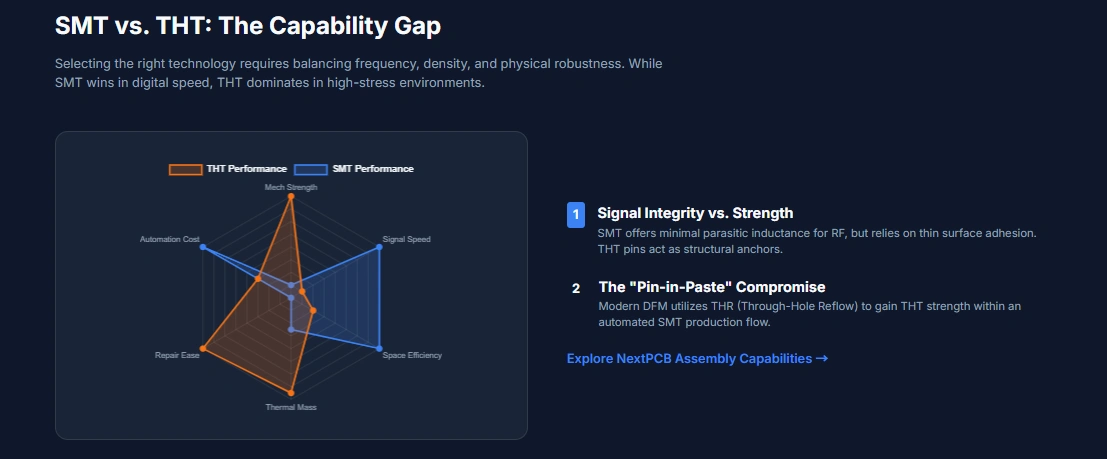
This is the physical gap SMT can never bridge. SMT components simply "sit" on the surface. Their resistance to mechanical stress relies entirely on the adhesion of a microscopic layer of copper foil and solder paste.
In the real world, PCBs are subjected to serious physical abuse:
THT leads pass all the way through the board, anchored by a solid plug of solder formed during wave soldering. This "rooted" structure provides unmatched mechanical strength against shear and pull forces.
Handling serious current is THT’s traditional stronghold. When dealing with high-wattage dissipation, your thermal path dictates whether your product lives or goes up in smoke.
For SMT power devices, heat must be pushed down through thermal vias into large, internal copper planes. This eats up incredibly valuable routing space and is fundamentally bottlenecked by the thermal resistance of the FR-4 substrate itself.
In contrast, classic THT packages (like TO-247 or TO-220) feature a dedicated metal mounting tab. Engineers can bolt them directly to massive extruded aluminum heatsinks—or even use the product's metal enclosure as a heatsink—paired with active airflow. This direct-to-ambient thermal transfer is something micro SMDs simply cannot replicate.
Consumer tech is designed for a 2 to 3-year lifecycle—if it breaks, you chuck it. But industrial variable frequency drives, medical monitors, or grid protection relays are expected to operate for 20 to 30+ years.
When a machine goes down in a remote mine or a dusty factory floor:
In the early Proof-of-Concept (PoC) stages, THT is still the king of rapid iteration.
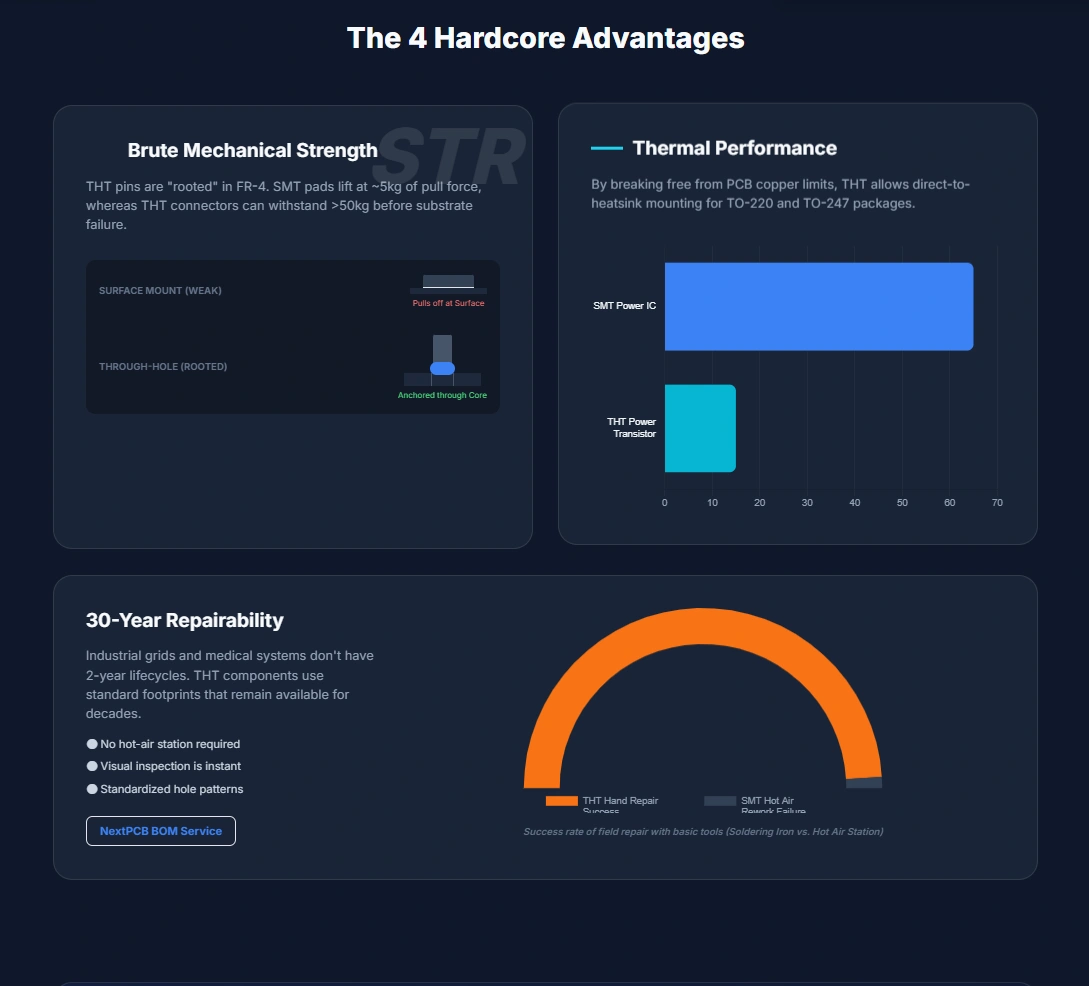
If THT is so robust, why not use it everywhere? Because when it comes to Signal Integrity (SI) and mass production costs, THT hits a hard ceiling.
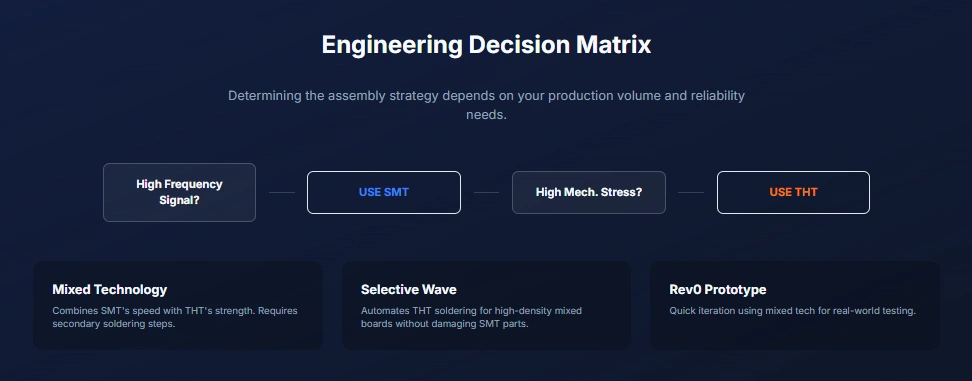
When evaluating Design for Manufacturability (DFM) or dropping files to a contract manufacturer, engineers must navigate the hidden costs of "Mixed Technology" assembly:
Table 2: DFM Cost Analysis for Mixed SMT/THT Technology
| DFM Challenge | Production Pain Point | The Hidden Cost | Engineer's Solution |
|---|---|---|---|
| Blocked Inner Routing | THT vias punch through the whole board, severing ground planes and blocking high-speed tracks. | Forces unnecessary layer count increases, spiking bare board costs. | Ban THT in high-speed zones; group THT connectors strictly along the board edges. |
| Secondary Assembly Steps | After reflow, the board must go through wave soldering or manual hand soldering for THT parts. | Increases lead time, labor costs, and thermal stress on SMT components. | Minimize THT BOM count, or transition to Through-Hole Reflow (THR) components. |
| Wave Solder Fixtures | If bottom-side SMT exists, custom pallets (fixtures) are required to shield SMDs during wave soldering. | High NRE (Non-Recurring Engineering) fees, only viable for large production runs. | Discuss with your CM early to find the breakeven point between fixture costs and hand-soldering. |
If you need the mechanical strength of THT but refuse to pay for a secondary wave soldering step, modern manufacturing offers an elegant solution: Pin-in-Paste (PiP) / Through-Hole Reflow (THR). By using high-temp rated THT components, solder paste is printed directly into the plated through-holes, and the THT part goes through the standard SMT reflow oven alongside everything else.
However, this requires extreme precision in stencil step-down design and solder volume calculation. This makes auditing your manufacturer's PCB Assembly Capabilities critical. Whether your layout is a high-density HDI design or a rugged mixed-tech power board, partnering with elite PCB Assembly Services (Gia công PCBA) can help you avoid nasty manufacturing traps before you even finalize your Gerber files.
Q1: Everyone is pushing SMT. Will THT parts go completely obsolete and become impossible to buy in the next 10 years?
A: Absolutely not. While digital logic ICs abandoned DIP packages long ago, the demand for THT in power electronics (capacitors, MOSFETs, relays) and electromechanical parts (switches, connectors) is massive. The industrial, military, and automotive supply chains rely on them. The "THT is dying" narrative is mostly baseless fear-mongering.
Q2: My design is 98% SMT, with just two through-hole pin headers. Will the factory charge me massive wave soldering fees for this?
A: Generally, no. For extremely low THT part counts, a reputable contract manufacturer won't run it through a wave machine. They will use Selective Wave Soldering or simply have skilled technicians hand solder them post-reflow. During the DFM review, you can negotiate the most cost-effective routing with your CM.
Q3: I'm a hobbyist and I hate the idea of learning SMT soldering. Is it bad to stick purely to THT?
A: If you are building low-frequency analog circuits (like audio synthesizers or guitar pedals), THT is perfectly fine. But if you want to play with modern MCUs (like an ESP32) or high-speed sensors, SMT is unavoidable. Honestly, with a cheap hotplate or a hot air gun, SMT soldering is actually faster and cleaner than clipping leads on 50 through-hole resistors. Don't let the small size intimidate you!
SMT and THT are not enemies; they are complementary tools in an engineer's arsenal. The most mature commercial designs follow a simple rule: "Let SMT handle the brains, logic, and high-speed routing, while THT does the heavy lifting for power delivery, interfaces, and structural integrity."
If you've just finished routing a mixed-technology board and are looking for a reliable partner for prototyping or mass production, NextPCB offers highly automated SMT lines paired with veteran selective/manual soldering teams. Simply upload your Gerbers and BOM to get a transparent, instant Online PCBA Quote (Sebut Harga PCBA), and let's get your hardcore hardware built right the first time.
>> Full PCB Assembly Guide at NextPCB Here.
Get an instant quote for your mixed-technology designs. From quick prototypes to industrial-scale manufacturing.

Still, need help? Contact Us: support@nextpcb.com
Need a PCB or PCBA quote? Quote now