

Lolly Zheng- Sales Account Manager at NextPCB.com

 NextPCB Capabilities
Printed Circuit Boards
NextPCB Capabilities
Printed Circuit Boards
 PCB Assembly
 Layer Buildup
 SMD-Stencils
 PCB Design-Aid & Layout
 Mechanics
 Quality
 Drills & Throughplating
 Factory & Certificate
 PCB Assembly Factory Show
Certificate
PCB Assembly Factory Show
Certificate

Support Team
Feedback:
support@nextpcb.com


Abstract: Surface Mount Device (SMD) resistors are the most ubiquitous passive components in modern electronics. However, when designing analog front-ends, precision instrumentation, or sensitive RF circuits, the choice of resistor technology becomes a critical factor for success. The debate between thin-film resistors and thick-film resistors is fundamentally about balancing precision, reliability, and cost. This comprehensive guide breaks down the manufacturing differences, core specifications (like Tolerance and TCR), and essential PCB layout rules to help hardware engineers choose the right chip resistor technology for high-accuracy PCB designs.
Thick-film resistors are the industry standard for general-purpose electronic circuits, accounting for the vast majority of surface-mount resistors used in PCB assembly today. They are manufactured using a screen-printing process. A resistive paste—composed of metal oxides (typically ruthenium oxide) mixed with a glass frit and organic binders—is printed onto a ceramic substrate (usually alumina, Al2O3).
After printing, the substrate is fired at high temperatures (around 850°C) to burn off the binders and fuse the glass and metal oxide into a solid, durable film. This film is relatively "thick," typically ranging from 10 to 50 micrometers (μm).
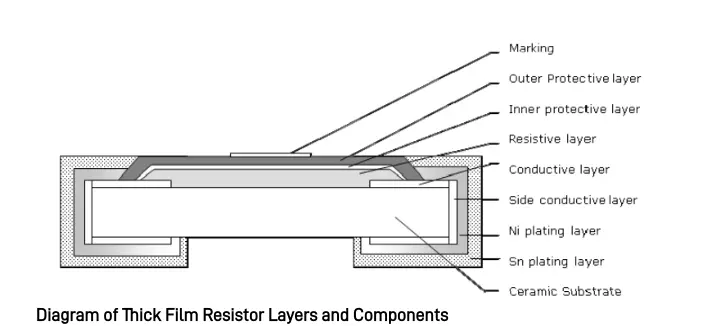
Because of this rugged glass-metal matrix, thick-film resistors excel in harsh environments. They can handle high current surges, making them excellent candidates for power electronics. If your design involves significant heat dissipation, you may also want to explore specialized high-power resistor PCB design techniques. However, the granular nature of the fired paste results in higher electrical noise and makes it difficult to achieve extremely tight resistance tolerances.
Thin-film resistors, on the other hand, are the go-to choice for precision electronics. Instead of screen printing, the resistive material (often Nickel-Chromium or Tantalum Nitride) is deposited onto a high-purity ceramic or silicon substrate using a vacuum deposition process known as sputtering.
This creates a highly uniform, ultra-thin metallic layer—usually only 0.1 μm thick (hence the name "thin-film"). Because the sputtering process is tightly controlled at the atomic level, and the resistance value is fine-tuned using precision laser trimming, thin-film resistors offer unparalleled accuracy.
The homogeneous metallic structure means that thin-film resistors exhibit extremely low current noise, minimal parasitic inductance, and highly stable electrical characteristics over temperature and time. However, their ultra-thin construction makes them more vulnerable to chemical contamination (like sulfur or moisture) and catastrophic failure from electrostatic discharge (ESD) or power surges.
When selecting a chip resistor, engineers must evaluate several parameters beyond the basic resistance value. Below is a comprehensive comparison to guide your chip resistor selection.
| Parameter | Thick-Film Resistor | Thin-Film Resistor |
|---|---|---|
| Manufacturing Process | Screen printing paste and firing | Vacuum sputtering deposition |
| Film Thickness | 10 μm to 50 μm | ~0.1 μm |
| Tolerance (Accuracy) | Typically ±1% to ±5% | ±0.1% down to ±0.01% |
| TCR (Temp Coefficient) | ±100 to ±200 ppm/°C | ±5 to ±25 ppm/°C |
| Current Noise | High (due to granular structure) | Very Low (homogeneous metal film) |
| Surge / Pulse Capability | Excellent | Poor (fragile film structure) |
| Cost | Very Low | High (5x to 20x higher than thick-film) |
| Typical Applications | Digital logic, pull-ups, general circuits | Medical devices, audio, precision ADC/DAC |
In standard digital circuits, a 5% shift in a pull-up resistor's value will not cause a micro-controller to misinterpret a logic high. Thick-film resistors are perfectly adequate here. However, in analog signal processing, resistor accuracy directly defines the system's performance limit.
1. Voltage Dividers in ADC/DAC Circuits
If you are designing a high-resolution Analog-to-Digital Converter (ADC) circuit, the reference voltage must be rock solid. If you use a thick-film voltage divider, a 1% tolerance combined with a 100 ppm/°C Temperature Coefficient of Resistance (TCR) means the voltage will drift significantly as the PCB heats up. For a 16-bit ADC, this drift will instantly consume multiple Least Significant Bits (LSBs) of accuracy, rendering your high-resolution chip useless. Thin-film resistors with ±0.1% tolerance and 10 ppm/°C TCR are mandatory here.
2. Instrumentation Amplifiers (Gain Setting)
In operational amplifiers, especially instrumentation amplifiers used for reading weak sensor data (like strain gauges or load cells), the Common Mode Rejection Ratio (CMRR) is heavily dependent on the exact matching of external resistors. Any mismatch between resistors caused by temperature changes will amplify noise. Thin-film resistors provide the necessary tracking stability.
3. Audio and RF Applications
Current noise in thick-film resistors is generated by electrons navigating the random granular boundaries of the glass/metal paste. This "1/f noise" is unacceptable in high-fidelity audio pre-amplifiers. Thin-film resistors behave more like pure metal wires, generating negligible excess noise. Furthermore, their tight tolerances help maintain exact impedance matching, which is critical when designing advanced PCBs for RF applications.
Procuring an expensive 0.01% thin-film resistor is only half the battle. Poor PCB layout and assembly practices can induce mechanical stress or thermal gradients that physically alter the resistance value, defeating the purpose of using a precision component.
1. Mechanical Stress Isolation
SMD ceramic substrates are brittle. When the FR4 PCB flexes, it exerts stress on the soldered resistor. Due to the piezoresistive effect, this mechanical stress causes a measurable shift in resistance.
Layout Rule: Never place precision thin-film resistors near V-score lines, breakaway tabs, mounting holes, or heavy components (like transformers) that might cause board flexure during assembly or field use. Orient them parallel to the expected bending axis of the PCB.
2. Thermal Management and Placement
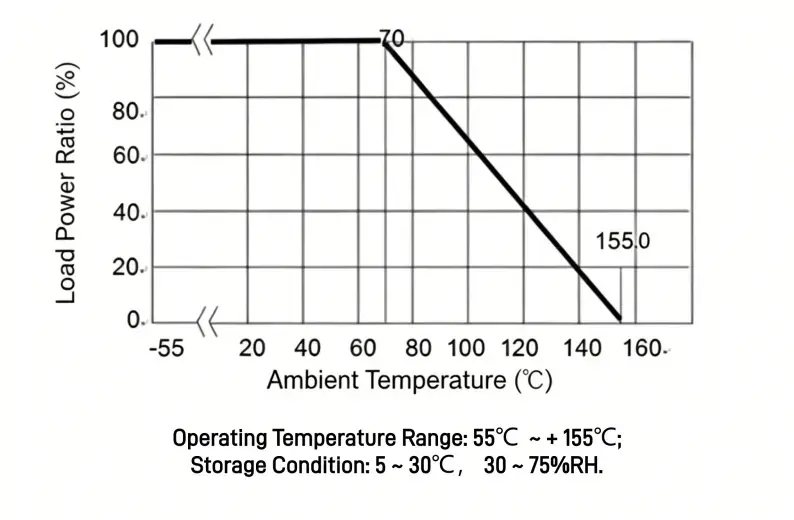
Even with a low TCR of 10 ppm/°C, extreme temperature swings will cause resistance drift. Furthermore, if a precision resistor is placed near a hot component (like a power MOSFET or voltage regulator), the uneven heating can create a thermoelectric voltage (Seebeck effect) across the resistor's terminals, introducing a DC offset error.
Layout Rule: Keep precision analog sections physically isolated from high-power power supplies. Utilize copper pours for thermal distribution to ensure the entire analog section remains at an isothermal (uniform) temperature.
3. Trace Routing and Parasitics
For very low-value precision resistors (often used for current sensing), trace resistance becomes a significant error source.
Layout Rule: Always use a 4-wire Kelvin connection layout for low-ohm precision measurements. Separate the high-current path from the voltage-sensing path directly at the resistor pads to eliminate trace resistance from the measurement loop.
| Design Element | PCB Layout Rule | Impact on Precision |
|---|---|---|
| Component Placement | Keep away from PCB edges, V-scores, and mounting holes. | Prevents piezoresistive shifts caused by mechanical stress and board flexing. |
| Thermal Zoning | Isolate from high-heat components (MOSFETs, LDOs). | Minimizes TCR drift and prevents thermocouple effects at the solder joints. |
| Pad Design | Use perfectly symmetrical pads and strictly follow IPC-7351. | Ensures even solder surface tension during reflow, preventing tombstoning and stress. |
| Trace Routing | Use Kelvin connections for resistors under 1 ohm. | Removes copper trace resistance errors from the analog measurement. |
| Moisture Protection | Consider conformal coating for harsh environments. | Thin-film materials are susceptible to moisture and sulfur ingress, which alters resistance. |
The decision ultimately comes down to your Bill of Materials (BOM) budget versus your circuit's tolerance for error.
Choose Thick-Film When:
Choose Thin-Film When:
Can I directly replace a thick-film resistor with a thin-film resistor on an existing PCB?
Physically, yes, if the package sizes (e.g., 0402, 0603) match. However, you must evaluate the power ratings and surge requirements. Thin-film resistors are much weaker against pulse loads, so placing a thin-film resistor in a power-surge environment designed for a thick-film component will likely result in failure.
Is sulfur a concern for these resistors?
Yes, standard thick-film resistors use silver-based inner terminations that can react with sulfur in the air, creating silver sulfide (an insulator) and causing the resistor to fail open. If your PCB operates in industrial or automotive environments, you must specify "Anti-Sulfur" resistors (which use gold or specialized barriers).
Does the solder paste affect resistor accuracy?
Yes, standard SAC305 lead-free solder is rigid. When the PCB cools after reflow, the mismatch in the Coefficient of Thermal Expansion (CTE) between the FR4 board and the ceramic resistor creates stress. For ultra-precision applications, engineers sometimes use specialized flexible solders or specify precise pad geometries to minimize this post-reflow stress.
Ready to assemble your PCB with the right passive components? Get a quote from NextPCB →
Whether your design requires standard thick-film arrays for digital logic or highly sensitive thin-film components for medical instrumentation, NextPCB provides world-class PCB Assembly Services. With precise automated SMT lines and rigorous AOI/X-ray inspection, we ensure your precision components are placed perfectly.

Still, need help? Contact Us: support@nextpcb.com
Need a PCB or PCBA quote? Quote now