NextPCB Capabilities
Printed Circuit Boards
NextPCB Capabilities
Printed Circuit Boards
 PCB Assembly
 Layer Buildup
 SMD-Stencils
 PCB Design-Aid & Layout
 Mechanics
 Quality
 Drills & Throughplating
 Factory & Certificate
 PCB Assembly Factory Show
Certificate
PCB Assembly Factory Show
Certificate

Support Team
Feedback:
support@nextpcb.com


Modern electronic systems no longer draw steady and predictable current. Devices such as microcontrollers (MCUs), FPGAs, SoCs, and AI processors generate rapid transient current demands within nanoseconds. A processor that averages around 1A of current may briefly require several amperes during clock switching or intensive processing. When the Power Distribution Network (PDN) is not properly designed, these sudden current spikes can cause voltage droop, increased ripple, signal integrity issues, and even random system resets.
>>> Recommen reading: Next-Gen FPGA Migration: Secure Prototyping Support for Your Arora V GW5AT Designs

Illustration of a multilayer PCB highlighting power distribution networks (PDN) and internal layer structure for stable power delivery
In modern multilayer PCB designs used in industrial IoT devices, networking equipment, and embedded systems, board space is limited while power demands continue to grow. This makes PDN design a critical part of PCB architecture rather than just a layout task. A reliable PDN relies on properly designed power and ground planes, effective decoupling capacitor placement, low-inductance vias, and optimized PCB stackup. This article explores practical techniques for designing reliable PDNs in multilayer PCBs, helping engineers achieve stable power delivery in high-performance electronic systems.
A Power Distribution Network (PDN) is the system that delivers power from the voltage regulator to the components that consume it on a PCB. It is not a single trace or component but a combination of elements including the voltage regulator module (VRM), power planes, ground planes, decoupling capacitors, vias, and copper routing that connects everything together. These elements work together to provide stable power to devices such as MCUs, processors, FPGAs, and other digital ICs.
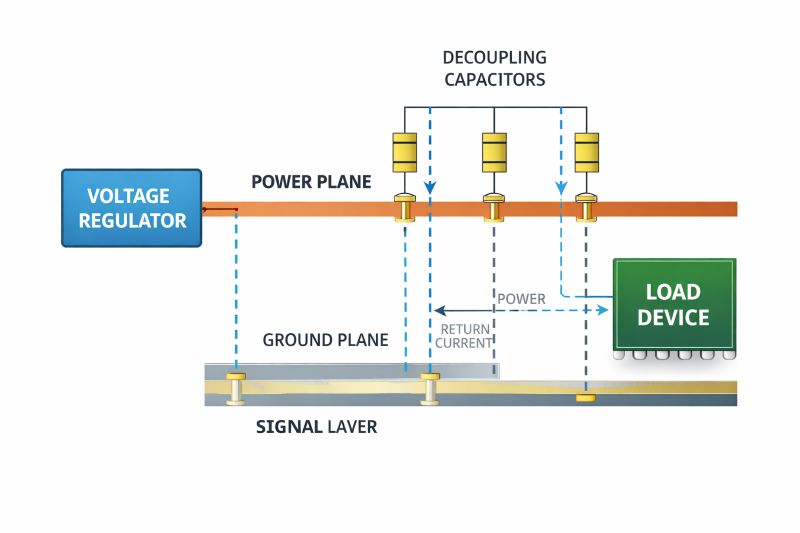
Basic PDN architecture showing power delivery from the voltage regulator to the load device using decoupling capacitors and planes
In practice, the job of the PDN is simple: ensure that the load device always receives a stable voltage , even when current demand changes rapidly. However, modern processors switch extremely fast and draw sudden bursts of current, which means the PDN must respond instantly. If the power network cannot supply this current quickly enough, voltage drops, noise increases, and system instability may occur.
The key goal of PDN design is to keep impedance low across a wide frequency range so the power network can respond quickly to current changes. Engineers typically define a target impedance based on the allowable voltage ripple and the maximum transient current drawn by the device. For example, if a processor allows 50 mV voltage ripple and can draw 2 A transient current, the PDN impedance must stay below 25 mΩ .
Maintaining this low impedance requires several design techniques working together. Bulk capacitors handle slower power changes, smaller MLCC capacitors manage mid-frequency noise, and plane capacitance inside multilayer PCBs helps suppress high-frequency disturbances. When these elements are properly arranged, the PDN can deliver stable power even during rapid switching events.
Power integrity problems often appear when current changes very quickly. At high switching speeds, even a small amount of inductance in traces, vias, or capacitor loops can generate voltage spikes. This is why PDN design focuses heavily on minimizing inductance and keeping current paths short.
In practical PCB layout, this means placing decoupling capacitors close to power pins, reducing loop area, using solid power and ground planes, and avoiding long power traces. These simple layout decisions can significantly improve PDN performance and reduce voltage noise.
A common mistake in PCB design is assuming that adding more capacitors will automatically solve power integrity problems. In reality, the PDN behaves as a system where planes, vias, traces, and capacitors all interact. Poor placement or incorrect capacitor combinations can even increase impedance due to resonance effects.
For reliable PDN performance, designers should focus on proper stackup planning, tight power-ground plane coupling, efficient decoupling placement, and minimizing inductance in current paths. Multilayer PCBs naturally help achieve this by providing large power planes and distributed capacitance, which improves high-frequency power stability.
The stability of a Power Distribution Network (PDN) is strongly influenced by the PCB stackup structure . In multilayer boards, the arrangement of signal, power, and ground layers determines how efficiently current flows and how well noise is controlled. A well-planned stackup allows power and return currents to travel through low-impedance paths, which reduces voltage fluctuations and improves overall power integrity.
A common and reliable approach is placing power planes close to ground planes . When these layers are adjacent, they create natural plane capacitance and reduce loop inductance, helping the PDN respond quickly to transient current demand. This is one of the main reasons multilayer PCBs provide better power stability than simple 2-layer designs.
A widely used stackup for many embedded and industrial designs is the 4-layer configuration :
This structure works well because the power plane is tightly coupled with the ground plane. The close spacing between these layers helps reduce noise, improves return current paths, and lowers PDN impedance. For many microcontroller-based systems and IoT devices, this configuration provides a good balance between performance and manufacturing cost.
As systems become more complex—such as boards with FPGAs, AI processors, or high-speed interfaces—designers often move to 6-layer or 8-layer stackups. Additional layers allow dedicated power planes, better ground reference layers, and improved routing flexibility. This helps maintain stable voltage rails even when current demand increases significantly.
More layers also improve EMI performance and reduce signal interference because return currents remain tightly controlled. In high-performance electronics, the stackup design becomes an important part of both power integrity and signal integrity strategy .
Before sending your high-speed multilayer design to fabrication, use HQDFM (by NextPCB)—a free, industry-grade PCB design analysis tool. Instantly detect potential PDN bottlenecks, improper clearance, via-in-pad issues, and stackup conflicts.
Download HQDFM for Free *Get a comprehensive DFM report in seconds!
Decoupling capacitors play a critical role in maintaining stable voltage at the load device. When a processor or MCU suddenly demands current, the voltage regulator cannot react instantly due to control loop limitations. Decoupling capacitors act as local energy storage , supplying short bursts of current directly to the device and preventing voltage drops.
Without proper decoupling, the power rail can experience ripple, noise, and voltage droop during switching events. This can lead to unstable operation, signal integrity issues, and sometimes unexpected resets in digital systems. Proper capacitor placement and distribution help the PDN respond quickly to these rapid current changes.
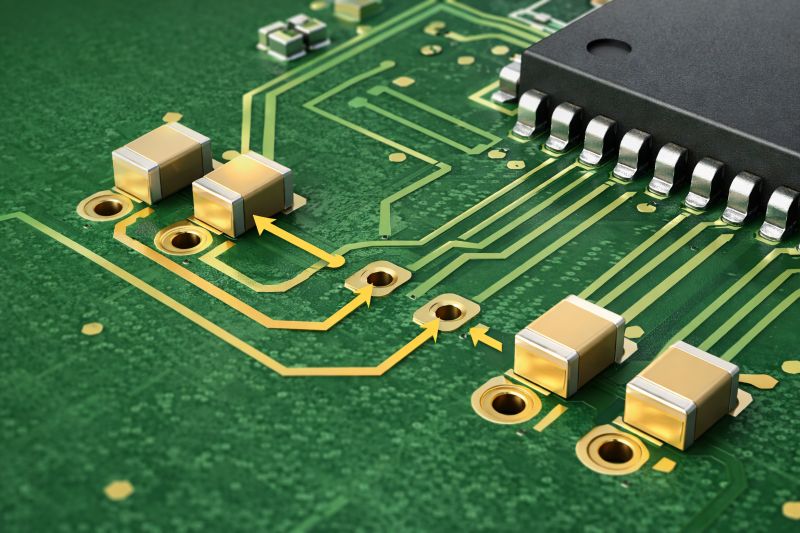
Example of good decoupling capacitor placement close to IC pins to minimize inductance and improve power stability
No single capacitor can effectively handle noise across all frequencies. Different capacitor values are used together to support different frequency ranges in the PDN. Larger capacitors typically handle slower current variations, while smaller capacitors respond to faster switching noise closer to the device.
In practice, designers often combine bulk capacitors with smaller MLCC capacitors placed near the load. This layered approach helps maintain low impedance across a wide frequency range and ensures the power rail remains stable during both slow and fast current changes.
The effectiveness of a decoupling capacitor depends heavily on its placement. Capacitors should be positioned as close as possible to the power pins of the device they support. Short connections between the capacitor, the power pin, and the ground plane help minimize inductance and allow the capacitor to respond quickly to transient current demand.
A good layout practice is to use short traces, place a ground via near the capacitor pad, and avoid long routing paths between the capacitor and the device. Reducing loop area between the power and ground connections improves high-frequency performance and keeps the PDN stable during fast switching activity.
Simply adding more capacitors does not always improve power integrity. Poor placement, shared vias, or incorrect capacitor combinations can reduce the effectiveness of the decoupling network. In some cases, poorly selected capacitor values can even introduce resonance that increases noise.
Instead of increasing capacitor count, designers should focus on proper placement, balanced value selection, and minimizing inductive paths. When combined with a well-planned multilayer stackup, an optimized decoupling strategy significantly improves PDN stability and overall system reliability.
When routing high-current power rails on a PCB, narrow traces can quickly create voltage drop and heat buildup. For example, if a 3–4 A rail is routed through a thin trace, the resistance of the copper can reduce the voltage reaching the load device. Instead of long traces, designers should use wide traces or dedicated power planes to distribute current evenly and reduce resistance.
Copper thickness also affects current capacity. Most PCBs use 1 oz copper , which is suitable for low-power circuits, but designs carrying more than 3–4 A often benefit from 2 oz copper to reduce voltage drop and improve heat dissipation. When power needs to move between layers, avoid using a single via. A common practice is to place 4–6 vias near regulators or power components so the current can spread across multiple paths. Maintaining wide copper areas and avoiding narrow sections in the power path helps keep voltage stable and improves PCB reliability.
Use power planes instead of traces for rails above ~2 A
Use 2 oz copper when current exceeds ~4 A
Place multiple vias (4–6) for high-current layer transitions
Avoid narrow copper necks in power pours
Designing a PDN on paper is only the first step. Engineers verify its performance using simulation and measurement tools to analyze behavior across different frequencies and detect issues like impedance spikes or poor decoupling before manufacturing.
Early analysis allows designers to adjust capacitor values, placement, and PCB stackup , reducing prototype revisions and ensuring stable power delivery in the final PCB.
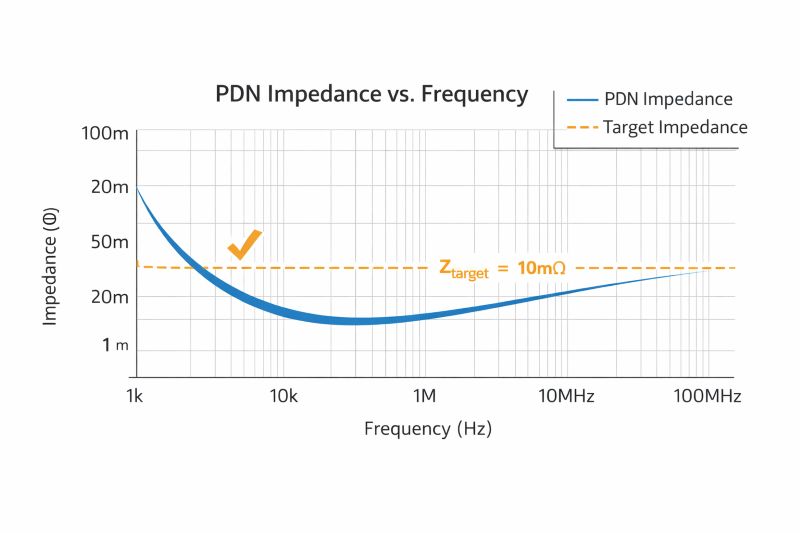
PDN impedance vs frequency plot demonstrating how impedance must stay below the target level for stable power delivery
Engineers use impedance vs frequency plots to evaluate PDN performance. A stable PDN should maintain impedance below the defined target impedance across the operating frequency range.
PDN Simulation tools allows engineers to:
After building a PCB prototype, engineers verify PDN performance by measuring power rail ripple using an oscilloscope while the system is under load . This helps determine whether the power network can maintain stable voltage during current fluctuations.
For accurate results, the oscilloscope probe should be placed close to the load device with a short ground connection. Proper probing techniques help capture the true behavior of the power rail and avoid measurement noise.
Another validation method is load step testing , where the system experiences sudden current changes. This allows engineers to observe how the voltage rail responds and how quickly it recovers after the transient event.
A well-designed PDN should show minimal voltage droop and fast recovery, confirming that the PCB can maintain stable power during real operating conditions.
The following table highlights common PDN layout mistakes in multilayer PCBs and practical ways to avoid them.
| Design Mistake | What Happens | Better Approach |
|---|---|---|
| Routing high-current rails with long traces | Long traces increase resistance and inductance, which can cause voltage drop when current demand increases. | Use power planes or wide copper pours for high-current rails. |
| Decoupling capacitors placed far from IC pins | Long connections increase loop inductance, reducing the capacitor’s ability to respond to transient current spikes. | Place decoupling capacitors close to the IC power pins with short connections to the ground plane. |
| Using only one via for power transitions | A single via can become a bottleneck and generate heat under high current. | Use multiple vias in parallel to distribute current evenly. |
| Splitting the ground plane | Return current paths become longer, increasing noise and signal integrity issues. | Keep the ground plane continuous and manage noise through layout. |
In conclusion, Designing a reliable Power Distribution Network (PDN) is essential for stable multilayer PCB performance. As modern processors and high-speed devices demand higher transient currents, the PCB power network must deliver clean and stable voltage under varying load conditions. This can be achieved through careful stackup planning, proper decoupling capacitor placement, low-impedance power planes, and efficient current paths through traces and vias. By validating designs with simulation and real measurements, engineers can ensure stable power delivery, improved signal integrity, reduced noise, and long-term reliability in high-performance electronic systems.
Still, need help? Contact Us: support@nextpcb.com
Need a PCB or PCBA quote? Quote now