NextPCB Capabilities
Printed Circuit Boards
NextPCB Capabilities
Printed Circuit Boards
 PCB Assembly
 Layer Buildup
 SMD-Stencils
 PCB Design-Aid & Layout
 Mechanics
 Quality
 Drills & Throughplating
 Factory & Certificate
 PCB Assembly Factory Show
Certificate
PCB Assembly Factory Show
Certificate

Support Team
Feedback:
support@nextpcb.com


Single-board computers like the Raspberry Pi are widely used in industrial automation, edge computing, and embedded control systems, often operating continuously under real workloads. In enclosed or high-load conditions, heat buildup becomes a serious constraint. Once temperatures exceed safe limits, thermal throttling reduces clock speed, leading to performance drops, latency, and potential instability—unacceptable in industrial deployments.
Passive heatsinks alone are often insufficient, while constant-speed fans waste power and create noise. A better solution is PWM-based intelligent cooling integrated directly into a multilayer PCB. By combining temperature sensing, controlled fan switching, stable grounding, and optimized current paths, thermal management becomes a reliable engineering subsystem that ensures consistent performance and long-term system stability.
Raspberry Pi boards are compact and efficient, but in real deployments, thermal behavior becomes a limiting factor.
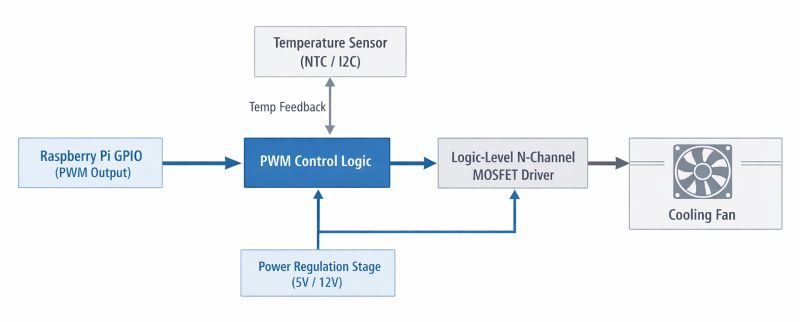
Caption - Block-level system architecture of an intelligent PWM-based fan controller PCB integrating Raspberry Pi GPIO control, temperature sensing, MOSFET switching, and regulated power stage
The intelligent fan controller is designed as a closed-loop thermal subsystem rather than a discrete cooling accessory. It integrates temperature sensing, PWM generation, power switching, and regulation into a unified architecture.
The Raspberry Pi provides the control interface through GPIO-based PWM output. Thermal feedback—either internal or external—drives proportional duty cycle adjustment. A logic-level MOSFET isolates the control logic from fan current, ensuring safe switching of 5V or 12V loads. Power regulation and filtering maintain supply stability, while protection elements mitigate switching transients.
This architecture transforms cooling from reactive airflow into controlled thermal regulation, enabling lower acoustic noise, improved power efficiency, and scalable expansion toward multi-sensor or PID-controlled systems.
The reliability of an intelligent fan controller depends on its switching stage. In this design, PWM control combined with a properly selected logic-level MOSFET ensures efficient operation, minimal heat dissipation, and electrical robustness.
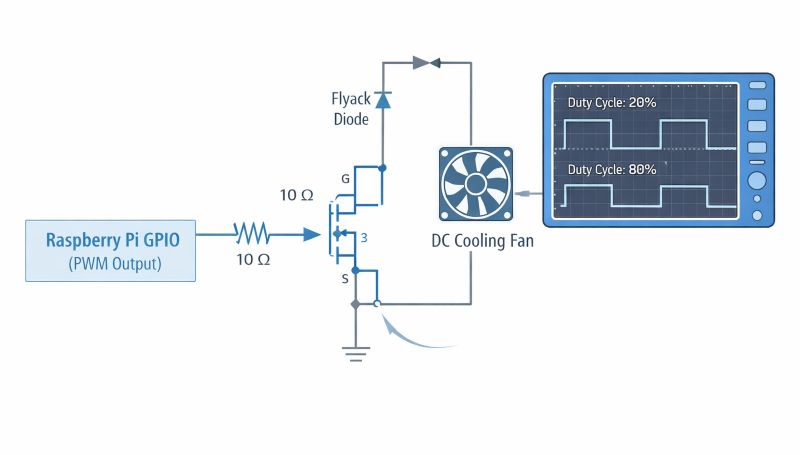
PWM-based fan control circuit using a logic-level N-channel MOSFET in low-side configuration, demonstrating efficient switching and thermal management for Raspberry Pi systems
Rather than reducing fan speed by lowering supply voltage, PWM varies airflow by rapidly switching the fan ON and OFF while adjusting duty cycle.
This approach provides four key advantages:
Linear loss:
P = Vdrop × I
PWM minimizes this because:
Pcond = I2 × RDS(on)
For example, with:
This confirms negligible heat generation under proper device selection.
The MOSFET defines switching efficiency, thermal stability, and GPIO safety.
VGS = 3.3V
Important: VGS(th) only indicates the point where conduction begins — not full enhancement.
20–25 kHz (inaudible range)
Switching loss:
Pswitch ≈ ½(VDS × ID × (tr + tf) × f)
Lower rise and fall times reduce switching losses and improve efficiency.
Even simple fan drivers require proper gate conditioning and transient protection.
Gate current:
IG = Qg / t
V = L × (di / dt)
A flyback diode prevents destructive voltage spikes across the MOSFET. (4-wire PWM fans typically include internal suppression.)
These enhance EMC stability and long-term durability.
Total MOSFET loss:
Ptotal = Pcond + Pswitch
Temperature rise estimation:
Prise = Ptotal × RθJA
Example:
If:
This confirms whether additional copper spreading or thermal vias are required.
Thermal performance is influenced not only by the circuit, but by PCB stackup. In PWM-based Raspberry Pi fan controllers, poor layer planning can introduce noise, unstable return paths, and increased EMI—especially when switching inductive loads.
While a 2-layer PCB may work for simple logic, it quickly shows limitations once high di/dt switching and sensor accuracy are involved. Without a continuous ground plane, return currents take longer paths, increasing loop area, ringing, and radiated emissions.
A production-ready thermal controller benefits significantly from a 4-layer structure:
This structure:
A multilayer PCB is not about complexity—it is about controlled return paths, reduced emissions, and improved long-term reliability. For industrial Raspberry Pi deployments, proper stackup design transforms a functional prototype into a production-ready solution.
Once the circuit is defined, long-term reliability depends on PCB layout. In a PWM-based Raspberry Pi fan controller, the MOSFET switching stage, power path, and ground structure determine how heat and current behave over time. Poor layout may function initially but accelerates aging, increases EMI, and creates thermal hotspots under continuous load.
The MOSFET is the primary heat source. Even with low RDS(on), conduction and switching losses generate localized heating. Large copper pours connected to the drain/source help spread heat laterally. In multilayer boards, mirroring copper on internal planes and connecting through thermal vias significantly reduces effective thermal resistance.
Junction temperature is approximated by:
TJ = TA + (PD × RθJA)
Increasing copper area lowers RθJA, improving thermal margin and component lifetime.
Thermal vias transfer heat from the top layer into internal copper planes. An array of small vias under the MOSFET pad enables vertical heat flow, reducing hotspot concentration—especially in enclosed systems.
High di/dt switching currents must return directly beneath the power path. The critical loop:
Supply → MOSFET → Fan → Ground
must remain physically compact and supported by a continuous ground plane.
Since:
V = L × (di / dt)
larger loop area increases voltage spikes and EMI. Ground stitching vias near switching nodes reduce parasitic inductance and stabilize operation.
High-current fan traces should be isolated from GPIO, I²C, or sensor lines to prevent noise coupling. Trace width must be calculated based on current, copper thickness, and allowable temperature rise. Excessive current density leads to localized heating and long-term reliability issues.
Introducing PWM control significantly changes electrical behavior. Fast switching edges generate high di/dt, voltage transients, and radiated emissions that can affect Raspberry Pi GPIO stability, sensor accuracy, and overall system reliability. Power integrity and EMI stability must therefore be addressed during layout—not after testing.
PWM switching creates voltage spikes according to:
V = L × (di / dt)
Even small parasitic inductance can produce noticeable overshoot, leading to GPIO glitches, sensor noise, or EMC failures.
Power integrity and EMI performance are layout decisions. Controlled loop geometry, proper decoupling, and ground continuity ensure the PWM fan controller remains electrically stable, EMC-compliant, and production-ready.
A thermal management PCB must not only function electrically—it must also be manufacturable at scale. In PWM-driven fan controllers, current paths, copper distribution, and thermal structures directly affect fabrication yield and assembly reliability. Ignoring DFM can result in overheated traces, weak solder joints, and inconsistent production quality.
Design validation must confirm electrical stability, thermal performance, and EMI control under realistic operating conditions.
| Test Category | What to Verify | Purpose |
|---|---|---|
| PWM Signal Verification | Clean rising/falling edges, stable duty cycle, proper 3.3V gate drive, minimal ringing | Ensures stable switching and reduced EMI risk |
| Thermal Validation | MOSFET temperature, copper heat spreading, absence of hotspots | Confirms effective heat dissipation and safe junction temperature |
| Load Testing (CPU Stress) | Temperature response, fan speed stability, no oscillation | Validates closed-loop thermal regulation under sustained load |
| EMI Observation | Supply rail noise, ground bounce, GPIO stability | Ensures switching does not cause interference or resets |
Multilayer PCBs are not mandatory for every fan controller. A well-designed 2-layer board may suffice for low-current, electrically quiet environments. However, in industrial or EMI-sensitive systems, a 4-layer stackup provides better return path control, reduced emissions, and improved thermal stability. The choice should be driven by electrical and environmental requirements—not default complexity.
Thermal management in Raspberry Pi systems is not simply a matter of adding a fan—it is fundamentally a PCB design challenge. In industrial and embedded deployments, heat, switching noise, and power integrity must be addressed through proper PWM control, disciplined layout, compact current loops, and solid grounding. A well-designed multilayer stackup further improves EMI control, return path stability, and thermal spreading, ensuring consistent performance under sustained load.
Equally important is production readiness. Trace widths, copper thickness, via current capacity, and stackup choices must align with real manufacturing constraints. When cooling is treated as a complete electrical, thermal, and DFM-driven system rather than an accessory, a simple GPIO-driven PWM signal can evolve into a reliable, production-ready thermal control solution.
Designing a high-performance multilayer PCB with controlled thermal and EMI characteristics requires absolute precision in manufacturing. Whether you are building an industrial prototype or ramping up to mass production, NextPCB provides the reliability, speed, and support you need.
Get an instant fabrication estimate for your custom Raspberry Pi thermal management board today.
Still, need help? Contact Us: support@nextpcb.com
Need a PCB or PCBA quote? Quote now