

Zhang

 NextPCB Capabilities
Printed Circuit Boards
NextPCB Capabilities
Printed Circuit Boards
 PCB Assembly
 Layer Buildup
 SMD-Stencils
 PCB Design-Aid & Layout
 Mechanics
 Quality
 Drills & Throughplating
 Factory & Certificate
 PCB Assembly Factory Show
Certificate
PCB Assembly Factory Show
Certificate

Support Team
Feedback:
support@nextpcb.com


Table of Contents
Datasheet Download: If you are looking for the detailed technical specifications, you can directly view and download the official IRFZ44N Datasheet (PDF) ↓ here to access electrical characteristics and performance curves.
The IRFZ44N is a MOSFET power transistor made by Infineon Technologies. It's known for its capacity to switch high voltage and current levels. MOSFET means Metal Oxide Semiconductor Field Effect Transistor, a transistor type that has low resistance to output and high resistance to input. The IRFZ44N can handle a maximum voltage of 55 volts and a maximum current of 49 amperes.

The IRFZ44N transistor is suitable for situations that demand high voltage and current switchings like power supply and motor control circuits. Due to its low on-state resistance, it can manage high currents effectively with minimal energy usage. It is widely recognized for its reliability and robustness, which makes it a popular choice in the electronics industry.
The IRFZ44N transistor is a great choice for low-power circuits that require control over large loads using a weak signal. Furthermore, it has a low gate charge, which makes it easy to manage with a weak external signal. In addition, it works well for high-frequency applications up to 1MHz and can withstand a wide temperature range (-55°C to +175°C).
The IRFZ44N is a reliable electronic component that is capable of handling high currents and voltages in circuits. It has a low output impedance, high input impedance, and low on-state resistance which makes it versatile and suitable for a variety of applications. It is commonly used in power supplies and audio amplifiers, making it an ideal choice for both professional engineers and amateurs.
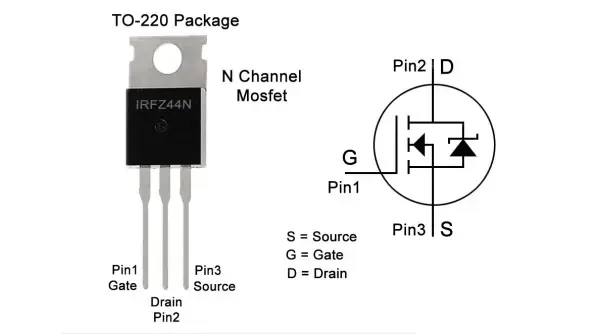
The MOSFET is a type of transistor that works as either an amplifier or switch in electronic circuits. It has three terminals and works by adjusting the width of the semiconductor material channel between two doped areas. The voltage applied to the third terminal, known as the gate, is what regulates the channel's width.
MOSFET transistors are divided into two types based on their channel composition: n-channel MOSFET (NMOS) and p-channel MOSFET (PMOS). The channel of an NMOS transistor is made up of mainly electrons, while that of a PMOS transistor is made up of mainly holes. These transistors function based on the electric field produced by the gate voltage and charge carriers in the channel.
MOSFET transistors are great for high-frequency applications due to their high input impedance. This means they don't drain much current from the input signal, which reduces the impact on the signal source. Additionally, they have a low output impedance, which lowers power dissipation and enables them to efficiently drive high loads.
MOSFET transistors are great for quick switching between on and off states, making them a top choice for applications that require rapid switchings like motor control circuits, power supplies, and audio amplifiers. They're also perfect for integrated circuits due to their small size and compatibility with CMOS technology, hence they're widely used.
To summarize, MOSFET transistors are commonly used components in electronic circuits due to their versatility. Their properties include high input impedance, fast switching speeds, and low output impedance. Moreover, MOSFET transistors work by utilizing the electric field generated by the gate voltage and charge carriers in the channel. They are used in motor control circuits, power supplies, audio amplifiers, and integrated circuits.
> Recommend reading: What's the difference between MOSFET and BJT and how to choose?
The MOSFET transistor known as IRFZ44N is widely used in electronic circuits because it has the capability to switch high currents and voltages. It is commonly utilized for various applications.
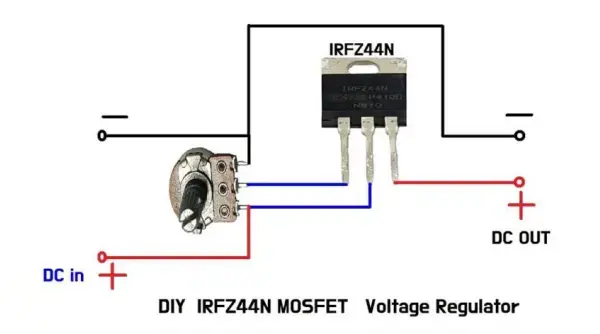
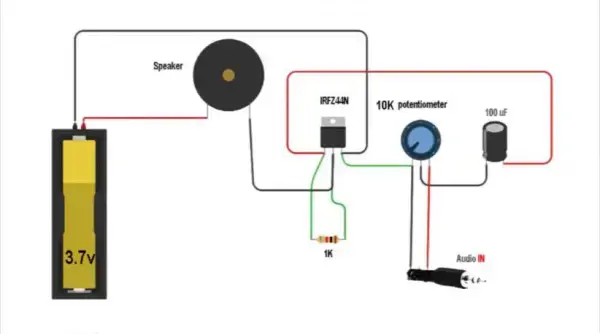
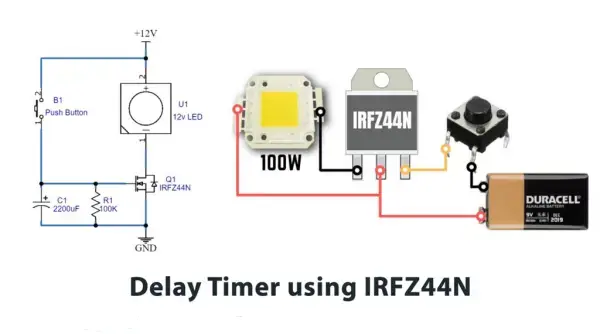
The IRFZ44N is a frequently used part in electronics where there's a need for high current and voltage switching. Such as motor control circuits, power supplies, and lighting control. Therefore, its high current and voltage ratings, low on-state resistance, and fast switching speed make it a preferred choice.
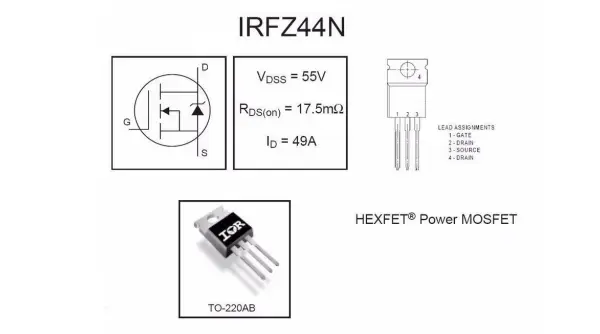
The IRFZ44N MOSFET is designed with three pins. They can be used to connect it to other components in an electronic circuit. These three pins are known as the output pins.
This pin is connected to the ground in a circuit and it enables the current to pass through the load.
The diagram shows the three pins of the IRFZ44N: drain, gate, and source. The voltage applied to the gate pin determines the flow between the drain and source pins. Usually, the gate pin is connected to a control signal from a device such as a microcontroller or an oscillator. In order to avoid damaging the component or circuit, it's crucial to connect the IRFZ44N pins properly. The datasheet for the IRFZ44N provides specific details on pin layout and recommended connection procedures.
To design a circuit using an IRFZ44N power MOSFET transistor, it is important to follow a few key steps carefully. Here is a general guideline on how to do it:
To design a circuit that utilizes the IRFZ44N power MOSFET transistor, it is important to carefully assess the circuit needs, select appropriate components, calculate gate voltage, design the gate driver circuit, and conduct thorough testing and optimization.
>Recommend reading: How to Test MOSFETs: A Comprehensive Guide
The electrical characteristics of the IRFZ44N power MOSFET transistor are important to understand in order to design a circuit and to ensure proper operation of the component. Here are some of the key electrical characteristics of the IRFZ44N:
Understanding these electrical characteristics is essential for designing a circuit using the IRFZ44N power MOSFET transistor. By considering these parameters, you can select appropriate components, design the gate driver circuit, and ensure that the circuit operates within the safe limits of the component.
There are other options in the market that can be considered as alternatives to the popular IRFZ44N power MOSFET transistor. Some of these alternatives are listed below.
When looking to replace the IRFZ44N power MOSFET transistor, make sure to choose alternative options that meet the voltage and current requirements, on-resistance, and gate capacitance of your application. Always consult the datasheet of any alternative component to ensure compatibility.
If you're having issues with the IRFZ44N power MOSFET transistor in your circuit, there are troubleshooting steps that you can take.
If no resolution has been attained after completing the initial attempts, take a closer look at your circuit and determine if any other components may be preventing an optimal outcome. Replace these parts as necessary for another round of testing to ensure success!
If you are planning to purchase the IRFZ44N MOSFET or looking for suitable alternative parts, getting access to accurate prices, real-time inventory, and authentic sources is crucial for your projects or production lines.
We highly recommend checking out HQ Online (hqonline.com). HQ Online provides a rigorous 100% genuine product guarantee, real-time inventory updates, and fast global shipping, making sure your urgent repair or manufacturing needs are met without any delays.
Additionally, NextPCB offers comprehensive electronic component sourcing services (BOM Service) alongside our advanced PCB fabrication. Through our extensive in-house component mall, we ensure a strict 100% genuine guarantee for all parts sourced. Whether you need a few components for a prototype or bulk orders for mass production, our one-stop turnkey sourcing and PCB assembly (PCBA) services are tailored to save you time and maximize your cost-efficiency. If you have any further questions or specific requirements, please feel free to contact us at support@nextpcb.com.
Q1: Can I drive an IRFZ44N directly from an Arduino or ESP32 GPIO?
A: Technically, yes, but it is not recommended for high-current loads. The IRFZ44N is not a logic-level MOSFET. While its threshold voltage (VGS(th)) is between 2V and 4V, this is only the point where it starts to conduct. To fully turn it on and achieve the minimum RDS(on), you typically need a gate voltage (VGS) of 10V. Using it with 5V (Arduino) or 3.3V (ESP32) will result in high resistance and excessive heat.
Q2: Why is my IRFZ44N getting extremely hot even with a small load?
A: This is usually due to the MOSFET operating in the linear region rather than the saturation region. If your gate voltage is too low (e.g., 5V), the internal resistance (RDS(on)) increases significantly. According to the formula P = I2 × R, even a moderate current will generate massive heat. Always check the ID vs. VDS curves in the datasheet to ensure your gate voltage is sufficient for your load.
Q3: What is the difference between IRFZ44N and IRLZ44N?
A: The "L" in IRLZ44N stands for Logic Level. The IRLZ44N is designed to be fully saturated at a VGS of 5V, making it much more suitable for direct connection to microcontrollers. If you are designing a PCB for 5V logic without a dedicated gate driver, the IRLZ44N is the superior choice.
Q4: Do I need a Gate Resistor for the IRFZ44N?
A: Yes. A small resistor (typically 100Ω to 470Ω) between the microcontroller pin and the Gate is recommended to limit the initial current spike caused by the MOSFET's input capacitance. Additionally, a 10kΩ pull-down resistor from Gate to Source is essential to ensure the MOSFET stays OFF when the MCU pin is in a high-impedance state (like during startup).
Q5: How can I drive an IRFZ44N properly if I only have a 5V signal?
A: The best practice is to use a transistor-based driver or a dedicated gate driver IC (like the TC4427). A simple NPN transistor (like the 2N2222) can be used to level-shift a higher voltage (e.g., 12V from your power supply) to the Gate of the IRFZ44N.
Q6: What are the best PCB layout practices for using IRFZ44N in high-power switching?
A: When designing your PCB at NextPCB, ensure that the high-current paths (Drain and Source) use thick copper traces or pours. Minimize the loop area of the gate drive circuit to reduce EMI. If you are switching high currents frequently (PWM), consider adding a large copper plane or a dedicated heatsink to manage the thermal output.
The IRFZ44N power MOSFET transistor is a versatile choice for high-performance applications in the field of power electronics. With its impressive current and voltage ratings, low on-resistance levels, and fast switching speeds - it's no wonder that this component has become so widely favored among professionals who require reliable control over their electrical systems. To maximize performance when using an IRFZ44N, be sure to observe all recommended practices: double check your connection methods; plan accordingly based upon appliance requirements; monitor gate voltages and load thresholds vigilantly during operation - then you can enjoy peak efficiency from your device with minimal risk!

Still, need help? Contact Us: support@nextpcb.com
Need a PCB or PCBA quote? Quote now